Event submissions
Published
This submission belongs to the session S1. One Health Approaches to Emerging Zoonotic Threats of the event The 2nd International Online Conference on Veterinary Sciences
Published date
02 Sep, 2026
Academic Editor
'%3e%3cpath%20d='M12.6657%2010.9104C12.4185%2010.325%2012.0599%209.79327%2011.6097%209.34482C11.1609%208.89508%2010.6293%208.5365%2010.0442%208.28888C10.0389%208.28626%2010.0337%208.28495%2010.0285%208.28233C10.8446%207.69279%2011.3752%206.73249%2011.3752%205.64904C11.3752%203.8542%209.92103%202.39999%208.1262%202.39999C6.33136%202.39999%204.87715%203.8542%204.87715%205.64904C4.87715%206.73249%205.40774%207.69279%206.22393%208.28364C6.21869%208.28626%206.21345%208.28757%206.20821%208.29019C5.62129%208.5378%205.09463%208.89284%204.64265%209.34613C4.1929%209.79493%203.83432%2010.3266%203.58671%2010.9117C3.34345%2011.4845%203.21226%2012.0987%203.20023%2012.7209C3.19988%2012.7349%203.20233%2012.7488%203.20744%2012.7619C3.21255%2012.7749%203.22022%2012.7867%203.22998%2012.7968C3.23975%2012.8068%203.25142%2012.8147%203.26431%2012.8202C3.2772%2012.8256%203.29105%2012.8284%203.30504%2012.8284H4.09109C4.14874%2012.8284%204.19459%2012.7825%204.1959%2012.7262C4.2221%2011.7148%204.62823%2010.7676%205.34617%2010.0497C6.08899%209.30683%207.0755%208.89808%208.1262%208.89808C9.17689%208.89808%2010.1634%209.30683%2010.9062%2010.0497C11.6242%2010.7676%2012.0303%2011.7148%2012.0565%2012.7262C12.0578%2012.7838%2012.1037%2012.8284%2012.1613%2012.8284H12.9474C12.9613%2012.8284%2012.9752%2012.8256%2012.9881%2012.8202C13.001%2012.8147%2013.0126%2012.8068%2013.0224%2012.7968C13.0322%2012.7867%2013.0398%2012.7749%2013.0449%2012.7619C13.0501%2012.7488%2013.0525%2012.7349%2013.0522%2012.7209C13.0391%2012.0947%2012.9094%2011.4855%2012.6657%2010.9104ZM8.1262%207.9024C7.52486%207.9024%206.9589%207.6679%206.53312%207.24211C6.10733%206.81633%205.87283%206.25037%205.87283%205.64904C5.87283%205.0477%206.10733%204.48174%206.53312%204.05596C6.9589%203.63018%207.52486%203.39567%208.1262%203.39567C8.72753%203.39567%209.29349%203.63018%209.71927%204.05596C10.1451%204.48174%2010.3796%205.0477%2010.3796%205.64904C10.3796%206.25037%2010.1451%206.81633%209.71927%207.24211C9.29349%207.6679%208.72753%207.9024%208.1262%207.9024Z'%20fill='%235D1EE1'/%3e%3c/g%3e%3c/svg%3e) Vittorio Sarchese
Vittorio SarcheseCitation
Francesca Gucciardi, Antonina princiotta, Silvia Scibetta, Valeria Blanda, Paola Galluzzo, Sergio Migliore, Ettore Napoli, Santina Di Bella, Annalisa Guercio, Giuseppa Purpari, HEPATITIS E VIRUS IN WILDLIFE: AN EMERGING HEALTH RISK, in Proceedings of The 2nd International Online Conference on Veterinary Sciences, 7 September–9 September 2026, MDPI: Basel, Switzerland
Share
Email
Facebook
Twitter
LinkedIn
HEPATITIS E VIRUS IN WILDLIFE: AN EMERGING HEALTH RISK
'%3e%3cpath%20d='M12.6647%2010.9104C12.4176%2010.325%2012.0589%209.7933%2011.6088%209.34485C11.16%208.89511%2010.6283%208.53653%2010.0432%208.28891C10.038%208.28629%2010.0327%208.28498%2010.0275%208.28236C10.8437%207.69282%2011.3743%206.73252%2011.3743%205.64907C11.3743%203.85423%209.92005%202.40002%208.12522%202.40002C6.33038%202.40002%204.87618%203.85423%204.87618%205.64907C4.87618%206.73252%205.40677%207.69282%206.22296%208.28367C6.21772%208.28629%206.21248%208.2876%206.20724%208.29022C5.62031%208.53783%205.09365%208.89287%204.64167%209.34616C4.19192%209.79496%203.83334%2010.3266%203.58573%2010.9117C3.34247%2011.4846%203.21128%2012.0987%203.19925%2012.721C3.1989%2012.735%203.20135%2012.7489%203.20646%2012.7619C3.21157%2012.7749%203.21924%2012.7868%203.22901%2012.7968C3.23877%2012.8068%203.25045%2012.8148%203.26334%2012.8202C3.27623%2012.8256%203.29007%2012.8284%203.30406%2012.8284H4.09012C4.14776%2012.8284%204.19362%2012.7825%204.19493%2012.7262C4.22113%2011.7148%204.62726%2010.7676%205.34519%2010.0497C6.08802%209.30686%207.07452%208.89811%208.12522%208.89811C9.17592%208.89811%2010.1624%209.30686%2010.9052%2010.0497C11.6232%2010.7676%2012.0293%2011.7148%2012.0555%2012.7262C12.0568%2012.7839%2012.1027%2012.8284%2012.1603%2012.8284H12.9464C12.9604%2012.8284%2012.9742%2012.8256%2012.9871%2012.8202C13%2012.8148%2013.0117%2012.8068%2013.0214%2012.7968C13.0312%2012.7868%2013.0389%2012.7749%2013.044%2012.7619C13.0491%2012.7489%2013.0515%2012.735%2013.0512%2012.721C13.0381%2012.0947%2012.9084%2011.4856%2012.6647%2010.9104ZM8.12522%207.90243C7.52388%207.90243%206.95792%207.66793%206.53214%207.24215C6.10636%206.81636%205.87185%206.2504%205.87185%205.64907C5.87185%205.04773%206.10636%204.48177%206.53214%204.05599C6.95792%203.63021%207.52388%203.3957%208.12522%203.3957C8.72655%203.3957%209.29252%203.63021%209.7183%204.05599C10.1441%204.48177%2010.3786%205.04773%2010.3786%205.64907C10.3786%206.2504%2010.1441%206.81636%209.7183%207.24215C9.29252%207.66793%208.72655%207.90243%208.12522%207.90243Z'%20fill='%235D1EE1'/%3e%3c/g%3e%3c/svg%3e)
Francesca Gucciardi 1
Antonina princiotta 1
Silvia Scibetta 1
Valeria Blanda 1
Paola Galluzzo 1
Sergio Migliore 1
Ettore Napoli 2
Santina Di Bella 1
Annalisa Guercio 1
Giuseppa Purpari 1
1. Istituto Zooprofilattico Sperimentale della Sicilia “A. Mirri”, 90129 Palermo, Italy
2. Department of Veterinary Sciences, University of Messina, Viale Giovanni Palatuci 13, 98168 Messina, Italy
Abstract
INTRODUCTION
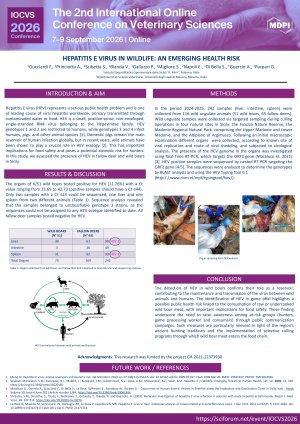
Hepatitis E virus (HEV) represents a serious public health problem and is one of leading cause of viral hepatitis worldwide, primary transmitted through contaminated water or food. HEV is a small, positive-sense, non-enveloped, single-stranded RNA virus belonging to the Hepeviridae family HEV genotypes 1 and 2 are restricted to humans, while genotypes 3 and 4 infect humans, pigs, and other animal species. Domestic pigs remain the main reservoir of human infection globally, but in recent years, wild animals have been shown to play a crucial role in HEV ecology. This has important implications for food safety and poses a potential zoonotic risk for hunters. In this study, we assessed the presence of HEV in fallow deer and wild boars in Sicily.
METHODS
In the period 2024-2025, 242 samples (liver, intestine, spleen) were collected from 116 wild ungulate animals (51 wild boars, 65 fallow deers). The presence of the HEV genome in the organs was investigated using Real-time RT-PCR, which targets the ORF3 gene (Macaluso et al. 2021) HEV positive samples were sequenced by nested RT-PCR targeting the ORF2 gene. The sequences were analyzed to determine the genotypes by BLAST analysis and using the HEV Typing Tool 0.1 (http:/ / www.rivm.nl/mpf/typingtool/hev/)
RESULTS
The organs of 6/51 wild boars tested positive for HEV (11.76%) with a Ct value ranging from 21.69 to 42.73 (positive samples should have a Ct ≤44). Only two samples with a Ct ≤23 could be sequenced, one liver and one spleen from two different animals. Sequence analysis revealed that the samples belonged to unclassifiable genotype 3 strains, as the sequences could not be assigned to any HEV subtype identified to date. All fallow deer samples tested negative for HEV.
CONCLUSIONS
The detection of HEV in wild boars confirms their role as a reservoir, contributing to the maintenance and transmission of the virus between wild animals and humans. The identification of HEV in game offal highlights a possible public health risk linked to the consumption of raw or undercooked wild boar meat, with important implications for food safety. These finding underscore the need to raise awareness among at-risk groups (hunters, game processing worker and consumers) through public communication campaigns. Such measures are particularly relevant in light of the region's ancient hunting traditions and the implementation of selective culling programs through which wild boar meat enters the food chain.
Keywords
ONE HEALTH
HEV
HEALTH RISK
WILD BOAR
ZOONOSIS
FOOD SAFETY
Poster
Gucciardi et al. 25-08-26.pdf
Molecular Epidemiology and Dissemination of Extended-Spectrum Beta-Lactamases (ESBL)- producing Escherichia coli of European Wildlife: A Systematic Review and Meta-Analysis
Bioinformatics methods for managing drug resistance in zoonotic gastrointestinal helminths of pets with a One Health approach: A Systematic Review