Event submissions
Published
This submission belongs to the session S2. Surveillance and Epidemiological Modelling at the Human–Animal–Environment Interface of the event The 2nd International Online Conference on Veterinary Sciences
Published date
02 Sep, 2026
Academic Editor
'%3e%3cpath%20d='M12.6657%2010.9104C12.4185%2010.325%2012.0599%209.79327%2011.6097%209.34482C11.1609%208.89508%2010.6293%208.5365%2010.0442%208.28888C10.0389%208.28626%2010.0337%208.28495%2010.0285%208.28233C10.8446%207.69279%2011.3752%206.73249%2011.3752%205.64904C11.3752%203.8542%209.92103%202.39999%208.1262%202.39999C6.33136%202.39999%204.87715%203.8542%204.87715%205.64904C4.87715%206.73249%205.40774%207.69279%206.22393%208.28364C6.21869%208.28626%206.21345%208.28757%206.20821%208.29019C5.62129%208.5378%205.09463%208.89284%204.64265%209.34613C4.1929%209.79493%203.83432%2010.3266%203.58671%2010.9117C3.34345%2011.4845%203.21226%2012.0987%203.20023%2012.7209C3.19988%2012.7349%203.20233%2012.7488%203.20744%2012.7619C3.21255%2012.7749%203.22022%2012.7867%203.22998%2012.7968C3.23975%2012.8068%203.25142%2012.8147%203.26431%2012.8202C3.2772%2012.8256%203.29105%2012.8284%203.30504%2012.8284H4.09109C4.14874%2012.8284%204.19459%2012.7825%204.1959%2012.7262C4.2221%2011.7148%204.62823%2010.7676%205.34617%2010.0497C6.08899%209.30683%207.0755%208.89808%208.1262%208.89808C9.17689%208.89808%2010.1634%209.30683%2010.9062%2010.0497C11.6242%2010.7676%2012.0303%2011.7148%2012.0565%2012.7262C12.0578%2012.7838%2012.1037%2012.8284%2012.1613%2012.8284H12.9474C12.9613%2012.8284%2012.9752%2012.8256%2012.9881%2012.8202C13.001%2012.8147%2013.0126%2012.8068%2013.0224%2012.7968C13.0322%2012.7867%2013.0398%2012.7749%2013.0449%2012.7619C13.0501%2012.7488%2013.0525%2012.7349%2013.0522%2012.7209C13.0391%2012.0947%2012.9094%2011.4855%2012.6657%2010.9104ZM8.1262%207.9024C7.52486%207.9024%206.9589%207.6679%206.53312%207.24211C6.10733%206.81633%205.87283%206.25037%205.87283%205.64904C5.87283%205.0477%206.10733%204.48174%206.53312%204.05596C6.9589%203.63018%207.52486%203.39567%208.1262%203.39567C8.72753%203.39567%209.29349%203.63018%209.71927%204.05596C10.1451%204.48174%2010.3796%205.0477%2010.3796%205.64904C10.3796%206.25037%2010.1451%206.81633%209.71927%207.24211C9.29349%207.6679%208.72753%207.9024%208.1262%207.9024Z'%20fill='%235D1EE1'/%3e%3c/g%3e%3c/svg%3e) Francesco Mira
Francesco MiraCitation
Vijay Kumar Subbiah, Novaldi Noer, Rajesh Kumar, Dexter Miller Robben, Co-circulation and Segment-Specific Genome Relationships of Infectious Bursal Disease Virus in Borneo, in Proceedings of The 2nd International Online Conference on Veterinary Sciences, 7 September–9 September 2026, MDPI: Basel, Switzerland
Share
Email
Facebook
Twitter
LinkedIn
Co-circulation and Segment-Specific Genome Relationships of Infectious Bursal Disease Virus in Borneo
'%3e%3cpath%20d='M12.6647%2010.9104C12.4176%2010.325%2012.0589%209.7933%2011.6088%209.34485C11.16%208.89511%2010.6283%208.53653%2010.0432%208.28891C10.038%208.28629%2010.0327%208.28498%2010.0275%208.28236C10.8437%207.69282%2011.3743%206.73252%2011.3743%205.64907C11.3743%203.85423%209.92005%202.40002%208.12522%202.40002C6.33038%202.40002%204.87618%203.85423%204.87618%205.64907C4.87618%206.73252%205.40677%207.69282%206.22296%208.28367C6.21772%208.28629%206.21248%208.2876%206.20724%208.29022C5.62031%208.53783%205.09365%208.89287%204.64167%209.34616C4.19192%209.79496%203.83334%2010.3266%203.58573%2010.9117C3.34247%2011.4846%203.21128%2012.0987%203.19925%2012.721C3.1989%2012.735%203.20135%2012.7489%203.20646%2012.7619C3.21157%2012.7749%203.21924%2012.7868%203.22901%2012.7968C3.23877%2012.8068%203.25045%2012.8148%203.26334%2012.8202C3.27623%2012.8256%203.29007%2012.8284%203.30406%2012.8284H4.09012C4.14776%2012.8284%204.19362%2012.7825%204.19493%2012.7262C4.22113%2011.7148%204.62726%2010.7676%205.34519%2010.0497C6.08802%209.30686%207.07452%208.89811%208.12522%208.89811C9.17592%208.89811%2010.1624%209.30686%2010.9052%2010.0497C11.6232%2010.7676%2012.0293%2011.7148%2012.0555%2012.7262C12.0568%2012.7839%2012.1027%2012.8284%2012.1603%2012.8284H12.9464C12.9604%2012.8284%2012.9742%2012.8256%2012.9871%2012.8202C13%2012.8148%2013.0117%2012.8068%2013.0214%2012.7968C13.0312%2012.7868%2013.0389%2012.7749%2013.044%2012.7619C13.0491%2012.7489%2013.0515%2012.735%2013.0512%2012.721C13.0381%2012.0947%2012.9084%2011.4856%2012.6647%2010.9104ZM8.12522%207.90243C7.52388%207.90243%206.95792%207.66793%206.53214%207.24215C6.10636%206.81636%205.87185%206.2504%205.87185%205.64907C5.87185%205.04773%206.10636%204.48177%206.53214%204.05599C6.95792%203.63021%207.52388%203.3957%208.12522%203.3957C8.72655%203.3957%209.29252%203.63021%209.7183%204.05599C10.1441%204.48177%2010.3786%205.04773%2010.3786%205.64907C10.3786%206.2504%2010.1441%206.81636%209.7183%207.24215C9.29252%207.66793%208.72655%207.90243%208.12522%207.90243Z'%20fill='%235D1EE1'/%3e%3c/g%3e%3c/svg%3e)
Vijay Kumar Subbiah 1
Novaldi Noer 2
Rajesh Kumar 1
Dexter Miller Robben 1
1. Biotechnology Research Institute, Universiti Malaysia Sabah, 88400 Kota Kinabalu, Sabah, Malaysia
2. Poultry Veterinarian, Kota Bekasi, 17136 West Java, Indonesia
Abstract
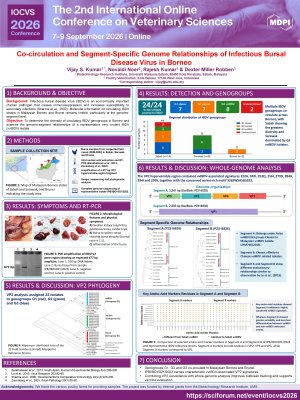
Molecular surveillance of poultry viruses is essential for tracking pathogen diversity, informing vaccination strategies and strengthening animal health preparedness within regional food production systems. Infectious bursal disease virus (IBDV) is an economically important pathogen of chickens that causes immunosuppression and increases flock susceptibility to secondary infections. However, molecular information on circulating IBDV strains in Malaysian Borneo and Brunei remains limited, particularly at the genome-segment level. In this study, we characterised IBDV detected in bursa tissues collected between 2020 and 2023 from suspected field cases in Sabah, Sarawak and Brunei. A total of 24 bursa samples were homogenised, viral nucleic acids were extracted, and IBDV was detected by RT-PCR. Strain typing was performed by amplifying a 677 bp fragment of the VP2 hypervariable region using VP2-specific primers, followed by Sanger sequencing and phylogenetic analysis. All 24 samples tested positive for IBDV. VP2-based analysis assigned the isolates to three genogroups, comprising classic strains in Genogroup G1, variant strains in Genogroup G2 and very virulent IBDV (vvIBDV) strains in Genogroup G3. Among the typed samples, G1, G2 and G3 accounted for 7, 7 and 8 isolates, respectively, with two samples remaining unassigned. To further characterise a representative vvIBDV isolate, complete genome sequencing was performed for IPB/IBDV021/2023. The isolate contained Segment A of 3,241 bp and Segment B of 2,803 bp. The VP2 hypervariable region contained vvIBDV-associated amino acid signatures, including 222A, 242I, 253Q, 256I, 279D, 284A, 294I and 299S, together with the conserved serine-rich motif 326SWSASGS332. Segment A was most closely related to the Malaysian vvIBDV isolate UPM766/2018, whereas Segment B showed closest affinity to Chinese vvIBDV-related isolates, suggesting segment-specific evolutionary relationships. These findings demonstrate the co-circulation of genetically distinct IBDV strains in Malaysian Borneo and Brunei and highlight the value of combining VP2 surveillance with complete genome analysis for vaccine evaluation, outbreak tracking and regional poultry disease biosurveillance.
Keywords
Infectious bursal disease virus
vvIBDV
VP2 gene
Segment A
Segment B
Poultry diseases
Molecular surveillance.
Poster
Poster_IOCVS2026_Final.pdf
Microbiological quality, molecular characterization, and antimicrobial resistance profiling of foodborne bacterial pathogens in donkey milk and associated environmental sources in Maharashtra, India
Behavioural Patterns of Antibiotic Use in Bovine Mastitis: A Cluster-Based Analysis Among Veterinarians in Kerala, India