Event submissions
Published
This submission belongs to the session S3. Antimicrobial Resistance and Food Safety: A One Health Perspective of the event The 2nd International Online Conference on Veterinary Sciences
Published date
02 Sep, 2026
Academic Editor
'%3e%3cpath%20d='M12.6657%2010.9104C12.4185%2010.325%2012.0599%209.79327%2011.6097%209.34482C11.1609%208.89508%2010.6293%208.5365%2010.0442%208.28888C10.0389%208.28626%2010.0337%208.28495%2010.0285%208.28233C10.8446%207.69279%2011.3752%206.73249%2011.3752%205.64904C11.3752%203.8542%209.92103%202.39999%208.1262%202.39999C6.33136%202.39999%204.87715%203.8542%204.87715%205.64904C4.87715%206.73249%205.40774%207.69279%206.22393%208.28364C6.21869%208.28626%206.21345%208.28757%206.20821%208.29019C5.62129%208.5378%205.09463%208.89284%204.64265%209.34613C4.1929%209.79493%203.83432%2010.3266%203.58671%2010.9117C3.34345%2011.4845%203.21226%2012.0987%203.20023%2012.7209C3.19988%2012.7349%203.20233%2012.7488%203.20744%2012.7619C3.21255%2012.7749%203.22022%2012.7867%203.22998%2012.7968C3.23975%2012.8068%203.25142%2012.8147%203.26431%2012.8202C3.2772%2012.8256%203.29105%2012.8284%203.30504%2012.8284H4.09109C4.14874%2012.8284%204.19459%2012.7825%204.1959%2012.7262C4.2221%2011.7148%204.62823%2010.7676%205.34617%2010.0497C6.08899%209.30683%207.0755%208.89808%208.1262%208.89808C9.17689%208.89808%2010.1634%209.30683%2010.9062%2010.0497C11.6242%2010.7676%2012.0303%2011.7148%2012.0565%2012.7262C12.0578%2012.7838%2012.1037%2012.8284%2012.1613%2012.8284H12.9474C12.9613%2012.8284%2012.9752%2012.8256%2012.9881%2012.8202C13.001%2012.8147%2013.0126%2012.8068%2013.0224%2012.7968C13.0322%2012.7867%2013.0398%2012.7749%2013.0449%2012.7619C13.0501%2012.7488%2013.0525%2012.7349%2013.0522%2012.7209C13.0391%2012.0947%2012.9094%2011.4855%2012.6657%2010.9104ZM8.1262%207.9024C7.52486%207.9024%206.9589%207.6679%206.53312%207.24211C6.10733%206.81633%205.87283%206.25037%205.87283%205.64904C5.87283%205.0477%206.10733%204.48174%206.53312%204.05596C6.9589%203.63018%207.52486%203.39567%208.1262%203.39567C8.72753%203.39567%209.29349%203.63018%209.71927%204.05596C10.1451%204.48174%2010.3796%205.0477%2010.3796%205.64904C10.3796%206.25037%2010.1451%206.81633%209.71927%207.24211C9.29349%207.6679%208.72753%207.9024%208.1262%207.9024Z'%20fill='%235D1EE1'/%3e%3c/g%3e%3c/svg%3e) Ruichao Li
Ruichao LiCitation
Abhina K S, Naureen Taj, Vinod V K, Jess Vergis, Sakkariya Ibrahim, Behavioural Patterns of Antibiotic Use in Bovine Mastitis: A Cluster-Based Analysis Among Veterinarians in Kerala, India, in Proceedings of The 2nd International Online Conference on Veterinary Sciences, 7 September–9 September 2026, MDPI: Basel, Switzerland
Share
Email
Facebook
Twitter
LinkedIn
Behavioural Patterns of Antibiotic Use in Bovine Mastitis: A Cluster-Based Analysis Among Veterinarians in Kerala, India
'%3e%3cpath%20d='M12.6647%2010.9104C12.4176%2010.325%2012.0589%209.7933%2011.6088%209.34485C11.16%208.89511%2010.6283%208.53653%2010.0432%208.28891C10.038%208.28629%2010.0327%208.28498%2010.0275%208.28236C10.8437%207.69282%2011.3743%206.73252%2011.3743%205.64907C11.3743%203.85423%209.92005%202.40002%208.12522%202.40002C6.33038%202.40002%204.87618%203.85423%204.87618%205.64907C4.87618%206.73252%205.40677%207.69282%206.22296%208.28367C6.21772%208.28629%206.21248%208.2876%206.20724%208.29022C5.62031%208.53783%205.09365%208.89287%204.64167%209.34616C4.19192%209.79496%203.83334%2010.3266%203.58573%2010.9117C3.34247%2011.4846%203.21128%2012.0987%203.19925%2012.721C3.1989%2012.735%203.20135%2012.7489%203.20646%2012.7619C3.21157%2012.7749%203.21924%2012.7868%203.22901%2012.7968C3.23877%2012.8068%203.25045%2012.8148%203.26334%2012.8202C3.27623%2012.8256%203.29007%2012.8284%203.30406%2012.8284H4.09012C4.14776%2012.8284%204.19362%2012.7825%204.19493%2012.7262C4.22113%2011.7148%204.62726%2010.7676%205.34519%2010.0497C6.08802%209.30686%207.07452%208.89811%208.12522%208.89811C9.17592%208.89811%2010.1624%209.30686%2010.9052%2010.0497C11.6232%2010.7676%2012.0293%2011.7148%2012.0555%2012.7262C12.0568%2012.7839%2012.1027%2012.8284%2012.1603%2012.8284H12.9464C12.9604%2012.8284%2012.9742%2012.8256%2012.9871%2012.8202C13%2012.8148%2013.0117%2012.8068%2013.0214%2012.7968C13.0312%2012.7868%2013.0389%2012.7749%2013.044%2012.7619C13.0491%2012.7489%2013.0515%2012.735%2013.0512%2012.721C13.0381%2012.0947%2012.9084%2011.4856%2012.6647%2010.9104ZM8.12522%207.90243C7.52388%207.90243%206.95792%207.66793%206.53214%207.24215C6.10636%206.81636%205.87185%206.2504%205.87185%205.64907C5.87185%205.04773%206.10636%204.48177%206.53214%204.05599C6.95792%203.63021%207.52388%203.3957%208.12522%203.3957C8.72655%203.3957%209.29252%203.63021%209.7183%204.05599C10.1441%204.48177%2010.3786%205.04773%2010.3786%205.64907C10.3786%206.2504%2010.1441%206.81636%209.7183%207.24215C9.29252%207.66793%208.72655%207.90243%208.12522%207.90243Z'%20fill='%235D1EE1'/%3e%3c/g%3e%3c/svg%3e)
Abhina K S 1
Naureen Taj 1
Vinod V K 2
Jess Vergis 3
Sakkariya Ibrahim 2
1. Department of Animal Husbandry, Veterinary Dispensary, Nayarambalam, 682511, India
2. College of Veterinary and Animal Sciences, Pookode, Kerala Veterinary and Animal Sciences University, Lakkidi P.O.- 673 576, Wayanad, India
3. ICAR- Indian Veterinary Research Institute, Izatnagar, 243 122, Bareilly, India
Abstract
Abstract
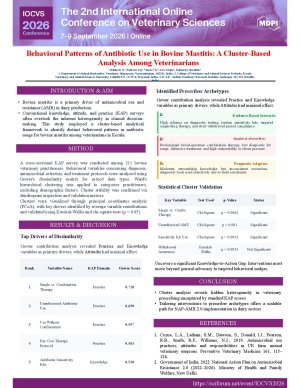
Introduction: Bovine mastitis is a primary driver of antimicrobial use and resistance (AMR) in dairy production. Conventional knowledge, attitude, and practice (KAP) surveys often overlook the inherent heterogeneity in clinical decision-making. This study employed a cluster-based analytical framework to identify distinct behavioral patterns in antibiotic usage for bovine mastitis among veterinarians in Kerala.
Methods: A cross-sectional KAP survey was conducted among 211 bovine veterinary practitioners. Behavioral variables concerning diagnosis, antimicrobial selection, and treatment protocols were analyzed using Gower’s dissimilarity matrix for mixed data types. Ward’s hierarchical clustering was applied to categorize practitioners, excluding demographic factors. Cluster stability was confirmed via dendrogram inspection and validation metrics. Clusters were visualized through principal coordinates analysis (PCoA), with key drivers identified by average variable contributions and validated using Kruskal-Wallis and chi-square tests (p < 0.05).
Results: Distinct behavioral clusters emerged, primarily differentiated by diagnostic reliance, antimicrobial selection, and stewardship adherence. Clinical practice and knowledge-related variables contributed more significantly to cluster separation than attitudinal measures. One cluster exhibited evidence-based prescribing characterized by high diagnostic integration and protocol adherence, whereas other clusters relied predominantly on empirical therapy and broad-spectrum antibiotics.
Conclusions: Cluster-based analysis reveals substantial heterogeneity in mastitis treatment practices that traditional scoring may obscure. These findings emphasize the need for behavior-informed, targeted antimicrobial stewardship strategies. Tailoring veterinary education and policy interventions to specific practitioner profiles can significantly enhance AMR mitigation efforts in dairy production systems.
Keywords
AMR
Antimicrobial stewardship
Bovine mastitis
Cluster analysis
KAP surveys
Veterinarians
Poster
POSTER FINAL.pdf
Microbiological quality, molecular characterization, and antimicrobial resistance profiling of foodborne bacterial pathogens in donkey milk and associated environmental sources in Maharashtra, India
Meta-Regression Analysis of Knockdown Resistance Mutations Associated with Pyrethroid Resistance in Anopheles Mosquitoes across Sub-Saharan Africa