Event submissions
Published
This submission belongs to the session S3. Antimicrobial Resistance and Food Safety: A One Health Perspective of the event The 2nd International Online Conference on Veterinary Sciences
Published date
02 Sep, 2026
Academic Editor
'%3e%3cpath%20d='M12.6657%2010.9104C12.4185%2010.325%2012.0599%209.79327%2011.6097%209.34482C11.1609%208.89508%2010.6293%208.5365%2010.0442%208.28888C10.0389%208.28626%2010.0337%208.28495%2010.0285%208.28233C10.8446%207.69279%2011.3752%206.73249%2011.3752%205.64904C11.3752%203.8542%209.92103%202.39999%208.1262%202.39999C6.33136%202.39999%204.87715%203.8542%204.87715%205.64904C4.87715%206.73249%205.40774%207.69279%206.22393%208.28364C6.21869%208.28626%206.21345%208.28757%206.20821%208.29019C5.62129%208.5378%205.09463%208.89284%204.64265%209.34613C4.1929%209.79493%203.83432%2010.3266%203.58671%2010.9117C3.34345%2011.4845%203.21226%2012.0987%203.20023%2012.7209C3.19988%2012.7349%203.20233%2012.7488%203.20744%2012.7619C3.21255%2012.7749%203.22022%2012.7867%203.22998%2012.7968C3.23975%2012.8068%203.25142%2012.8147%203.26431%2012.8202C3.2772%2012.8256%203.29105%2012.8284%203.30504%2012.8284H4.09109C4.14874%2012.8284%204.19459%2012.7825%204.1959%2012.7262C4.2221%2011.7148%204.62823%2010.7676%205.34617%2010.0497C6.08899%209.30683%207.0755%208.89808%208.1262%208.89808C9.17689%208.89808%2010.1634%209.30683%2010.9062%2010.0497C11.6242%2010.7676%2012.0303%2011.7148%2012.0565%2012.7262C12.0578%2012.7838%2012.1037%2012.8284%2012.1613%2012.8284H12.9474C12.9613%2012.8284%2012.9752%2012.8256%2012.9881%2012.8202C13.001%2012.8147%2013.0126%2012.8068%2013.0224%2012.7968C13.0322%2012.7867%2013.0398%2012.7749%2013.0449%2012.7619C13.0501%2012.7488%2013.0525%2012.7349%2013.0522%2012.7209C13.0391%2012.0947%2012.9094%2011.4855%2012.6657%2010.9104ZM8.1262%207.9024C7.52486%207.9024%206.9589%207.6679%206.53312%207.24211C6.10733%206.81633%205.87283%206.25037%205.87283%205.64904C5.87283%205.0477%206.10733%204.48174%206.53312%204.05596C6.9589%203.63018%207.52486%203.39567%208.1262%203.39567C8.72753%203.39567%209.29349%203.63018%209.71927%204.05596C10.1451%204.48174%2010.3796%205.0477%2010.3796%205.64904C10.3796%206.25037%2010.1451%206.81633%209.71927%207.24211C9.29349%207.6679%208.72753%207.9024%208.1262%207.9024Z'%20fill='%235D1EE1'/%3e%3c/g%3e%3c/svg%3e) Ruichao Li
Ruichao LiCitation
Afif Ihza Abdala, Dian Meididewi Nuraini, Peerapol Sukhon, Jaruwan Kampa, Parinya Sroithongkham, Patchara Phuektes, Global Prevalence of Antimicrobial Resistance in ESKAPE Pathogens Causing Canine Otitis Externa (1995-2025): A Systematic Review and Meta Analysis, in Proceedings of The 2nd International Online Conference on Veterinary Sciences, 7 September–9 September 2026, MDPI: Basel, Switzerland
Share
Email
Facebook
Twitter
LinkedIn
Global Prevalence of Antimicrobial Resistance in ESKAPE Pathogens Causing Canine Otitis Externa (1995-2025): A Systematic Review and Meta Analysis
'%3e%3cpath%20d='M12.6647%2010.9104C12.4176%2010.325%2012.0589%209.7933%2011.6088%209.34485C11.16%208.89511%2010.6283%208.53653%2010.0432%208.28891C10.038%208.28629%2010.0327%208.28498%2010.0275%208.28236C10.8437%207.69282%2011.3743%206.73252%2011.3743%205.64907C11.3743%203.85423%209.92005%202.40002%208.12522%202.40002C6.33038%202.40002%204.87618%203.85423%204.87618%205.64907C4.87618%206.73252%205.40677%207.69282%206.22296%208.28367C6.21772%208.28629%206.21248%208.2876%206.20724%208.29022C5.62031%208.53783%205.09365%208.89287%204.64167%209.34616C4.19192%209.79496%203.83334%2010.3266%203.58573%2010.9117C3.34247%2011.4846%203.21128%2012.0987%203.19925%2012.721C3.1989%2012.735%203.20135%2012.7489%203.20646%2012.7619C3.21157%2012.7749%203.21924%2012.7868%203.22901%2012.7968C3.23877%2012.8068%203.25045%2012.8148%203.26334%2012.8202C3.27623%2012.8256%203.29007%2012.8284%203.30406%2012.8284H4.09012C4.14776%2012.8284%204.19362%2012.7825%204.19493%2012.7262C4.22113%2011.7148%204.62726%2010.7676%205.34519%2010.0497C6.08802%209.30686%207.07452%208.89811%208.12522%208.89811C9.17592%208.89811%2010.1624%209.30686%2010.9052%2010.0497C11.6232%2010.7676%2012.0293%2011.7148%2012.0555%2012.7262C12.0568%2012.7839%2012.1027%2012.8284%2012.1603%2012.8284H12.9464C12.9604%2012.8284%2012.9742%2012.8256%2012.9871%2012.8202C13%2012.8148%2013.0117%2012.8068%2013.0214%2012.7968C13.0312%2012.7868%2013.0389%2012.7749%2013.044%2012.7619C13.0491%2012.7489%2013.0515%2012.735%2013.0512%2012.721C13.0381%2012.0947%2012.9084%2011.4856%2012.6647%2010.9104ZM8.12522%207.90243C7.52388%207.90243%206.95792%207.66793%206.53214%207.24215C6.10636%206.81636%205.87185%206.2504%205.87185%205.64907C5.87185%205.04773%206.10636%204.48177%206.53214%204.05599C6.95792%203.63021%207.52388%203.3957%208.12522%203.3957C8.72655%203.3957%209.29252%203.63021%209.7183%204.05599C10.1441%204.48177%2010.3786%205.04773%2010.3786%205.64907C10.3786%206.2504%2010.1441%206.81636%209.7183%207.24215C9.29252%207.66793%208.72655%207.90243%208.12522%207.90243Z'%20fill='%235D1EE1'/%3e%3c/g%3e%3c/svg%3e)
Afif Ihza Abdala 1
Dian Meididewi Nuraini 2
Peerapol Sukhon 3,4
Jaruwan Kampa 5
Parinya Sroithongkham 5
Patchara Phuektes 5
1. Faculty of Veterinary Medicine, Khon Kaen University, Khon Kaen
2. Department of Animal Science, Faculty of Animal Science, Universitas Sebelas Maret, Surakarta, 57126
3. Department of Anatomy, Faculty of Veterinary Medicine, Khon Kaen University, Khon Kaen
4. Research Program on Toxic Substance, Microorganisms and Feed Additives in Livestock and Aquatic Animals for Food Safety, Khon Kaen University, Khon Kaen 40002
5. Division of Pathobiology, Faculty of Veterinary Medicine, Khon Kaen University, Khon Kaen, 40002
Abstract
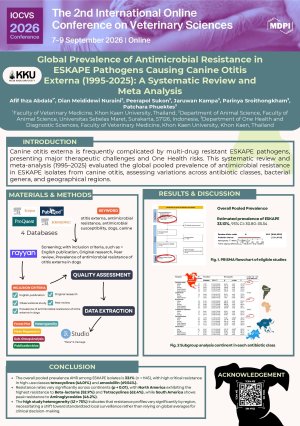
Introduction: Canine otitis externa (COE) remains a clinical challenge due to frequent treatment failures. The ESKAPE pathogens (Enterococcus faecium, Staphylococcus aureus, Klebsiella pneumoniae, Acinetobacter baumannii, Pseudomonas aeruginosa, and Enterobacter spp.) are major contributors to COE. This study aims to provide a comprehensive global estimate of antimicrobial resistance prevalence across drug classes and to identify resistance trends within these bacterial species.
Methods: Following PRISMA 2020 guidelines, a comprehensive systematic search was conducted across the Scopus, ScienceDirect, PubMed, and ProQuest databases. Ultimately, 37 studies published between 1995 and 2024 comprising 58,223 clinical isolates, met the predefined inclusion criteria. Random-effects model was employed to determine pooled resistance rates for each antimicrobial class using meta package in R software. Heterogeneity was evaluated using the I2 statistic.
Results: The pooled prevalence of antimicrobial resistance (AMR) among ESKAPE pathogens in COE was 33.13% (95% CI: 30.80–35.54%). Resistance varied significantly by antibiotic class (p < 0.01), with the highest robust rates observed for beta-lactams (n = 388; 34.36%), aminoglycosides (n = 196; 29.17%), and fluoroquinolones (n = 169; 20.67%). Subgroup analysis by antibiotic type identified highest resistance were observed in second-generation cephalosporins (74.15%), followed by amoxicillin (69.54%) and neomycin (58.58%). At the genus level (p < 0.01), Staphylococcus spp. exhibited significant resistance across multiple antibiotic classes, particularly to beta-lactams (38.82%), and aminoglycosides (32.55%), however Pseudomonas spp. showed very high resistance to amphenicols (91.26%). High heterogeneity (I2 > 85%) indicated substantial global variation in AMR patterns.
Conclusion: The escalating resistance of ESKAPE pathogens, particularly against frontline treatments like neomycin and amoxicillin, signals a growing crisis in veterinary dermatology. These findings provide a critical baseline for the development of targeted therapeutic protocols to manage multidrug-resistant infections and to strengthen global antimicrobial stewardship in veterinary field.
Keywords
ESKAPE pathogens
canine otitis externa
antimicrobial resistance
veterinary dermatology
meta-analysis.
Poster
Poster.pdf
Bridging the Knowledge–Practice Gap in Tick Prevention: A One Health based Study among Companion Animal Owners in Kerala, India
A National Evaluation of One Health, Zoonotic Threats, and Antimicrobial Stewardship among Professional college Students in India