Event submissions
Published
This submission belongs to the session S3. Antimicrobial Resistance and Food Safety: A One Health Perspective of the event The 2nd International Online Conference on Veterinary Sciences
Published date
02 Sep, 2026
Academic Editor
'%3e%3cpath%20d='M12.6657%2010.9104C12.4185%2010.325%2012.0599%209.79327%2011.6097%209.34482C11.1609%208.89508%2010.6293%208.5365%2010.0442%208.28888C10.0389%208.28626%2010.0337%208.28495%2010.0285%208.28233C10.8446%207.69279%2011.3752%206.73249%2011.3752%205.64904C11.3752%203.8542%209.92103%202.39999%208.1262%202.39999C6.33136%202.39999%204.87715%203.8542%204.87715%205.64904C4.87715%206.73249%205.40774%207.69279%206.22393%208.28364C6.21869%208.28626%206.21345%208.28757%206.20821%208.29019C5.62129%208.5378%205.09463%208.89284%204.64265%209.34613C4.1929%209.79493%203.83432%2010.3266%203.58671%2010.9117C3.34345%2011.4845%203.21226%2012.0987%203.20023%2012.7209C3.19988%2012.7349%203.20233%2012.7488%203.20744%2012.7619C3.21255%2012.7749%203.22022%2012.7867%203.22998%2012.7968C3.23975%2012.8068%203.25142%2012.8147%203.26431%2012.8202C3.2772%2012.8256%203.29105%2012.8284%203.30504%2012.8284H4.09109C4.14874%2012.8284%204.19459%2012.7825%204.1959%2012.7262C4.2221%2011.7148%204.62823%2010.7676%205.34617%2010.0497C6.08899%209.30683%207.0755%208.89808%208.1262%208.89808C9.17689%208.89808%2010.1634%209.30683%2010.9062%2010.0497C11.6242%2010.7676%2012.0303%2011.7148%2012.0565%2012.7262C12.0578%2012.7838%2012.1037%2012.8284%2012.1613%2012.8284H12.9474C12.9613%2012.8284%2012.9752%2012.8256%2012.9881%2012.8202C13.001%2012.8147%2013.0126%2012.8068%2013.0224%2012.7968C13.0322%2012.7867%2013.0398%2012.7749%2013.0449%2012.7619C13.0501%2012.7488%2013.0525%2012.7349%2013.0522%2012.7209C13.0391%2012.0947%2012.9094%2011.4855%2012.6657%2010.9104ZM8.1262%207.9024C7.52486%207.9024%206.9589%207.6679%206.53312%207.24211C6.10733%206.81633%205.87283%206.25037%205.87283%205.64904C5.87283%205.0477%206.10733%204.48174%206.53312%204.05596C6.9589%203.63018%207.52486%203.39567%208.1262%203.39567C8.72753%203.39567%209.29349%203.63018%209.71927%204.05596C10.1451%204.48174%2010.3796%205.0477%2010.3796%205.64904C10.3796%206.25037%2010.1451%206.81633%209.71927%207.24211C9.29349%207.6679%208.72753%207.9024%208.1262%207.9024Z'%20fill='%235D1EE1'/%3e%3c/g%3e%3c/svg%3e) BeiBei Li
BeiBei LiCitation
Sakineh Khanamani Falahatipour, Atefeh - Heidar Ammameh, Plant Secondary Metabolites as Adjuvants to Restore Tetracycline Efficacy Against Multidrug-Resistant Zoonotic Escherichia coli, in Proceedings of The 2nd International Online Conference on Veterinary Sciences, 7 September–9 September 2026, MDPI: Basel, Switzerland
Share
Email
Facebook
Twitter
LinkedIn
Plant Secondary Metabolites as Adjuvants to Restore Tetracycline Efficacy Against Multidrug-Resistant Zoonotic Escherichia coli
'%3e%3cpath%20d='M12.6647%2010.9104C12.4176%2010.325%2012.0589%209.7933%2011.6088%209.34485C11.16%208.89511%2010.6283%208.53653%2010.0432%208.28891C10.038%208.28629%2010.0327%208.28498%2010.0275%208.28236C10.8437%207.69282%2011.3743%206.73252%2011.3743%205.64907C11.3743%203.85423%209.92005%202.40002%208.12522%202.40002C6.33038%202.40002%204.87618%203.85423%204.87618%205.64907C4.87618%206.73252%205.40677%207.69282%206.22296%208.28367C6.21772%208.28629%206.21248%208.2876%206.20724%208.29022C5.62031%208.53783%205.09365%208.89287%204.64167%209.34616C4.19192%209.79496%203.83334%2010.3266%203.58573%2010.9117C3.34247%2011.4846%203.21128%2012.0987%203.19925%2012.721C3.1989%2012.735%203.20135%2012.7489%203.20646%2012.7619C3.21157%2012.7749%203.21924%2012.7868%203.22901%2012.7968C3.23877%2012.8068%203.25045%2012.8148%203.26334%2012.8202C3.27623%2012.8256%203.29007%2012.8284%203.30406%2012.8284H4.09012C4.14776%2012.8284%204.19362%2012.7825%204.19493%2012.7262C4.22113%2011.7148%204.62726%2010.7676%205.34519%2010.0497C6.08802%209.30686%207.07452%208.89811%208.12522%208.89811C9.17592%208.89811%2010.1624%209.30686%2010.9052%2010.0497C11.6232%2010.7676%2012.0293%2011.7148%2012.0555%2012.7262C12.0568%2012.7839%2012.1027%2012.8284%2012.1603%2012.8284H12.9464C12.9604%2012.8284%2012.9742%2012.8256%2012.9871%2012.8202C13%2012.8148%2013.0117%2012.8068%2013.0214%2012.7968C13.0312%2012.7868%2013.0389%2012.7749%2013.044%2012.7619C13.0491%2012.7489%2013.0515%2012.735%2013.0512%2012.721C13.0381%2012.0947%2012.9084%2011.4856%2012.6647%2010.9104ZM8.12522%207.90243C7.52388%207.90243%206.95792%207.66793%206.53214%207.24215C6.10636%206.81636%205.87185%206.2504%205.87185%205.64907C5.87185%205.04773%206.10636%204.48177%206.53214%204.05599C6.95792%203.63021%207.52388%203.3957%208.12522%203.3957C8.72655%203.3957%209.29252%203.63021%209.7183%204.05599C10.1441%204.48177%2010.3786%205.04773%2010.3786%205.64907C10.3786%206.2504%2010.1441%206.81636%209.7183%207.24215C9.29252%207.66793%208.72655%207.90243%208.12522%207.90243Z'%20fill='%235D1EE1'/%3e%3c/g%3e%3c/svg%3e)
Sakineh Khanamani Falahatipour 1
Atefeh - Heidar Ammameh 1
1. Department of Comparative Biosciences, Faculty of Veterinary Medicine, University of Tehran, Tehran, Iran
Abstract
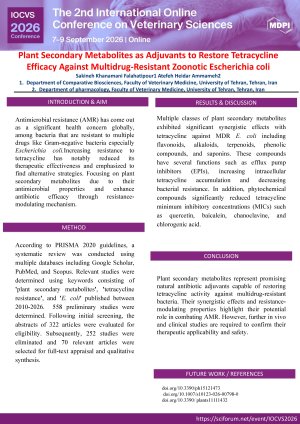
Introduction: Antimicrobial resistance (AMR) is a pressing global health threat, observed in Gram-negative bacteria, especially Escherichia coli, unaffected by multiple drug classes. Tetracycline efficacy has diminished, to the extent that the drug exhibits reduced effectiveness. This has led researchers to seek alternative strategies, for instance plant secondary metabolites. These compounds have natural antimicrobial effects; more significantly, they can restore antibiotic activity by disrupting bacterial defense mechanism.
Methods: A systematic review was carried out following PRISMA 2020 guidelines. Google Scholar, PubMed, and Scopus were searched using keywords ‘plant secondary metabolites’, ‘tetracycline resistance’, and ‘E. Coli’; only papers published between 2010 and May 2026 were considered. The initial search returned 558 studies. After duplicate removal, 322 abstracts were assessed for relevance including in vitro, in silico, and systematic studies. Then 253 irrelevant studies were excluded due to non-English articles or association with other bacteria, leaving 69 articles read in full and used for qualitative synthesis.
Results: Several classes of plant secondary metabolites exhibited effects alongside tetracycline against MDR E. coli; flavonoids, alkaloids, terpenoids, phenolic compounds, and saponins showed synergistic effects using checkerboard, fractional inhibitory concentration index (FIC), and time-kill assay. Mechanistically, in many cases they acted as efflux pump inhibitors (EPIs), which led to more tetracycline accumulating inside the bacteria and a corresponding drop in resistance. Certain phytochemicals lowered minimum inhibitory concentrations (MICs) of tetracycline — quercetin, cepharanthine, ellagic acid, propyl gallate, catechin, myricetin, thymol, carnosic acid, triterpenoid, and chlorogenic acid demonstrated this effect.
Conclusions: Plant secondary metabolites appear as genuine candidates for natural antibiotic adjuvants, and tetracycline activity against multidrug-resistant bacteria can be restored. Their synergistic effects and ability to modify bacterial susceptibility. However, due to the low bioavailability of plant metabolites under in vivo conditions, further studies in this area are still required. The authors declare no conflicts of interest.
Keywords
plant secondary metabolites
tetracycline resistance
E. Coli
Poster
atefeh heidar ammameh- 1.pdf
A National Evaluation of One Health, Zoonotic Threats, and Antimicrobial Stewardship among Professional college Students in India
Cattle production systems characteristics and their influence on antimicrobial use, alternatives, and resistance risk in Nigeria