Event submissions
Published
This submission belongs to the session S2. Surveillance and Epidemiological Modelling at the Human–Animal–Environment Interface of the event The 2nd International Online Conference on Veterinary Sciences
Published date
02 Sep, 2026
Academic Editor
'%3e%3cpath%20d='M12.6657%2010.9104C12.4185%2010.325%2012.0599%209.79327%2011.6097%209.34482C11.1609%208.89508%2010.6293%208.5365%2010.0442%208.28888C10.0389%208.28626%2010.0337%208.28495%2010.0285%208.28233C10.8446%207.69279%2011.3752%206.73249%2011.3752%205.64904C11.3752%203.8542%209.92103%202.39999%208.1262%202.39999C6.33136%202.39999%204.87715%203.8542%204.87715%205.64904C4.87715%206.73249%205.40774%207.69279%206.22393%208.28364C6.21869%208.28626%206.21345%208.28757%206.20821%208.29019C5.62129%208.5378%205.09463%208.89284%204.64265%209.34613C4.1929%209.79493%203.83432%2010.3266%203.58671%2010.9117C3.34345%2011.4845%203.21226%2012.0987%203.20023%2012.7209C3.19988%2012.7349%203.20233%2012.7488%203.20744%2012.7619C3.21255%2012.7749%203.22022%2012.7867%203.22998%2012.7968C3.23975%2012.8068%203.25142%2012.8147%203.26431%2012.8202C3.2772%2012.8256%203.29105%2012.8284%203.30504%2012.8284H4.09109C4.14874%2012.8284%204.19459%2012.7825%204.1959%2012.7262C4.2221%2011.7148%204.62823%2010.7676%205.34617%2010.0497C6.08899%209.30683%207.0755%208.89808%208.1262%208.89808C9.17689%208.89808%2010.1634%209.30683%2010.9062%2010.0497C11.6242%2010.7676%2012.0303%2011.7148%2012.0565%2012.7262C12.0578%2012.7838%2012.1037%2012.8284%2012.1613%2012.8284H12.9474C12.9613%2012.8284%2012.9752%2012.8256%2012.9881%2012.8202C13.001%2012.8147%2013.0126%2012.8068%2013.0224%2012.7968C13.0322%2012.7867%2013.0398%2012.7749%2013.0449%2012.7619C13.0501%2012.7488%2013.0525%2012.7349%2013.0522%2012.7209C13.0391%2012.0947%2012.9094%2011.4855%2012.6657%2010.9104ZM8.1262%207.9024C7.52486%207.9024%206.9589%207.6679%206.53312%207.24211C6.10733%206.81633%205.87283%206.25037%205.87283%205.64904C5.87283%205.0477%206.10733%204.48174%206.53312%204.05596C6.9589%203.63018%207.52486%203.39567%208.1262%203.39567C8.72753%203.39567%209.29349%203.63018%209.71927%204.05596C10.1451%204.48174%2010.3796%205.0477%2010.3796%205.64904C10.3796%206.25037%2010.1451%206.81633%209.71927%207.24211C9.29349%207.6679%208.72753%207.9024%208.1262%207.9024Z'%20fill='%235D1EE1'/%3e%3c/g%3e%3c/svg%3e) Francesco Mira
Francesco MiraCitation
Mohammad Hossein Pakrooh, Mohammadjavad Salimi, Hamidreza Azizi, Baran Hashemi, A Meta-Analysis of the Prevalence of Abortion-Causing Parasites in Dairy Cattle in Isfahan and Chaharmahal va Bakhtiari Provinces, Iran, in Proceedings of The 2nd International Online Conference on Veterinary Sciences, 7 September–9 September 2026, MDPI: Basel, Switzerland
Share
Email
Facebook
Twitter
LinkedIn
A Meta-Analysis of the Prevalence of Abortion-Causing Parasites in Dairy Cattle in Isfahan and Chaharmahal va Bakhtiari Provinces, Iran
'%3e%3cpath%20d='M12.6647%2010.9104C12.4176%2010.325%2012.0589%209.7933%2011.6088%209.34485C11.16%208.89511%2010.6283%208.53653%2010.0432%208.28891C10.038%208.28629%2010.0327%208.28498%2010.0275%208.28236C10.8437%207.69282%2011.3743%206.73252%2011.3743%205.64907C11.3743%203.85423%209.92005%202.40002%208.12522%202.40002C6.33038%202.40002%204.87618%203.85423%204.87618%205.64907C4.87618%206.73252%205.40677%207.69282%206.22296%208.28367C6.21772%208.28629%206.21248%208.2876%206.20724%208.29022C5.62031%208.53783%205.09365%208.89287%204.64167%209.34616C4.19192%209.79496%203.83334%2010.3266%203.58573%2010.9117C3.34247%2011.4846%203.21128%2012.0987%203.19925%2012.721C3.1989%2012.735%203.20135%2012.7489%203.20646%2012.7619C3.21157%2012.7749%203.21924%2012.7868%203.22901%2012.7968C3.23877%2012.8068%203.25045%2012.8148%203.26334%2012.8202C3.27623%2012.8256%203.29007%2012.8284%203.30406%2012.8284H4.09012C4.14776%2012.8284%204.19362%2012.7825%204.19493%2012.7262C4.22113%2011.7148%204.62726%2010.7676%205.34519%2010.0497C6.08802%209.30686%207.07452%208.89811%208.12522%208.89811C9.17592%208.89811%2010.1624%209.30686%2010.9052%2010.0497C11.6232%2010.7676%2012.0293%2011.7148%2012.0555%2012.7262C12.0568%2012.7839%2012.1027%2012.8284%2012.1603%2012.8284H12.9464C12.9604%2012.8284%2012.9742%2012.8256%2012.9871%2012.8202C13%2012.8148%2013.0117%2012.8068%2013.0214%2012.7968C13.0312%2012.7868%2013.0389%2012.7749%2013.044%2012.7619C13.0491%2012.7489%2013.0515%2012.735%2013.0512%2012.721C13.0381%2012.0947%2012.9084%2011.4856%2012.6647%2010.9104ZM8.12522%207.90243C7.52388%207.90243%206.95792%207.66793%206.53214%207.24215C6.10636%206.81636%205.87185%206.2504%205.87185%205.64907C5.87185%205.04773%206.10636%204.48177%206.53214%204.05599C6.95792%203.63021%207.52388%203.3957%208.12522%203.3957C8.72655%203.3957%209.29252%203.63021%209.7183%204.05599C10.1441%204.48177%2010.3786%205.04773%2010.3786%205.64907C10.3786%206.2504%2010.1441%206.81636%209.7183%207.24215C9.29252%207.66793%208.72655%207.90243%208.12522%207.90243Z'%20fill='%235D1EE1'/%3e%3c/g%3e%3c/svg%3e)
Mohammad Hossein Pakrooh 1,2
Mohammadjavad Salimi 3
Hamidreza Azizi 4
Baran Hashemi 5
1. Interdisciplinary student research institute of veterinary medicine (ISRI-VetM), Growth center, research assistant, Shahrekord University, Chaharmahal & Bakhtiari
2. Faculty of Veterinary Medicine, Shahrekord University, Chaharmahal & Bakhtiari
3. Department of Animal Science, Faculty of Agriculture, Shahrekord University, Chaharmahal & Bakhtiari
4. Department of Pathobiology, Faculty of Veterinary Medicine, Shahrekord University, Chaharmahal and Bakhtiari
5. School of Veterinary Medicine, Shahrekord University, Chaharmahal & Bakhtiari
Abstract
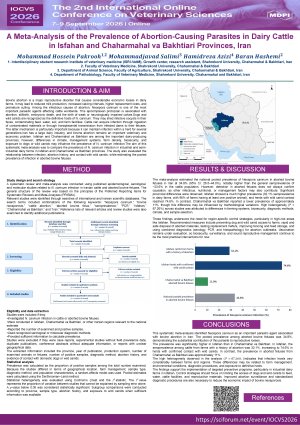
This study aimed to conduct a systematic meta-analysis to compare the seroprevalence of major abortion-causing parasites, particularly Neospora caninum, between industrial and semi-industrial dairy farms in two major Iranian provinces, Isfahan and Chaharmahal va Bakhtiari. A comprehensive search and integration of existing epidemiological, serological, and molecular studies from the region were performed. Data were pooled and statistically analyzed using random-effects models, specifically the DerSimonian-Laird method, to account for heterogeneity across studies. The meta-analysis revealed a significantly higher overall seroprevalence of N. caninum in Isfahan Province. The seroprevalence in dairy cattle with a history of abortion in Isfahan was 32.1%, peaking at 74.6% in herds with confirmed contact with wild canids. In contrast, the prevalence in aborted fetuses in Chaharmahal va Bakhtiari was notably lower at 11%. The statistical comparison showed a significant difference (p < 0.05) between the two provinces, with high heterogeneity (I² = 87.26%) indicating substantial regional variation. The national pooled prevalence in aborted fetuses was estimated at 34.8%. These findings unequivocally identify N. caninum as a primary parasitic agent of bovine abortion in the studied regions, with the risk being substantially higher in industrial farms in Isfahan. The study concludes that targeted preventive strategies, including strict management of definitive host access and vaccination programs, are urgently needed, especially in high-prevalence areas like Isfahan, to mitigate significant economic losses and improve reproductive herd health.
Keywords
bovine abortion
dairy cattle
Neospora caninum
prevalence
meta-analysis
Iran
Poster
A Meta-Analysis of the Prevalence of Abortion-Causing Parasites in Dairy Cattle in Isfahan and Chaharmahal va Bakhtiari Provinces, Iran.pdf
Surveillance of Varroa destructor in Honey Bees: A One Health Approach and Epidemiological Modelling
Feed protein stability and bacterial disease in commercial broilers – an observational study in Multan, Pakistan