Event submissions
Published
This submission belongs to the session S1. One Health Approaches to Emerging Zoonotic Threats of the event The 2nd International Online Conference on Veterinary Sciences
Published date
02 Sep, 2026
Academic Editor
'%3e%3cpath%20d='M12.6657%2010.9104C12.4185%2010.325%2012.0599%209.79327%2011.6097%209.34482C11.1609%208.89508%2010.6293%208.5365%2010.0442%208.28888C10.0389%208.28626%2010.0337%208.28495%2010.0285%208.28233C10.8446%207.69279%2011.3752%206.73249%2011.3752%205.64904C11.3752%203.8542%209.92103%202.39999%208.1262%202.39999C6.33136%202.39999%204.87715%203.8542%204.87715%205.64904C4.87715%206.73249%205.40774%207.69279%206.22393%208.28364C6.21869%208.28626%206.21345%208.28757%206.20821%208.29019C5.62129%208.5378%205.09463%208.89284%204.64265%209.34613C4.1929%209.79493%203.83432%2010.3266%203.58671%2010.9117C3.34345%2011.4845%203.21226%2012.0987%203.20023%2012.7209C3.19988%2012.7349%203.20233%2012.7488%203.20744%2012.7619C3.21255%2012.7749%203.22022%2012.7867%203.22998%2012.7968C3.23975%2012.8068%203.25142%2012.8147%203.26431%2012.8202C3.2772%2012.8256%203.29105%2012.8284%203.30504%2012.8284H4.09109C4.14874%2012.8284%204.19459%2012.7825%204.1959%2012.7262C4.2221%2011.7148%204.62823%2010.7676%205.34617%2010.0497C6.08899%209.30683%207.0755%208.89808%208.1262%208.89808C9.17689%208.89808%2010.1634%209.30683%2010.9062%2010.0497C11.6242%2010.7676%2012.0303%2011.7148%2012.0565%2012.7262C12.0578%2012.7838%2012.1037%2012.8284%2012.1613%2012.8284H12.9474C12.9613%2012.8284%2012.9752%2012.8256%2012.9881%2012.8202C13.001%2012.8147%2013.0126%2012.8068%2013.0224%2012.7968C13.0322%2012.7867%2013.0398%2012.7749%2013.0449%2012.7619C13.0501%2012.7488%2013.0525%2012.7349%2013.0522%2012.7209C13.0391%2012.0947%2012.9094%2011.4855%2012.6657%2010.9104ZM8.1262%207.9024C7.52486%207.9024%206.9589%207.6679%206.53312%207.24211C6.10733%206.81633%205.87283%206.25037%205.87283%205.64904C5.87283%205.0477%206.10733%204.48174%206.53312%204.05596C6.9589%203.63018%207.52486%203.39567%208.1262%203.39567C8.72753%203.39567%209.29349%203.63018%209.71927%204.05596C10.1451%204.48174%2010.3796%205.0477%2010.3796%205.64904C10.3796%206.25037%2010.1451%206.81633%209.71927%207.24211C9.29349%207.6679%208.72753%207.9024%208.1262%207.9024Z'%20fill='%235D1EE1'/%3e%3c/g%3e%3c/svg%3e) Chengming Wang
Chengming WangCitation
Marija Ivaškienė, Smiltė Verbickaitė, Zoja Miknienė, Modestas Žilius, Development and Evaluation of Organic Acid-Based Hydrogels for Antifungal Treatment of Companion Animal Dermatomycoses: A One Health Perspective, in Proceedings of The 2nd International Online Conference on Veterinary Sciences, 7 September–9 September 2026, MDPI: Basel, Switzerland
Share
Email
Facebook
Twitter
LinkedIn
Development and Evaluation of Organic Acid-Based Hydrogels for Antifungal Treatment of Companion Animal Dermatomycoses: A One Health Perspective
'%3e%3cpath%20d='M12.6647%2010.9104C12.4176%2010.325%2012.0589%209.7933%2011.6088%209.34485C11.16%208.89511%2010.6283%208.53653%2010.0432%208.28891C10.038%208.28629%2010.0327%208.28498%2010.0275%208.28236C10.8437%207.69282%2011.3743%206.73252%2011.3743%205.64907C11.3743%203.85423%209.92005%202.40002%208.12522%202.40002C6.33038%202.40002%204.87618%203.85423%204.87618%205.64907C4.87618%206.73252%205.40677%207.69282%206.22296%208.28367C6.21772%208.28629%206.21248%208.2876%206.20724%208.29022C5.62031%208.53783%205.09365%208.89287%204.64167%209.34616C4.19192%209.79496%203.83334%2010.3266%203.58573%2010.9117C3.34247%2011.4846%203.21128%2012.0987%203.19925%2012.721C3.1989%2012.735%203.20135%2012.7489%203.20646%2012.7619C3.21157%2012.7749%203.21924%2012.7868%203.22901%2012.7968C3.23877%2012.8068%203.25045%2012.8148%203.26334%2012.8202C3.27623%2012.8256%203.29007%2012.8284%203.30406%2012.8284H4.09012C4.14776%2012.8284%204.19362%2012.7825%204.19493%2012.7262C4.22113%2011.7148%204.62726%2010.7676%205.34519%2010.0497C6.08802%209.30686%207.07452%208.89811%208.12522%208.89811C9.17592%208.89811%2010.1624%209.30686%2010.9052%2010.0497C11.6232%2010.7676%2012.0293%2011.7148%2012.0555%2012.7262C12.0568%2012.7839%2012.1027%2012.8284%2012.1603%2012.8284H12.9464C12.9604%2012.8284%2012.9742%2012.8256%2012.9871%2012.8202C13%2012.8148%2013.0117%2012.8068%2013.0214%2012.7968C13.0312%2012.7868%2013.0389%2012.7749%2013.044%2012.7619C13.0491%2012.7489%2013.0515%2012.735%2013.0512%2012.721C13.0381%2012.0947%2012.9084%2011.4856%2012.6647%2010.9104ZM8.12522%207.90243C7.52388%207.90243%206.95792%207.66793%206.53214%207.24215C6.10636%206.81636%205.87185%206.2504%205.87185%205.64907C5.87185%205.04773%206.10636%204.48177%206.53214%204.05599C6.95792%203.63021%207.52388%203.3957%208.12522%203.3957C8.72655%203.3957%209.29252%203.63021%209.7183%204.05599C10.1441%204.48177%2010.3786%205.04773%2010.3786%205.64907C10.3786%206.2504%2010.1441%206.81636%209.7183%207.24215C9.29252%207.66793%208.72655%207.90243%208.12522%207.90243Z'%20fill='%235D1EE1'/%3e%3c/g%3e%3c/svg%3e)
Marija Ivaškienė 1
Smiltė Verbickaitė 1
Zoja Miknienė 1
Modestas Žilius 1
1. Lithuanian University of Health Sciences, Veterinary Academy, Kaunas
Abstract
Introduction
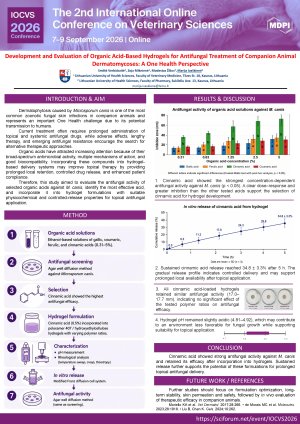
Dermatophytosis caused by Microsporum canis is a common zoonotic skin infection in pets, often requiring prolonged treatment due to persistence in keratinized tissues. Its zoonotic nature highlights its importance within the One Health framework, as infected animals may contribute to transmission to humans. Organic acids represent promising antifungal agents due to their biocompatibility and mechanisms of action. Hydrogel systems may enhance topical drug delivery by enabling controlled release and improved retention. This study aimed to evaluate the antifungal activity of selected organic acids and to assess the physicochemical and antifungal properties of acid-based hydrogel formulations.
Methods
Ethanol-based solutions of gallic, coumaric, ferulic, and cinnamic acids (0.31–5%) were tested against M. canis using the agar well diffusion method. Cinnamic acid demonstrated the highest antifungal efficacy, which led to its selection for incorporation (0.5%) into hydrogel formulations containing poloxamer 407 and hydroxyethylcellulose with varying polymer ratios. Hydrogels were characterized by pH measurement and rheological analysis. Antifungal activity was evaluated using the same diffusion method. In vitro release studies were performed using a modified Franz diffusion cell system.
Results
Cinnamic acid demonstrated the highest antifungal activity, with inhibition zones increasing from 35.6 ± 1.7 mm (0.31%) to 73.2 ± 13.8 mm (5%). All hydrogel formulations retained antifungal activity against M. canis, producing ~17 mm inhibition zones, indicating diffusion limitations within the polymer matrix. Rheological analysis showed formulation-dependent viscosity (73.1–311.5 Pa·s at 35 °C), and all hydrogels had slightly acidic pH (4.81–4.92). In vitro, 34.8 ± 3.3% of cinnamic acid was released over 5 hours, suggesting a diffusion-controlled release profile.
Conclusions
Cinnamic acid demonstrated strong antifungal activity and retained its efficacy when incorporated into hydrogel systems, enabling controlled release. These findings indicate that cinnamic acid is a promising candidate for topical antifungal therapy, while poloxamer 407/hydroxyethylcellulose hydrogels may serve as a platform for prolonged local antifungal drug delivery.
Keywords
Dermatophytosis
Microsporum canis
organic acids
cinnamic acid
antifungal activity
hydrogels
topical drug delivery
poloxamer 407
hydroxyethylcellulose
veterinary dermatology
One Health
Poster
POSTER Development and Evaluation of Organic Acid-Based Hydrogels for Antifungal Treatment of Companion Animal Dermatomycoses A One Health Perspective.pdf
Global Prevalence of Cryptosporidium Infection in Cattle (2005–2024): A Systematic Review and Meta-Analysis of Epidemiological Patterns
Mite Eggs in Equine Faeces: An Incidental Finding with First Molecular Evidence of Chorioptes bovis and Psoroptes ovis in Nigerian Horses