Event submissions
Published
This submission belongs to the session S2. Surveillance and Epidemiological Modelling at the Human–Animal–Environment Interface of the event The 2nd International Online Conference on Veterinary Sciences
Published date
02 Sep, 2026
Academic Editor
'%3e%3cpath%20d='M12.6657%2010.9104C12.4185%2010.325%2012.0599%209.79327%2011.6097%209.34482C11.1609%208.89508%2010.6293%208.5365%2010.0442%208.28888C10.0389%208.28626%2010.0337%208.28495%2010.0285%208.28233C10.8446%207.69279%2011.3752%206.73249%2011.3752%205.64904C11.3752%203.8542%209.92103%202.39999%208.1262%202.39999C6.33136%202.39999%204.87715%203.8542%204.87715%205.64904C4.87715%206.73249%205.40774%207.69279%206.22393%208.28364C6.21869%208.28626%206.21345%208.28757%206.20821%208.29019C5.62129%208.5378%205.09463%208.89284%204.64265%209.34613C4.1929%209.79493%203.83432%2010.3266%203.58671%2010.9117C3.34345%2011.4845%203.21226%2012.0987%203.20023%2012.7209C3.19988%2012.7349%203.20233%2012.7488%203.20744%2012.7619C3.21255%2012.7749%203.22022%2012.7867%203.22998%2012.7968C3.23975%2012.8068%203.25142%2012.8147%203.26431%2012.8202C3.2772%2012.8256%203.29105%2012.8284%203.30504%2012.8284H4.09109C4.14874%2012.8284%204.19459%2012.7825%204.1959%2012.7262C4.2221%2011.7148%204.62823%2010.7676%205.34617%2010.0497C6.08899%209.30683%207.0755%208.89808%208.1262%208.89808C9.17689%208.89808%2010.1634%209.30683%2010.9062%2010.0497C11.6242%2010.7676%2012.0303%2011.7148%2012.0565%2012.7262C12.0578%2012.7838%2012.1037%2012.8284%2012.1613%2012.8284H12.9474C12.9613%2012.8284%2012.9752%2012.8256%2012.9881%2012.8202C13.001%2012.8147%2013.0126%2012.8068%2013.0224%2012.7968C13.0322%2012.7867%2013.0398%2012.7749%2013.0449%2012.7619C13.0501%2012.7488%2013.0525%2012.7349%2013.0522%2012.7209C13.0391%2012.0947%2012.9094%2011.4855%2012.6657%2010.9104ZM8.1262%207.9024C7.52486%207.9024%206.9589%207.6679%206.53312%207.24211C6.10733%206.81633%205.87283%206.25037%205.87283%205.64904C5.87283%205.0477%206.10733%204.48174%206.53312%204.05596C6.9589%203.63018%207.52486%203.39567%208.1262%203.39567C8.72753%203.39567%209.29349%203.63018%209.71927%204.05596C10.1451%204.48174%2010.3796%205.0477%2010.3796%205.64904C10.3796%206.25037%2010.1451%206.81633%209.71927%207.24211C9.29349%207.6679%208.72753%207.9024%208.1262%207.9024Z'%20fill='%235D1EE1'/%3e%3c/g%3e%3c/svg%3e) Patrick Butaye
Patrick ButayeCitation
Alice Ingrassia, Danilo De Pasquale, Bianca Maria Orlandella, Francesco Origgi, Gianmarco Ferrara, Detection of PBFDV, APyV and AdV in captive pet birds in Sicily, Italy, in Proceedings of The 2nd International Online Conference on Veterinary Sciences, 7 September–9 September 2026, MDPI: Basel, Switzerland
Share
Email
Facebook
Twitter
LinkedIn
Detection of PBFDV, APyV and AdV in captive pet birds in Sicily, Italy
'%3e%3cpath%20d='M12.6647%2010.9104C12.4176%2010.325%2012.0589%209.7933%2011.6088%209.34485C11.16%208.89511%2010.6283%208.53653%2010.0432%208.28891C10.038%208.28629%2010.0327%208.28498%2010.0275%208.28236C10.8437%207.69282%2011.3743%206.73252%2011.3743%205.64907C11.3743%203.85423%209.92005%202.40002%208.12522%202.40002C6.33038%202.40002%204.87618%203.85423%204.87618%205.64907C4.87618%206.73252%205.40677%207.69282%206.22296%208.28367C6.21772%208.28629%206.21248%208.2876%206.20724%208.29022C5.62031%208.53783%205.09365%208.89287%204.64167%209.34616C4.19192%209.79496%203.83334%2010.3266%203.58573%2010.9117C3.34247%2011.4846%203.21128%2012.0987%203.19925%2012.721C3.1989%2012.735%203.20135%2012.7489%203.20646%2012.7619C3.21157%2012.7749%203.21924%2012.7868%203.22901%2012.7968C3.23877%2012.8068%203.25045%2012.8148%203.26334%2012.8202C3.27623%2012.8256%203.29007%2012.8284%203.30406%2012.8284H4.09012C4.14776%2012.8284%204.19362%2012.7825%204.19493%2012.7262C4.22113%2011.7148%204.62726%2010.7676%205.34519%2010.0497C6.08802%209.30686%207.07452%208.89811%208.12522%208.89811C9.17592%208.89811%2010.1624%209.30686%2010.9052%2010.0497C11.6232%2010.7676%2012.0293%2011.7148%2012.0555%2012.7262C12.0568%2012.7839%2012.1027%2012.8284%2012.1603%2012.8284H12.9464C12.9604%2012.8284%2012.9742%2012.8256%2012.9871%2012.8202C13%2012.8148%2013.0117%2012.8068%2013.0214%2012.7968C13.0312%2012.7868%2013.0389%2012.7749%2013.044%2012.7619C13.0491%2012.7489%2013.0515%2012.735%2013.0512%2012.721C13.0381%2012.0947%2012.9084%2011.4856%2012.6647%2010.9104ZM8.12522%207.90243C7.52388%207.90243%206.95792%207.66793%206.53214%207.24215C6.10636%206.81636%205.87185%206.2504%205.87185%205.64907C5.87185%205.04773%206.10636%204.48177%206.53214%204.05599C6.95792%203.63021%207.52388%203.3957%208.12522%203.3957C8.72655%203.3957%209.29252%203.63021%209.7183%204.05599C10.1441%204.48177%2010.3786%205.04773%2010.3786%205.64907C10.3786%206.2504%2010.1441%206.81636%209.7183%207.24215C9.29252%207.66793%208.72655%207.90243%208.12522%207.90243Z'%20fill='%235D1EE1'/%3e%3c/g%3e%3c/svg%3e)
Alice Ingrassia 1
Danilo De Pasquale 2
Bianca Maria Orlandella 1
Francesco Origgi 1
Gianmarco Ferrara 1
1. Department of Veterinary Sciences, University of Messina, Messina, 98168, Italy
2. Mesotic Vet, Messina, Italy
Abstract
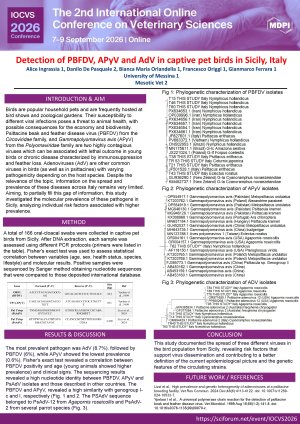
Birds are popular household pets and are frequently hosted at bird shows and zoological gardens. Their susceptibility to different viral infections poses a threat to animal health, with possible consequences for the economy and biodiversity. Psittacine beak and feather disease virus (PBFDV) from the Circoviridae family, and Gammapolyomavirus avis (APyV) from the Polyomaviridae family are two highly contagious viruses which can be associated with lethal outcome in young birds or chronic disease characterized by immunosuppression and feather loss. Adenoviruses (AdV) are other common viruses in birds (as well as in psittacines) with varying pathogenicity depending on the host species. Despite the relevance of the topic, information on the spread and prevalence of these diseases across Italy remains very limited. Aiming, to partially fill this gap of information, this study investigated the molecular prevalence of these pathogens in Sicily, analyzing individual risk factors associated with higher prevalence. A total of 166 oral-cloacal swabs were collected in captive pet birds from Sicily. After DNA extraction, each sample was assessed using different PCR protocols. The most prevalent pathogen was AdV (8.7%), followed by PBFDV (6%), while APyV showed the lowest prevalence (0.6%). Fisher's exact test revealed a correlation between PBFDV positivity and age (young animals showed higher prevalence) and clinical signs. The sequencing results revealed a high nucleotide identity between PBFDV, APyV and PsAdV isolates and those described in other countries. The PBFDV and APyV, revealed a high similarity with genogroup I-c and I, respectively. The PSAdV sequence belonged to PsAdV-12 from Agapornis roseicollis and PsAdV-2 from several parrot species. This study documented the spread of three different viruses in the bird population from Sicily, revealing risk factors that support virus dissemination and contributing to a better definition of the current epidemiological picture and the genetic features of the circulating strains.
Keywords
Parrots
Virus
Circovirus
Polyoma virus
Adenovirus
Poster
Poster Ferrara.pdf
Mite Eggs in Equine Faeces: An Incidental Finding with First Molecular Evidence of Chorioptes bovis and Psoroptes ovis in Nigerian Horses
Analysis of Viruses Carried by Wild Animal Feces in the Wolong Nature Reserve