Event submissions
Published
This submission belongs to the session S3. Antimicrobial Resistance and Food Safety: A One Health Perspective of the event The 2nd International Online Conference on Veterinary Sciences
Published date
02 Sep, 2026
Academic Editor
'%3e%3cpath%20d='M12.6657%2010.9104C12.4185%2010.325%2012.0599%209.79327%2011.6097%209.34482C11.1609%208.89508%2010.6293%208.5365%2010.0442%208.28888C10.0389%208.28626%2010.0337%208.28495%2010.0285%208.28233C10.8446%207.69279%2011.3752%206.73249%2011.3752%205.64904C11.3752%203.8542%209.92103%202.39999%208.1262%202.39999C6.33136%202.39999%204.87715%203.8542%204.87715%205.64904C4.87715%206.73249%205.40774%207.69279%206.22393%208.28364C6.21869%208.28626%206.21345%208.28757%206.20821%208.29019C5.62129%208.5378%205.09463%208.89284%204.64265%209.34613C4.1929%209.79493%203.83432%2010.3266%203.58671%2010.9117C3.34345%2011.4845%203.21226%2012.0987%203.20023%2012.7209C3.19988%2012.7349%203.20233%2012.7488%203.20744%2012.7619C3.21255%2012.7749%203.22022%2012.7867%203.22998%2012.7968C3.23975%2012.8068%203.25142%2012.8147%203.26431%2012.8202C3.2772%2012.8256%203.29105%2012.8284%203.30504%2012.8284H4.09109C4.14874%2012.8284%204.19459%2012.7825%204.1959%2012.7262C4.2221%2011.7148%204.62823%2010.7676%205.34617%2010.0497C6.08899%209.30683%207.0755%208.89808%208.1262%208.89808C9.17689%208.89808%2010.1634%209.30683%2010.9062%2010.0497C11.6242%2010.7676%2012.0303%2011.7148%2012.0565%2012.7262C12.0578%2012.7838%2012.1037%2012.8284%2012.1613%2012.8284H12.9474C12.9613%2012.8284%2012.9752%2012.8256%2012.9881%2012.8202C13.001%2012.8147%2013.0126%2012.8068%2013.0224%2012.7968C13.0322%2012.7867%2013.0398%2012.7749%2013.0449%2012.7619C13.0501%2012.7488%2013.0525%2012.7349%2013.0522%2012.7209C13.0391%2012.0947%2012.9094%2011.4855%2012.6657%2010.9104ZM8.1262%207.9024C7.52486%207.9024%206.9589%207.6679%206.53312%207.24211C6.10733%206.81633%205.87283%206.25037%205.87283%205.64904C5.87283%205.0477%206.10733%204.48174%206.53312%204.05596C6.9589%203.63018%207.52486%203.39567%208.1262%203.39567C8.72753%203.39567%209.29349%203.63018%209.71927%204.05596C10.1451%204.48174%2010.3796%205.0477%2010.3796%205.64904C10.3796%206.25037%2010.1451%206.81633%209.71927%207.24211C9.29349%207.6679%208.72753%207.9024%208.1262%207.9024Z'%20fill='%235D1EE1'/%3e%3c/g%3e%3c/svg%3e) BeiBei Li
BeiBei LiCitation
Manos Vlasiou, Mechanistic In Silico Evaluation of ABCG2-Mediated Drug–Drug Interactions in Lactating Animals: Implications for Efflux Modulation, Milk Excretion, and Antimicrobial Exposure, in Proceedings of The 2nd International Online Conference on Veterinary Sciences, 7 September–9 September 2026, MDPI: Basel, Switzerland
Share
Email
Facebook
Twitter
LinkedIn
Mechanistic In Silico Evaluation of ABCG2-Mediated Drug–Drug Interactions in Lactating Animals: Implications for Efflux Modulation, Milk Excretion, and Antimicrobial Exposure

Manos Vlasiou 1
1. Department of Veterinary Medicine, University of Nicosia, School of Veterinary Medicine, Nicosia
Abstract
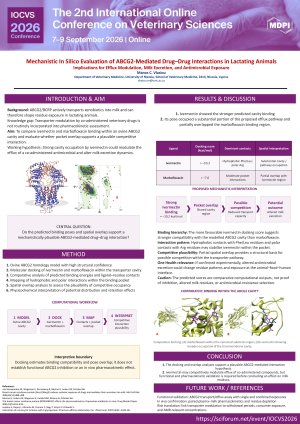
Drug disposition in lactating animals is critically influenced by active transport processes that regulate the transfer of xenobiotics into milk. The efflux transporter ABCG2/BCRP is a key determinant of this process; however, its modulation by co-administered veterinary drugs is not routinely considered in pharmacokinetic assessment. This study investigates the mechanistic basis of transporter-mediated drug–drug interactions and their potential impact on drug excretion dynamics in lactating systems.A structure-based computational framework was applied using an ovine ABCG2 homology model with high structural confidence. Molecular docking was performed to evaluate binding affinity and interaction profiles of representative veterinary drugs within the transporter cavity. Docking scores were analysed comparatively, and ligand–residue interactions were mapped to identify key binding determinants. Spatial overlap analysis was conducted to assess potential competitive inhibition. Ivermectin demonstrated a strong binding affinity within the ABCG2 cavity (predicted binding energy ≈ −10.2 kcal/mol), stabilised by hydrophobic interactions with residues such as Phe and Leu lining the binding pocket, and by polar contacts with Arg residues involved in substrate coordination. Marbofloxacin exhibited moderate affinity (≈ −7.6 kcal/mol) with partial spatial overlap within the binding region. Structural alignment revealed that ivermectin occupies a substantial portion of the efflux pathway, suggesting a potential inhibitory effect on substrate transport. The overlap in binding regions supports a competitive interaction mechanism, whereby ivermectin may reduce transporter-mediated efflux of co-administered compounds. Differences in physicochemical properties further indicate altered distribution and retention behaviour under co-administration scenarios.This study provides mechanistic evidence that ABCG2-mediated drug–drug interactions may significantly modulate efflux capacity and influence drug excretion into milk in lactating animals. Such modulation of antimicrobial excretion may contribute to sub-therapeutic residue levels in the food chain, potentially influencing the selection pressure for antimicrobial resistance at the human–animal interface.
Keywords
ABCG2 TRANSPORTERS
DRUG-DRUG INTERACTIONS
MILK EXCRETION
ANTIMICROBIAL EXPOSURE
Poster
IOCVS2026_ABCG2_Poster_Manos_Vlasiou.pdf
Beyond common serotypes: Genomic characterization of diverse avian pathogenic Escherichia coli associated with broiler colibacillosis in Pakistan
Long-Term Epidemiological Dynamics, Control of Brucellosis, and Human Complications in Albania and the Korçë Region:One Health Approaches to Emerging Zoonotic Threats.