Event submissions
Published
This submission belongs to the session S2. Surveillance and Epidemiological Modelling at the Human–Animal–Environment Interface of the event The 2nd International Online Conference on Veterinary Sciences
Published date
02 Sep, 2026
Academic Editor
'%3e%3cpath%20d='M12.6657%2010.9104C12.4185%2010.325%2012.0599%209.79327%2011.6097%209.34482C11.1609%208.89508%2010.6293%208.5365%2010.0442%208.28888C10.0389%208.28626%2010.0337%208.28495%2010.0285%208.28233C10.8446%207.69279%2011.3752%206.73249%2011.3752%205.64904C11.3752%203.8542%209.92103%202.39999%208.1262%202.39999C6.33136%202.39999%204.87715%203.8542%204.87715%205.64904C4.87715%206.73249%205.40774%207.69279%206.22393%208.28364C6.21869%208.28626%206.21345%208.28757%206.20821%208.29019C5.62129%208.5378%205.09463%208.89284%204.64265%209.34613C4.1929%209.79493%203.83432%2010.3266%203.58671%2010.9117C3.34345%2011.4845%203.21226%2012.0987%203.20023%2012.7209C3.19988%2012.7349%203.20233%2012.7488%203.20744%2012.7619C3.21255%2012.7749%203.22022%2012.7867%203.22998%2012.7968C3.23975%2012.8068%203.25142%2012.8147%203.26431%2012.8202C3.2772%2012.8256%203.29105%2012.8284%203.30504%2012.8284H4.09109C4.14874%2012.8284%204.19459%2012.7825%204.1959%2012.7262C4.2221%2011.7148%204.62823%2010.7676%205.34617%2010.0497C6.08899%209.30683%207.0755%208.89808%208.1262%208.89808C9.17689%208.89808%2010.1634%209.30683%2010.9062%2010.0497C11.6242%2010.7676%2012.0303%2011.7148%2012.0565%2012.7262C12.0578%2012.7838%2012.1037%2012.8284%2012.1613%2012.8284H12.9474C12.9613%2012.8284%2012.9752%2012.8256%2012.9881%2012.8202C13.001%2012.8147%2013.0126%2012.8068%2013.0224%2012.7968C13.0322%2012.7867%2013.0398%2012.7749%2013.0449%2012.7619C13.0501%2012.7488%2013.0525%2012.7349%2013.0522%2012.7209C13.0391%2012.0947%2012.9094%2011.4855%2012.6657%2010.9104ZM8.1262%207.9024C7.52486%207.9024%206.9589%207.6679%206.53312%207.24211C6.10733%206.81633%205.87283%206.25037%205.87283%205.64904C5.87283%205.0477%206.10733%204.48174%206.53312%204.05596C6.9589%203.63018%207.52486%203.39567%208.1262%203.39567C8.72753%203.39567%209.29349%203.63018%209.71927%204.05596C10.1451%204.48174%2010.3796%205.0477%2010.3796%205.64904C10.3796%206.25037%2010.1451%206.81633%209.71927%207.24211C9.29349%207.6679%208.72753%207.9024%208.1262%207.9024Z'%20fill='%235D1EE1'/%3e%3c/g%3e%3c/svg%3e) Patrick Butaye
Patrick ButayeCitation
Giuseppe Barbaccia, Delia Gambino, Lucia Galuppo, Luca Cicero, Pippo Bono, Giovanni Cassata, Antonio Vella, Distribution of Eimeria oocysts in cattle and sheep–goat farms in the Province of Palermo in the context of climate change (2024–2025), in Proceedings of The 2nd International Online Conference on Veterinary Sciences, 7 September–9 September 2026, MDPI: Basel, Switzerland
Share
Email
Facebook
Twitter
LinkedIn
Distribution of Eimeria oocysts in cattle and sheep–goat farms in the Province of Palermo in the context of climate change (2024–2025)
'%3e%3cpath%20d='M12.6647%2010.9104C12.4176%2010.325%2012.0589%209.7933%2011.6088%209.34485C11.16%208.89511%2010.6283%208.53653%2010.0432%208.28891C10.038%208.28629%2010.0327%208.28498%2010.0275%208.28236C10.8437%207.69282%2011.3743%206.73252%2011.3743%205.64907C11.3743%203.85423%209.92005%202.40002%208.12522%202.40002C6.33038%202.40002%204.87618%203.85423%204.87618%205.64907C4.87618%206.73252%205.40677%207.69282%206.22296%208.28367C6.21772%208.28629%206.21248%208.2876%206.20724%208.29022C5.62031%208.53783%205.09365%208.89287%204.64167%209.34616C4.19192%209.79496%203.83334%2010.3266%203.58573%2010.9117C3.34247%2011.4846%203.21128%2012.0987%203.19925%2012.721C3.1989%2012.735%203.20135%2012.7489%203.20646%2012.7619C3.21157%2012.7749%203.21924%2012.7868%203.22901%2012.7968C3.23877%2012.8068%203.25045%2012.8148%203.26334%2012.8202C3.27623%2012.8256%203.29007%2012.8284%203.30406%2012.8284H4.09012C4.14776%2012.8284%204.19362%2012.7825%204.19493%2012.7262C4.22113%2011.7148%204.62726%2010.7676%205.34519%2010.0497C6.08802%209.30686%207.07452%208.89811%208.12522%208.89811C9.17592%208.89811%2010.1624%209.30686%2010.9052%2010.0497C11.6232%2010.7676%2012.0293%2011.7148%2012.0555%2012.7262C12.0568%2012.7839%2012.1027%2012.8284%2012.1603%2012.8284H12.9464C12.9604%2012.8284%2012.9742%2012.8256%2012.9871%2012.8202C13%2012.8148%2013.0117%2012.8068%2013.0214%2012.7968C13.0312%2012.7868%2013.0389%2012.7749%2013.044%2012.7619C13.0491%2012.7489%2013.0515%2012.735%2013.0512%2012.721C13.0381%2012.0947%2012.9084%2011.4856%2012.6647%2010.9104ZM8.12522%207.90243C7.52388%207.90243%206.95792%207.66793%206.53214%207.24215C6.10636%206.81636%205.87185%206.2504%205.87185%205.64907C5.87185%205.04773%206.10636%204.48177%206.53214%204.05599C6.95792%203.63021%207.52388%203.3957%208.12522%203.3957C8.72655%203.3957%209.29252%203.63021%209.7183%204.05599C10.1441%204.48177%2010.3786%205.04773%2010.3786%205.64907C10.3786%206.2504%2010.1441%206.81636%209.7183%207.24215C9.29252%207.66793%208.72655%207.90243%208.12522%207.90243Z'%20fill='%235D1EE1'/%3e%3c/g%3e%3c/svg%3e)
Giuseppe Barbaccia 1
Delia Gambino 1,2
Lucia Galuppo 1
Luca Cicero 1
Pippo Bono 1
Giovanni Cassata 1
Antonio Vella 1
1. Istituto Zooprofilattico Sperimentale della Sicilia “A. Mirri”, Area Territoriale Palermo, 90129 Palermo
2. Department of Agricultural, Food and Forestry Science (SAAF), Università di Palermo, 90123 Palermo, Italy
Abstract
Introduction. Coccidiosis is a widespread enteric parasitic disease in domestic ruminants, caused by protozoa of the genus Eimeria, mainly affecting young animals and leading to diarrhea, growth retardation, and production losses. Transmission occurs through ingestion of oocysts shed in feces, which become infective after sporulation under favorable environmental conditions. Mild temperatures and high humidity, increasingly common in the context of Mediterranean climate change, can enhance the survival and spread of the parasite in livestock systems.
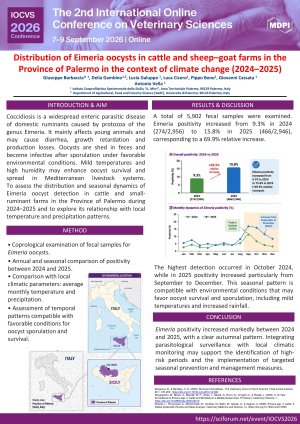
Methods. This study analyzed fecal samples from cattle and small ruminant farms in the Province of Palermo over the 2024–2025 period. A total of 5,902 samples were examined using coprological analysis to detect Eimeria oocysts. Specifically, 2,956 samples were analyzed in 2024 and 2,946 in 2025. Parasitological data were compared with local climatic parameters, including average monthly temperatures and precipitation, in order to assess possible correlations between environmental conditions and infection trends.
Results and conclusions. In 2024, 274 samples (9.3%) tested positive, with a peak observed in October. In 2025, 466 samples (15.8%) were positive, showing a significant increase, particularly during the autumn months from September to December. This rise appears to be associated with favorable climatic conditions, characterized by mild temperatures and increased humidity due to rainfall. These factors promote oocyst sporulation and survival, leading to greater environmental contamination. The findings highlight the importance of parasitological monitoring and the implementation of appropriate hygiene and management measures to limit the spread of coccidiosis. They also emphasize the need for targeted seasonal prevention strategies and improved environmental management, especially during high-risk periods linked to ongoing climate change, with benefits for animal health and the sustainability of livestock production systems.
Keywords
Coccidiosis
sheep–goat.
Poster
IOCVS 2026 Poster_Sciforum-186028.pdf
Long-Term Epidemiological Dynamics, Control of Brucellosis, and Human Complications in Albania and the Korçë Region:One Health Approaches to Emerging Zoonotic Threats.
Diagnostic Agreement Between Intradermal Tuberculin Test and Interferon-Gamma Release Assay in Bovine Tuberculosis Surveillance in Sicily, Italy (2024–2025)