Event submissions
Published
This submission belongs to the session S2. Surveillance and Epidemiological Modelling at the Human–Animal–Environment Interface of the event The 2nd International Online Conference on Veterinary Sciences
Published date
02 Sep, 2026
Academic Editor
'%3e%3cpath%20d='M12.6657%2010.9104C12.4185%2010.325%2012.0599%209.79327%2011.6097%209.34482C11.1609%208.89508%2010.6293%208.5365%2010.0442%208.28888C10.0389%208.28626%2010.0337%208.28495%2010.0285%208.28233C10.8446%207.69279%2011.3752%206.73249%2011.3752%205.64904C11.3752%203.8542%209.92103%202.39999%208.1262%202.39999C6.33136%202.39999%204.87715%203.8542%204.87715%205.64904C4.87715%206.73249%205.40774%207.69279%206.22393%208.28364C6.21869%208.28626%206.21345%208.28757%206.20821%208.29019C5.62129%208.5378%205.09463%208.89284%204.64265%209.34613C4.1929%209.79493%203.83432%2010.3266%203.58671%2010.9117C3.34345%2011.4845%203.21226%2012.0987%203.20023%2012.7209C3.19988%2012.7349%203.20233%2012.7488%203.20744%2012.7619C3.21255%2012.7749%203.22022%2012.7867%203.22998%2012.7968C3.23975%2012.8068%203.25142%2012.8147%203.26431%2012.8202C3.2772%2012.8256%203.29105%2012.8284%203.30504%2012.8284H4.09109C4.14874%2012.8284%204.19459%2012.7825%204.1959%2012.7262C4.2221%2011.7148%204.62823%2010.7676%205.34617%2010.0497C6.08899%209.30683%207.0755%208.89808%208.1262%208.89808C9.17689%208.89808%2010.1634%209.30683%2010.9062%2010.0497C11.6242%2010.7676%2012.0303%2011.7148%2012.0565%2012.7262C12.0578%2012.7838%2012.1037%2012.8284%2012.1613%2012.8284H12.9474C12.9613%2012.8284%2012.9752%2012.8256%2012.9881%2012.8202C13.001%2012.8147%2013.0126%2012.8068%2013.0224%2012.7968C13.0322%2012.7867%2013.0398%2012.7749%2013.0449%2012.7619C13.0501%2012.7488%2013.0525%2012.7349%2013.0522%2012.7209C13.0391%2012.0947%2012.9094%2011.4855%2012.6657%2010.9104ZM8.1262%207.9024C7.52486%207.9024%206.9589%207.6679%206.53312%207.24211C6.10733%206.81633%205.87283%206.25037%205.87283%205.64904C5.87283%205.0477%206.10733%204.48174%206.53312%204.05596C6.9589%203.63018%207.52486%203.39567%208.1262%203.39567C8.72753%203.39567%209.29349%203.63018%209.71927%204.05596C10.1451%204.48174%2010.3796%205.0477%2010.3796%205.64904C10.3796%206.25037%2010.1451%206.81633%209.71927%207.24211C9.29349%207.6679%208.72753%207.9024%208.1262%207.9024Z'%20fill='%235D1EE1'/%3e%3c/g%3e%3c/svg%3e) Patrick Butaye
Patrick ButayeCitation
Delia Gambino, Lucia Galuppo, Tiziana Orefice, Maurilio Saladino, Giuseppe Barbaccia, Natale Sergio Glorioso, Antonino Calagna, Antonio Vella, Giovanni Cassata, Diagnostic Agreement Between Intradermal Tuberculin Test and Interferon-Gamma Release Assay in Bovine Tuberculosis Surveillance in Sicily, Italy (2024–2025), in Proceedings of The 2nd International Online Conference on Veterinary Sciences, 7 September–9 September 2026, MDPI: Basel, Switzerland
Share
Email
Facebook
Twitter
LinkedIn
Diagnostic Agreement Between Intradermal Tuberculin Test and Interferon-Gamma Release Assay in Bovine Tuberculosis Surveillance in Sicily, Italy (2024–2025)
'%3e%3cpath%20d='M12.6647%2010.9104C12.4176%2010.325%2012.0589%209.7933%2011.6088%209.34485C11.16%208.89511%2010.6283%208.53653%2010.0432%208.28891C10.038%208.28629%2010.0327%208.28498%2010.0275%208.28236C10.8437%207.69282%2011.3743%206.73252%2011.3743%205.64907C11.3743%203.85423%209.92005%202.40002%208.12522%202.40002C6.33038%202.40002%204.87618%203.85423%204.87618%205.64907C4.87618%206.73252%205.40677%207.69282%206.22296%208.28367C6.21772%208.28629%206.21248%208.2876%206.20724%208.29022C5.62031%208.53783%205.09365%208.89287%204.64167%209.34616C4.19192%209.79496%203.83334%2010.3266%203.58573%2010.9117C3.34247%2011.4846%203.21128%2012.0987%203.19925%2012.721C3.1989%2012.735%203.20135%2012.7489%203.20646%2012.7619C3.21157%2012.7749%203.21924%2012.7868%203.22901%2012.7968C3.23877%2012.8068%203.25045%2012.8148%203.26334%2012.8202C3.27623%2012.8256%203.29007%2012.8284%203.30406%2012.8284H4.09012C4.14776%2012.8284%204.19362%2012.7825%204.19493%2012.7262C4.22113%2011.7148%204.62726%2010.7676%205.34519%2010.0497C6.08802%209.30686%207.07452%208.89811%208.12522%208.89811C9.17592%208.89811%2010.1624%209.30686%2010.9052%2010.0497C11.6232%2010.7676%2012.0293%2011.7148%2012.0555%2012.7262C12.0568%2012.7839%2012.1027%2012.8284%2012.1603%2012.8284H12.9464C12.9604%2012.8284%2012.9742%2012.8256%2012.9871%2012.8202C13%2012.8148%2013.0117%2012.8068%2013.0214%2012.7968C13.0312%2012.7868%2013.0389%2012.7749%2013.044%2012.7619C13.0491%2012.7489%2013.0515%2012.735%2013.0512%2012.721C13.0381%2012.0947%2012.9084%2011.4856%2012.6647%2010.9104ZM8.12522%207.90243C7.52388%207.90243%206.95792%207.66793%206.53214%207.24215C6.10636%206.81636%205.87185%206.2504%205.87185%205.64907C5.87185%205.04773%206.10636%204.48177%206.53214%204.05599C6.95792%203.63021%207.52388%203.3957%208.12522%203.3957C8.72655%203.3957%209.29252%203.63021%209.7183%204.05599C10.1441%204.48177%2010.3786%205.04773%2010.3786%205.64907C10.3786%206.2504%2010.1441%206.81636%209.7183%207.24215C9.29252%207.66793%208.72655%207.90243%208.12522%207.90243Z'%20fill='%235D1EE1'/%3e%3c/g%3e%3c/svg%3e)
Delia Gambino 1,2
Lucia Galuppo 1
Tiziana Orefice 1
Maurilio Saladino 1
Giuseppe Barbaccia 1
Natale Sergio Glorioso 3
Antonino Calagna 3
Antonio Vella 1
Giovanni Cassata 1
1. Istituto Zooprofilattico Sperimentale della Sicilia “A. Mirri”, Area Territoriale Palermo, 90129 Palermo
2. Department of Agricultural, Food and Forestry Science (SAAF), Università di Palermo, 90123 Palermo, Italy
3. Azienda Sanitaria Provinciale Palermo, Dipartimento di Prevenzione Veterinaria, U.O.C. Sanità Animale, 90129 Palermo
Abstract
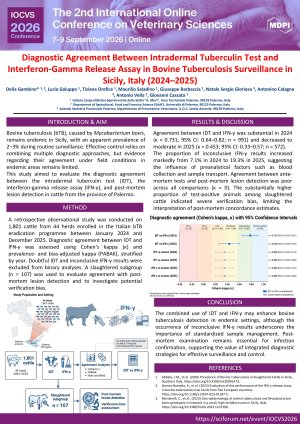
Introduction Bovine tuberculosis (bTB), caused by Mycobacterium bovis, remains endemic in Sicily, where apparent prevalence during routine screening ranges between 2% and 3%. Effective surveillance requires integrating multiple diagnostic tools; however, evidence on their concordance under operational conditions in high-prevalence settings is limited. This study assessed diagnostic agreement between the intradermal tuberculin test (IDT), the interferon-gamma release assay (IFN-γ), and post-mortem lesion detection in cattle from the province of Palermo.
Methods A retrospective observational study was conducted on 1,801 cattle from 44 herds enrolled in the national bTB eradication programme between January 2024 and December 2025. Pairwise agreement was assessed using Cohen's kappa (κ) and prevalence- and bias-adjusted kappa (PABAK), stratified by year. Non-definitive outcomes (doubtful IDT; inconclusive IFN-γ) were excluded from binary analyses. Verification bias in the slaughtered subgroup (n = 107) was evaluated by comparing test-positive proportions against the full cohort.
Results IDT–IFN-γ concordance was substantial in 2024 (κ = 0.731; 95% CI: 0.64–0.82; n = 991) and decreased to moderate in 2025 (κ = 0.453; 95% CI: 0.33–0.57; n = 572). Inconclusive IFN-γ results increased markedly from 7.1% to 19.3%. Agreement between ante-mortem tests and post-mortem lesion detection was poor across all comparisons, with kappa estimates close to zero and wide confidence intervals, consistent with severe verification bias (IDT positivity approximately six-fold higher among slaughtered animals).
Conclusions Parallel use of IDT and IFN-γ enhances herd-level detection in endemic settings. The marked increase in inconclusive IFN-γ results points to preanalytical sources of variability, blood collection and sample transport, as priority targets for procedural standardization. Post-mortem inspection is indispensable for official confirmation, but yields meaningful agreement estimates only when animals are selected for slaughter independently of their ante-mortem test result. Integrated diagnostic strategies remain critical for bTB control in persistently endemic regions.
Keywords
Bovine tubercolosis
Sicily
diagnostic
Poster
IOCVS 2026 Poster_Sciforum-186034.pdf
Distribution of Eimeria oocysts in cattle and sheep–goat farms in the Province of Palermo in the context of climate change (2024–2025)
High Prevalence of Multidrug-Resistant and Extended-Spectrum Beta-Lactamase-Producing Escherichia coli in Equine Uterine Infections: A One Health Concern