Event submissions
Published
This submission belongs to the session S3. Antimicrobial Resistance and Food Safety: A One Health Perspective of the event The 2nd International Online Conference on Veterinary Sciences
Published date
02 Sep, 2026
Academic Editor
'%3e%3cpath%20d='M12.6657%2010.9104C12.4185%2010.325%2012.0599%209.79327%2011.6097%209.34482C11.1609%208.89508%2010.6293%208.5365%2010.0442%208.28888C10.0389%208.28626%2010.0337%208.28495%2010.0285%208.28233C10.8446%207.69279%2011.3752%206.73249%2011.3752%205.64904C11.3752%203.8542%209.92103%202.39999%208.1262%202.39999C6.33136%202.39999%204.87715%203.8542%204.87715%205.64904C4.87715%206.73249%205.40774%207.69279%206.22393%208.28364C6.21869%208.28626%206.21345%208.28757%206.20821%208.29019C5.62129%208.5378%205.09463%208.89284%204.64265%209.34613C4.1929%209.79493%203.83432%2010.3266%203.58671%2010.9117C3.34345%2011.4845%203.21226%2012.0987%203.20023%2012.7209C3.19988%2012.7349%203.20233%2012.7488%203.20744%2012.7619C3.21255%2012.7749%203.22022%2012.7867%203.22998%2012.7968C3.23975%2012.8068%203.25142%2012.8147%203.26431%2012.8202C3.2772%2012.8256%203.29105%2012.8284%203.30504%2012.8284H4.09109C4.14874%2012.8284%204.19459%2012.7825%204.1959%2012.7262C4.2221%2011.7148%204.62823%2010.7676%205.34617%2010.0497C6.08899%209.30683%207.0755%208.89808%208.1262%208.89808C9.17689%208.89808%2010.1634%209.30683%2010.9062%2010.0497C11.6242%2010.7676%2012.0303%2011.7148%2012.0565%2012.7262C12.0578%2012.7838%2012.1037%2012.8284%2012.1613%2012.8284H12.9474C12.9613%2012.8284%2012.9752%2012.8256%2012.9881%2012.8202C13.001%2012.8147%2013.0126%2012.8068%2013.0224%2012.7968C13.0322%2012.7867%2013.0398%2012.7749%2013.0449%2012.7619C13.0501%2012.7488%2013.0525%2012.7349%2013.0522%2012.7209C13.0391%2012.0947%2012.9094%2011.4855%2012.6657%2010.9104ZM8.1262%207.9024C7.52486%207.9024%206.9589%207.6679%206.53312%207.24211C6.10733%206.81633%205.87283%206.25037%205.87283%205.64904C5.87283%205.0477%206.10733%204.48174%206.53312%204.05596C6.9589%203.63018%207.52486%203.39567%208.1262%203.39567C8.72753%203.39567%209.29349%203.63018%209.71927%204.05596C10.1451%204.48174%2010.3796%205.0477%2010.3796%205.64904C10.3796%206.25037%2010.1451%206.81633%209.71927%207.24211C9.29349%207.6679%208.72753%207.9024%208.1262%207.9024Z'%20fill='%235D1EE1'/%3e%3c/g%3e%3c/svg%3e) BeiBei Li
BeiBei LiCitation
Mohammad Manian, Hassan Momtaz, Mojtaba Kafi, Khorshid Rabiei Samani, Mohammadreza Nazem, Fazel sadeghian, High Prevalence of Multidrug-Resistant and Extended-Spectrum Beta-Lactamase-Producing Escherichia coli in Equine Uterine Infections: A One Health Concern, in Proceedings of The 2nd International Online Conference on Veterinary Sciences, 7 September–9 September 2026, MDPI: Basel, Switzerland
Share
Email
Facebook
Twitter
LinkedIn
High Prevalence of Multidrug-Resistant and Extended-Spectrum Beta-Lactamase-Producing Escherichia coli in Equine Uterine Infections: A One Health Concern
'%3e%3cpath%20d='M12.6647%2010.9104C12.4176%2010.325%2012.0589%209.7933%2011.6088%209.34485C11.16%208.89511%2010.6283%208.53653%2010.0432%208.28891C10.038%208.28629%2010.0327%208.28498%2010.0275%208.28236C10.8437%207.69282%2011.3743%206.73252%2011.3743%205.64907C11.3743%203.85423%209.92005%202.40002%208.12522%202.40002C6.33038%202.40002%204.87618%203.85423%204.87618%205.64907C4.87618%206.73252%205.40677%207.69282%206.22296%208.28367C6.21772%208.28629%206.21248%208.2876%206.20724%208.29022C5.62031%208.53783%205.09365%208.89287%204.64167%209.34616C4.19192%209.79496%203.83334%2010.3266%203.58573%2010.9117C3.34247%2011.4846%203.21128%2012.0987%203.19925%2012.721C3.1989%2012.735%203.20135%2012.7489%203.20646%2012.7619C3.21157%2012.7749%203.21924%2012.7868%203.22901%2012.7968C3.23877%2012.8068%203.25045%2012.8148%203.26334%2012.8202C3.27623%2012.8256%203.29007%2012.8284%203.30406%2012.8284H4.09012C4.14776%2012.8284%204.19362%2012.7825%204.19493%2012.7262C4.22113%2011.7148%204.62726%2010.7676%205.34519%2010.0497C6.08802%209.30686%207.07452%208.89811%208.12522%208.89811C9.17592%208.89811%2010.1624%209.30686%2010.9052%2010.0497C11.6232%2010.7676%2012.0293%2011.7148%2012.0555%2012.7262C12.0568%2012.7839%2012.1027%2012.8284%2012.1603%2012.8284H12.9464C12.9604%2012.8284%2012.9742%2012.8256%2012.9871%2012.8202C13%2012.8148%2013.0117%2012.8068%2013.0214%2012.7968C13.0312%2012.7868%2013.0389%2012.7749%2013.044%2012.7619C13.0491%2012.7489%2013.0515%2012.735%2013.0512%2012.721C13.0381%2012.0947%2012.9084%2011.4856%2012.6647%2010.9104ZM8.12522%207.90243C7.52388%207.90243%206.95792%207.66793%206.53214%207.24215C6.10636%206.81636%205.87185%206.2504%205.87185%205.64907C5.87185%205.04773%206.10636%204.48177%206.53214%204.05599C6.95792%203.63021%207.52388%203.3957%208.12522%203.3957C8.72655%203.3957%209.29252%203.63021%209.7183%204.05599C10.1441%204.48177%2010.3786%205.04773%2010.3786%205.64907C10.3786%206.2504%2010.1441%206.81636%209.7183%207.24215C9.29252%207.66793%208.72655%207.90243%208.12522%207.90243Z'%20fill='%235D1EE1'/%3e%3c/g%3e%3c/svg%3e)
Mohammad Manian 1
Hassan Momtaz 2
Mojtaba Kafi 3
Khorshid Rabiei Samani 4
Mohammadreza Nazem 5
Fazel sadeghian 1
1. Department of Clinical Sciences, School of Veterinary Medicine, Shiraz University, Shiraz
2. Department of Microbiology, Shahrekord Branch, Islamic Azad University, Shahrekord
3. Department of Animal Reproduction, School of Veterinary Medicine, Shiraz University, Shiraz
4. Faculty of Veterinary Medicine, Shahrekord Branch, Islamic Azad University, Shahrekord
5. Department of Clinical Sciences, Faculty of Veterinary Medicine, Shahrekord Branch, Islamic Azad University, Shahrekord
Abstract
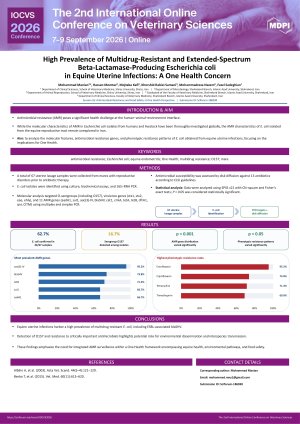
Introduction: Antimicrobial resistance (AMR) represents a major One Health challenge at the human–animal–environment interface. Although Escherichia coli from humans and livestock has been extensively studied, equine reproductive tract infections remain an underrecognized reservoir of resistance determinants. This study aimed to characterize the molecular features, antimicrobial resistance genes, and phenotypic resistance patterns of E. coli isolated from equine uterine infections, with emphasis on One Health implications.
Methods: A total of 67 uterine lavage samples were collected from mares with reproductive disorders prior to antibiotic therapy. E. coli isolates were identified using culture, biochemical assays, and 16S rRNA PCR. Molecular analysis targeted O-serogroups (including O157), virulence genes (stx1, stx2, eae, ehly), and 11 AMR genes (aadA1, sul1, aac(3)-IV, blaSHV, cat1, cmlA, tetA, tetB, dfrA1, qnr, CITM) using multiplex and simplex PCR. Antimicrobial susceptibility was assessed by disk diffusion against 13 antibiotics according to CLSI guidelines.
Results: E. coli was confirmed in 42/67 samples (62.7%). The most prevalent AMR genes were aac(3)-IV (95.2%), blaSHV (73.8%), tetB (71.4%), sul1 (66.7%), and aadA1 (66.7%). High phenotypic resistance rates were observed for enrofloxacin (95.2%), ciprofloxacin (73.8%), tetracycline (71.4%), and trimethoprim (69.0%). Serogroup O157 was detected in 16.7% of isolates. Significant variation was observed in AMR gene distribution (p < 0.001) and phenotypic resistance patterns (p < 0.05).
Conclusions: Equine uterine infections harbor a high prevalence of multidrug-resistant E. coli, including ESBL-associated blaSHV. Detection of O157 and resistance to critically important antimicrobials highlights potential risks for environmental dissemination and interspecies transmission. These findings emphasize the need for integrated AMR surveillance within a One Health framework encompassing equine health, environmental pathways, and food safety.
Keywords
antimicrobial resistance
Escherichia coli
equine endometritis
One Health
multidrug resistance
O157
mare
Poster
Equine_Ecoli_Poste.pdf
Diagnostic Agreement Between Intradermal Tuberculin Test and Interferon-Gamma Release Assay in Bovine Tuberculosis Surveillance in Sicily, Italy (2024–2025)
Antimicrobial Resistance in Pathogenic Bacteria from Endangered Fish: A One Health Approach to Emerging Zoonotic Threats