Event submissions
Published
This submission belongs to the session S3. Plastic and Composite Waste Recycling of the event The 1st International Online Conference on Recycling
Published date
03 Sep, 2026
Academic Editor
'%3e%3cpath%20d='M12.6657%2010.9104C12.4185%2010.325%2012.0599%209.79327%2011.6097%209.34482C11.1609%208.89508%2010.6293%208.5365%2010.0442%208.28888C10.0389%208.28626%2010.0337%208.28495%2010.0285%208.28233C10.8446%207.69279%2011.3752%206.73249%2011.3752%205.64904C11.3752%203.8542%209.92103%202.39999%208.1262%202.39999C6.33136%202.39999%204.87715%203.8542%204.87715%205.64904C4.87715%206.73249%205.40774%207.69279%206.22393%208.28364C6.21869%208.28626%206.21345%208.28757%206.20821%208.29019C5.62129%208.5378%205.09463%208.89284%204.64265%209.34613C4.1929%209.79493%203.83432%2010.3266%203.58671%2010.9117C3.34345%2011.4845%203.21226%2012.0987%203.20023%2012.7209C3.19988%2012.7349%203.20233%2012.7488%203.20744%2012.7619C3.21255%2012.7749%203.22022%2012.7867%203.22998%2012.7968C3.23975%2012.8068%203.25142%2012.8147%203.26431%2012.8202C3.2772%2012.8256%203.29105%2012.8284%203.30504%2012.8284H4.09109C4.14874%2012.8284%204.19459%2012.7825%204.1959%2012.7262C4.2221%2011.7148%204.62823%2010.7676%205.34617%2010.0497C6.08899%209.30683%207.0755%208.89808%208.1262%208.89808C9.17689%208.89808%2010.1634%209.30683%2010.9062%2010.0497C11.6242%2010.7676%2012.0303%2011.7148%2012.0565%2012.7262C12.0578%2012.7838%2012.1037%2012.8284%2012.1613%2012.8284H12.9474C12.9613%2012.8284%2012.9752%2012.8256%2012.9881%2012.8202C13.001%2012.8147%2013.0126%2012.8068%2013.0224%2012.7968C13.0322%2012.7867%2013.0398%2012.7749%2013.0449%2012.7619C13.0501%2012.7488%2013.0525%2012.7349%2013.0522%2012.7209C13.0391%2012.0947%2012.9094%2011.4855%2012.6657%2010.9104ZM8.1262%207.9024C7.52486%207.9024%206.9589%207.6679%206.53312%207.24211C6.10733%206.81633%205.87283%206.25037%205.87283%205.64904C5.87283%205.0477%206.10733%204.48174%206.53312%204.05596C6.9589%203.63018%207.52486%203.39567%208.1262%203.39567C8.72753%203.39567%209.29349%203.63018%209.71927%204.05596C10.1451%204.48174%2010.3796%205.0477%2010.3796%205.64904C10.3796%206.25037%2010.1451%206.81633%209.71927%207.24211C9.29349%207.6679%208.72753%207.9024%208.1262%207.9024Z'%20fill='%235D1EE1'/%3e%3c/g%3e%3c/svg%3e) Rossella Arrigo
Rossella ArrigoCitation
Mariana I. S. Aguiar, Daniela Espínola, Maria Inês C. Santos, João A. P. Coutinho, Ana P. M. Tavares, Frederik R. Wurm, Andreia F. Sousa, Ana M. Ferreira, Boosting laccase-mediated poly(vinyl alcohol) depolymerisation with polyol-based biosolvents, in Proceedings of The 1st International Online Conference on Recycling, 7 September–8 September 2026, MDPI: Basel, Switzerland
Share
Email
Facebook
Twitter
LinkedIn
Boosting laccase-mediated poly(vinyl alcohol) depolymerisation with polyol-based biosolvents
'%3e%3cpath%20d='M12.6647%2010.9104C12.4176%2010.325%2012.0589%209.7933%2011.6088%209.34485C11.16%208.89511%2010.6283%208.53653%2010.0432%208.28891C10.038%208.28629%2010.0327%208.28498%2010.0275%208.28236C10.8437%207.69282%2011.3743%206.73252%2011.3743%205.64907C11.3743%203.85423%209.92005%202.40002%208.12522%202.40002C6.33038%202.40002%204.87618%203.85423%204.87618%205.64907C4.87618%206.73252%205.40677%207.69282%206.22296%208.28367C6.21772%208.28629%206.21248%208.2876%206.20724%208.29022C5.62031%208.53783%205.09365%208.89287%204.64167%209.34616C4.19192%209.79496%203.83334%2010.3266%203.58573%2010.9117C3.34247%2011.4846%203.21128%2012.0987%203.19925%2012.721C3.1989%2012.735%203.20135%2012.7489%203.20646%2012.7619C3.21157%2012.7749%203.21924%2012.7868%203.22901%2012.7968C3.23877%2012.8068%203.25045%2012.8148%203.26334%2012.8202C3.27623%2012.8256%203.29007%2012.8284%203.30406%2012.8284H4.09012C4.14776%2012.8284%204.19362%2012.7825%204.19493%2012.7262C4.22113%2011.7148%204.62726%2010.7676%205.34519%2010.0497C6.08802%209.30686%207.07452%208.89811%208.12522%208.89811C9.17592%208.89811%2010.1624%209.30686%2010.9052%2010.0497C11.6232%2010.7676%2012.0293%2011.7148%2012.0555%2012.7262C12.0568%2012.7839%2012.1027%2012.8284%2012.1603%2012.8284H12.9464C12.9604%2012.8284%2012.9742%2012.8256%2012.9871%2012.8202C13%2012.8148%2013.0117%2012.8068%2013.0214%2012.7968C13.0312%2012.7868%2013.0389%2012.7749%2013.044%2012.7619C13.0491%2012.7489%2013.0515%2012.735%2013.0512%2012.721C13.0381%2012.0947%2012.9084%2011.4856%2012.6647%2010.9104ZM8.12522%207.90243C7.52388%207.90243%206.95792%207.66793%206.53214%207.24215C6.10636%206.81636%205.87185%206.2504%205.87185%205.64907C5.87185%205.04773%206.10636%204.48177%206.53214%204.05599C6.95792%203.63021%207.52388%203.3957%208.12522%203.3957C8.72655%203.3957%209.29252%203.63021%209.7183%204.05599C10.1441%204.48177%2010.3786%205.04773%2010.3786%205.64907C10.3786%206.2504%2010.1441%206.81636%209.7183%207.24215C9.29252%207.66793%208.72655%207.90243%208.12522%207.90243Z'%20fill='%235D1EE1'/%3e%3c/g%3e%3c/svg%3e)
Mariana I. S. Aguiar 1
Daniela Espínola 1
Maria Inês C. Santos 1
João A. P. Coutinho 1

Ana P. M. Tavares 1
Frederik R. Wurm 2

Andreia F. Sousa 1

Ana M. Ferreira 1
1. CICECO – Aveiro Institute of Materials, Department of Chemistry, University of Aveiro (UA), 3810-193, Aveiro, Portugal
2. Sustainable Polymer Chemistry, Department of Molecules & Materials, MESA+ Institute for Nanotechnology, University of Twente, P.O. Box 217, 7500 AE, Enschede, Netherlands
Abstract
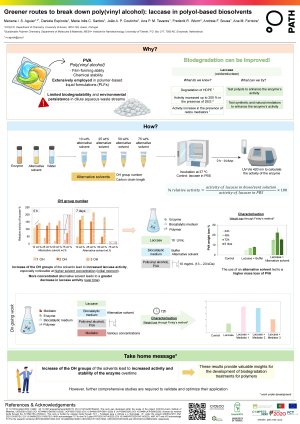
Polymer-based liquid formulations (PLFs) release persistent water-soluble polymers into aquatic environments. Poly(vinyl alcohol) (PVA) is particularly relevant because its film-forming properties and chemical stability, although useful in applications, hinder biodegradation of diluted waste streams in natural environments. While microbial PVA degradation has been reported, it often depends on pyrroloquinoline-quinone-dependent dehydrogenases, limiting broader implementation. This work explores laccase from Trametes versicolor as a cofactor-independent oxidative alternative, using bio-based polyols as non-conventional reaction media.
Polyols with different carbon chain lengths and hydroxyl contents were screened to understand how solvent polarity, hydrogen bonding and viscosity affect enzymatic behaviour. Laccase activity was monitored at pH 4.5 in buffer and aqueous polyol solutions over 14 days, followed by PVA depolymerisation assays in selected media. ABTS and TEMPO were tested as mediators, and a Design of Experiments strategy evaluated the combined effects of laccase concentration and polyol content.
Results showed that short-chain, highly hydroxylated polyols improved laccase performance, with glycerol giving approximately 200% higher apparent activity than buffer controls at 10–25 wt% after 7 days. Glycerol-containing media also promoted measurable PVA molecular weight reduction, indicating oxidative chain modification. Response surface modelling showed that optimal transformation occurred at intermediate enzyme and glycerol levels, rather than maximum values.
Overall, these findings highlight polyol-based biosolvents as promising sustainable media for enhancing enzymatic PVA depolymerisation and mitigating PLF-related polymer persistence.
This work was developed within the scope of the project CICECOAveiro Institute of Materials, UID/50011/2025 (DOI10.54499/UID/50011/2025) & LA/P/0006/2020 (DOI10.54499/LA/P/0006/2020), financed by national funds through the FCT/MCTES (PIDDAC). This work is funded by national funds through FCT – Fundação para a Ciência e a Tecnologia, I.P., under the projectGREEN-PATH (Ref.2023.15169.PEX,DOI10.54499/2023.15169.PEX). MISA acknowledges FCT for the Ph.D. grant PRT/BD/154714/2023. AMF, APT and AFS acknowledge FCT for the research contractsCEECIND/00361/2022 (DOI10.54499/2022.00361.CEECIND/CP1720/CT0020), CEECIND/01867/2020 andCEECINSTLA/00002/2022, respectively.
Keywords
Poly(vinyl alcohol)
Laccase
Polyol-based biosolvents
Enzymatic depolymerisation
Poster
Poster_092026_1stIOCRe2026_online.pdf
Environmental Benefits of Closed-Loop Recycling for Power Batteries: A Life Cycle Assessment of Regenerated Lithium-Ion Batteries
Intelligent Prediction of Compressive Strength for Cemented Tailings Backfill Using Bayesian Optimized Machine Learning