Event submissions
Published
This submission belongs to the session 2. Wildlife Ecotoxicology, Sentinel Species, and Ecosystem Health of the event The 3rd International Online Conference on Toxics
Published date
04 Sep, 2026
Academic Editor
'%3e%3cpath%20d='M12.6657%2010.9104C12.4185%2010.325%2012.0599%209.79327%2011.6097%209.34482C11.1609%208.89508%2010.6293%208.5365%2010.0442%208.28888C10.0389%208.28626%2010.0337%208.28495%2010.0285%208.28233C10.8446%207.69279%2011.3752%206.73249%2011.3752%205.64904C11.3752%203.8542%209.92103%202.39999%208.1262%202.39999C6.33136%202.39999%204.87715%203.8542%204.87715%205.64904C4.87715%206.73249%205.40774%207.69279%206.22393%208.28364C6.21869%208.28626%206.21345%208.28757%206.20821%208.29019C5.62129%208.5378%205.09463%208.89284%204.64265%209.34613C4.1929%209.79493%203.83432%2010.3266%203.58671%2010.9117C3.34345%2011.4845%203.21226%2012.0987%203.20023%2012.7209C3.19988%2012.7349%203.20233%2012.7488%203.20744%2012.7619C3.21255%2012.7749%203.22022%2012.7867%203.22998%2012.7968C3.23975%2012.8068%203.25142%2012.8147%203.26431%2012.8202C3.2772%2012.8256%203.29105%2012.8284%203.30504%2012.8284H4.09109C4.14874%2012.8284%204.19459%2012.7825%204.1959%2012.7262C4.2221%2011.7148%204.62823%2010.7676%205.34617%2010.0497C6.08899%209.30683%207.0755%208.89808%208.1262%208.89808C9.17689%208.89808%2010.1634%209.30683%2010.9062%2010.0497C11.6242%2010.7676%2012.0303%2011.7148%2012.0565%2012.7262C12.0578%2012.7838%2012.1037%2012.8284%2012.1613%2012.8284H12.9474C12.9613%2012.8284%2012.9752%2012.8256%2012.9881%2012.8202C13.001%2012.8147%2013.0126%2012.8068%2013.0224%2012.7968C13.0322%2012.7867%2013.0398%2012.7749%2013.0449%2012.7619C13.0501%2012.7488%2013.0525%2012.7349%2013.0522%2012.7209C13.0391%2012.0947%2012.9094%2011.4855%2012.6657%2010.9104ZM8.1262%207.9024C7.52486%207.9024%206.9589%207.6679%206.53312%207.24211C6.10733%206.81633%205.87283%206.25037%205.87283%205.64904C5.87283%205.0477%206.10733%204.48174%206.53312%204.05596C6.9589%203.63018%207.52486%203.39567%208.1262%203.39567C8.72753%203.39567%209.29349%203.63018%209.71927%204.05596C10.1451%204.48174%2010.3796%205.0477%2010.3796%205.64904C10.3796%206.25037%2010.1451%206.81633%209.71927%207.24211C9.29349%207.6679%208.72753%207.9024%208.1262%207.9024Z'%20fill='%235D1EE1'/%3e%3c/g%3e%3c/svg%3e) Carlos Barata
Carlos BarataCitation
Clara Naccari, Gaetano Cammilleri, Vincenzo Naccari, Giovanni Dell'Orfano, Paolo Rizzi, Gaetano Trevisi, Vincenzo Ferrantelli, Blue crab Callinectus sapidus a new sentinel species of metals pollution in Mediterranean Sea, in Proceedings of The 3rd International Online Conference on Toxics, 9 September–11 September 2026, MDPI: Basel, Switzerland
Share
Email
Facebook
Twitter
LinkedIn
Blue crab Callinectus sapidus a new sentinel species of metals pollution in Mediterranean Sea
'%3e%3cpath%20d='M12.6647%2010.9104C12.4176%2010.325%2012.0589%209.7933%2011.6088%209.34485C11.16%208.89511%2010.6283%208.53653%2010.0432%208.28891C10.038%208.28629%2010.0327%208.28498%2010.0275%208.28236C10.8437%207.69282%2011.3743%206.73252%2011.3743%205.64907C11.3743%203.85423%209.92005%202.40002%208.12522%202.40002C6.33038%202.40002%204.87618%203.85423%204.87618%205.64907C4.87618%206.73252%205.40677%207.69282%206.22296%208.28367C6.21772%208.28629%206.21248%208.2876%206.20724%208.29022C5.62031%208.53783%205.09365%208.89287%204.64167%209.34616C4.19192%209.79496%203.83334%2010.3266%203.58573%2010.9117C3.34247%2011.4846%203.21128%2012.0987%203.19925%2012.721C3.1989%2012.735%203.20135%2012.7489%203.20646%2012.7619C3.21157%2012.7749%203.21924%2012.7868%203.22901%2012.7968C3.23877%2012.8068%203.25045%2012.8148%203.26334%2012.8202C3.27623%2012.8256%203.29007%2012.8284%203.30406%2012.8284H4.09012C4.14776%2012.8284%204.19362%2012.7825%204.19493%2012.7262C4.22113%2011.7148%204.62726%2010.7676%205.34519%2010.0497C6.08802%209.30686%207.07452%208.89811%208.12522%208.89811C9.17592%208.89811%2010.1624%209.30686%2010.9052%2010.0497C11.6232%2010.7676%2012.0293%2011.7148%2012.0555%2012.7262C12.0568%2012.7839%2012.1027%2012.8284%2012.1603%2012.8284H12.9464C12.9604%2012.8284%2012.9742%2012.8256%2012.9871%2012.8202C13%2012.8148%2013.0117%2012.8068%2013.0214%2012.7968C13.0312%2012.7868%2013.0389%2012.7749%2013.044%2012.7619C13.0491%2012.7489%2013.0515%2012.735%2013.0512%2012.721C13.0381%2012.0947%2012.9084%2011.4856%2012.6647%2010.9104ZM8.12522%207.90243C7.52388%207.90243%206.95792%207.66793%206.53214%207.24215C6.10636%206.81636%205.87185%206.2504%205.87185%205.64907C5.87185%205.04773%206.10636%204.48177%206.53214%204.05599C6.95792%203.63021%207.52388%203.3957%208.12522%203.3957C8.72655%203.3957%209.29252%203.63021%209.7183%204.05599C10.1441%204.48177%2010.3786%205.04773%2010.3786%205.64907C10.3786%206.2504%2010.1441%206.81636%209.7183%207.24215C9.29252%207.66793%208.72655%207.90243%208.12522%207.90243Z'%20fill='%235D1EE1'/%3e%3c/g%3e%3c/svg%3e)
Clara Naccari 1
Gaetano Cammilleri 2
Vincenzo Naccari 3
Giovanni Dell'Orfano 3
Paolo Rizzi 3
Gaetano Trevisi 3
Vincenzo Ferrantelli 4
1. Department of Health Sciences, Univerisity "Magna Graecia" of Catanzaro, Catanzaro, 88100
2. Veterinary Health Institute of Sicily "A. Mirri ", Veterinary Health Institute of Sicily "A. Mirri ", Palermo, 90129
3. AUSL Ferrara, Via Arturo Cassoli, Ferrara, 44121
4. Veterinary Health Institute of Sicily "A. Mirri ", Veterinary Health Institute of Sicily "A. Mirri", Palermo, 90129
Abstract
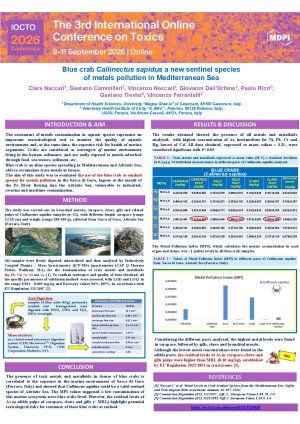
INTRODUCTION: Blue crab is an aline species spreading in Mediterranean and Adriatic Sea, able to accumulate trace metals in tissues. This study evaluated the use of the blue crab as sentinel species for metal pollution in the Sacca di Goro, lagoon at the mouth of the Po River flowing into the Adriatic Sea, vulnerable to industrial, riverine and maritime contamination.
METHODS: The study was carried out on bronchial muscle, carapace, claws, gills and related pulps of Callinectus sapidus samples (n=12) collected from Sacca of Goro, Adriatic Sea (Italy). All samples were digested and analyzed by ICP-MS for the determination of toxic metals and metalloids Hg, Pb, Cd, Cr, Ni and As [1].
RESULTS: The results confirmed the presence of highest concentration of As, intermediate for Ni, Pb, Cr and Hg, lowest of Cd. However, the Metal Pollution Index (MPI), related to metals accumulation in each tissue, was <1 (safety level). Considering the different parts analyzed, the highest metal levels were found in carapace, followed by gills, claws and bronchial muscle. The lowest concentrations were present in the pulps of carapace, claw and gill (the edible parts) but As was upper the MRL (0.10 mg/kg), established by EU Regulation 2025/1891 for crustaceans [2].
CONCLUSIONS: The presence of toxic metals and metalloids in tissues of blue crabs is correlated to the exposure in the marine environment of Sacca di Goro, showing that Callinecus sapidus could be a valid sentinel species of Adriatic Sea. The MPI values suggested a low contamination of this marine ecosystem; however, the residual levels of As in edible pulps (> MRL) highlight potential toxicological risks for consumer of this seafood.
REFERENCES:
[1] Naccari C et al. Metal Levels in Crab Sentinel Species from the Mediterranean Sea: Safety and Toxicological Risk Assessment. Animals, 16, 857, 2026; [2] Commission Regulation 2025/1891. Off. J. European Union L 18.9, 1-4.
Keywords
Callinectus sapidus
sentinel species
metals pollution
Mediterranean Sea
ICP-MS
Poster
Naccari C- POSTER IOCTO 2026.pdf
Testicular CNR1 and CNR2 expression in stray dogs from Campania Region, Italy: insights from a One Health sentinel model
Biochemical stress responses in Procambarus clarkii exposed to pristine and aged glitter