Event submissions
Published
This submission belongs to the session 2. Wildlife Ecotoxicology, Sentinel Species, and Ecosystem Health of the event The 3rd International Online Conference on Toxics
Published date
04 Sep, 2026
Academic Editor
'%3e%3cpath%20d='M12.6657%2010.9104C12.4185%2010.325%2012.0599%209.79327%2011.6097%209.34482C11.1609%208.89508%2010.6293%208.5365%2010.0442%208.28888C10.0389%208.28626%2010.0337%208.28495%2010.0285%208.28233C10.8446%207.69279%2011.3752%206.73249%2011.3752%205.64904C11.3752%203.8542%209.92103%202.39999%208.1262%202.39999C6.33136%202.39999%204.87715%203.8542%204.87715%205.64904C4.87715%206.73249%205.40774%207.69279%206.22393%208.28364C6.21869%208.28626%206.21345%208.28757%206.20821%208.29019C5.62129%208.5378%205.09463%208.89284%204.64265%209.34613C4.1929%209.79493%203.83432%2010.3266%203.58671%2010.9117C3.34345%2011.4845%203.21226%2012.0987%203.20023%2012.7209C3.19988%2012.7349%203.20233%2012.7488%203.20744%2012.7619C3.21255%2012.7749%203.22022%2012.7867%203.22998%2012.7968C3.23975%2012.8068%203.25142%2012.8147%203.26431%2012.8202C3.2772%2012.8256%203.29105%2012.8284%203.30504%2012.8284H4.09109C4.14874%2012.8284%204.19459%2012.7825%204.1959%2012.7262C4.2221%2011.7148%204.62823%2010.7676%205.34617%2010.0497C6.08899%209.30683%207.0755%208.89808%208.1262%208.89808C9.17689%208.89808%2010.1634%209.30683%2010.9062%2010.0497C11.6242%2010.7676%2012.0303%2011.7148%2012.0565%2012.7262C12.0578%2012.7838%2012.1037%2012.8284%2012.1613%2012.8284H12.9474C12.9613%2012.8284%2012.9752%2012.8256%2012.9881%2012.8202C13.001%2012.8147%2013.0126%2012.8068%2013.0224%2012.7968C13.0322%2012.7867%2013.0398%2012.7749%2013.0449%2012.7619C13.0501%2012.7488%2013.0525%2012.7349%2013.0522%2012.7209C13.0391%2012.0947%2012.9094%2011.4855%2012.6657%2010.9104ZM8.1262%207.9024C7.52486%207.9024%206.9589%207.6679%206.53312%207.24211C6.10733%206.81633%205.87283%206.25037%205.87283%205.64904C5.87283%205.0477%206.10733%204.48174%206.53312%204.05596C6.9589%203.63018%207.52486%203.39567%208.1262%203.39567C8.72753%203.39567%209.29349%203.63018%209.71927%204.05596C10.1451%204.48174%2010.3796%205.0477%2010.3796%205.64904C10.3796%206.25037%2010.1451%206.81633%209.71927%207.24211C9.29349%207.6679%208.72753%207.9024%208.1262%207.9024Z'%20fill='%235D1EE1'/%3e%3c/g%3e%3c/svg%3e) Jose V. Tarazona
Jose V. TarazonaCitation
Sara Futia, Paolo Pastorino, Montserrat Solé, Ambrosius Josef Martin Dörr, Barbara Caldaroni, Serena Anselmi, Camilla Mossotto, Alessandra Maganza, Alice Gabetti, Marino Prearo, Monia Renzi, Antonia Concetta Elia, Biochemical stress responses in Procambarus clarkii exposed to pristine and aged glitter, in Proceedings of The 3rd International Online Conference on Toxics, 9 September–11 September 2026, MDPI: Basel, Switzerland
Share
Email
Facebook
Twitter
LinkedIn
Biochemical stress responses in Procambarus clarkii exposed to pristine and aged glitter
'%3e%3cpath%20d='M12.6647%2010.9104C12.4176%2010.325%2012.0589%209.7933%2011.6088%209.34485C11.16%208.89511%2010.6283%208.53653%2010.0432%208.28891C10.038%208.28629%2010.0327%208.28498%2010.0275%208.28236C10.8437%207.69282%2011.3743%206.73252%2011.3743%205.64907C11.3743%203.85423%209.92005%202.40002%208.12522%202.40002C6.33038%202.40002%204.87618%203.85423%204.87618%205.64907C4.87618%206.73252%205.40677%207.69282%206.22296%208.28367C6.21772%208.28629%206.21248%208.2876%206.20724%208.29022C5.62031%208.53783%205.09365%208.89287%204.64167%209.34616C4.19192%209.79496%203.83334%2010.3266%203.58573%2010.9117C3.34247%2011.4846%203.21128%2012.0987%203.19925%2012.721C3.1989%2012.735%203.20135%2012.7489%203.20646%2012.7619C3.21157%2012.7749%203.21924%2012.7868%203.22901%2012.7968C3.23877%2012.8068%203.25045%2012.8148%203.26334%2012.8202C3.27623%2012.8256%203.29007%2012.8284%203.30406%2012.8284H4.09012C4.14776%2012.8284%204.19362%2012.7825%204.19493%2012.7262C4.22113%2011.7148%204.62726%2010.7676%205.34519%2010.0497C6.08802%209.30686%207.07452%208.89811%208.12522%208.89811C9.17592%208.89811%2010.1624%209.30686%2010.9052%2010.0497C11.6232%2010.7676%2012.0293%2011.7148%2012.0555%2012.7262C12.0568%2012.7839%2012.1027%2012.8284%2012.1603%2012.8284H12.9464C12.9604%2012.8284%2012.9742%2012.8256%2012.9871%2012.8202C13%2012.8148%2013.0117%2012.8068%2013.0214%2012.7968C13.0312%2012.7868%2013.0389%2012.7749%2013.044%2012.7619C13.0491%2012.7489%2013.0515%2012.735%2013.0512%2012.721C13.0381%2012.0947%2012.9084%2011.4856%2012.6647%2010.9104ZM8.12522%207.90243C7.52388%207.90243%206.95792%207.66793%206.53214%207.24215C6.10636%206.81636%205.87185%206.2504%205.87185%205.64907C5.87185%205.04773%206.10636%204.48177%206.53214%204.05599C6.95792%203.63021%207.52388%203.3957%208.12522%203.3957C8.72655%203.3957%209.29252%203.63021%209.7183%204.05599C10.1441%204.48177%2010.3786%205.04773%2010.3786%205.64907C10.3786%206.2504%2010.1441%206.81636%209.7183%207.24215C9.29252%207.66793%208.72655%207.90243%208.12522%207.90243Z'%20fill='%235D1EE1'/%3e%3c/g%3e%3c/svg%3e)
Sara Futia 1

Paolo Pastorino 2

Montserrat Solé 3
Ambrosius Josef Martin Dörr 1
Barbara Caldaroni 1
Serena Anselmi 4
Camilla Mossotto 2
Alessandra Maganza 2
Alice Gabetti 2

Marino Prearo 2

Monia Renzi 4,5

Antonia Concetta Elia 1
1. Department of Chemistry, Biology and Biotechnology, University of Perugia, Via Elce di Sotto, 8, Perugia, PG - 06123, Italy
2. The Veterinary Medical Research Institute for Piemonte, Liguria and Valle d’Aosta, 10154 Turin, Italy
3. Institute of Marine Sciences (ICM-CSIC), Pg. Marítim de la Barceloneta 37-49, 08003, Barcelona, Spain
4. Bioscience Research Center, via Aurelia Vecchia, 32, 58015 Orbetello, Italy
5. Department of Life Sciences, University of Trieste, 34127 Trieste, Italy
Abstract
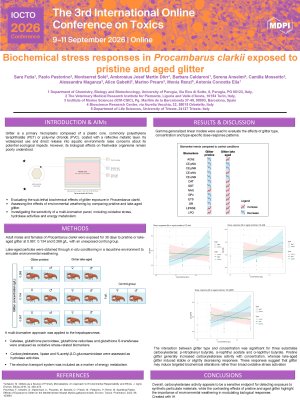
Glitter is a primary microplastic typically composed of a polyethylene terephthalate or polyvinyl chloride core coated with a reflective metallic layer, usually containing aluminium, titanium, iron or bismuth. Despite its widespread use and direct release into aquatic environments, its biological effects on freshwater organisms remain poorly understood. This study investigated sub-lethal biochemical responses to glitter exposure in the non-native crayfish Procambarus clarkii. Adult males and females were exposed for 30 days to pristine or lake-aged glitter at 0.067, 0.134 and 0.268 g/L, with an unexposed control group. Tested concentrations were selected from previous microplastic exposure studies, due to the limited availability of environmental concentration data for glitter. Lake-aged particles were obtained through in situ conditioning in a lacustrine environment to simulate environmental weathering. A multi-biomarker approach was applied to the hepatopancreas. Catalase, glutathione peroxidase, glutathione reductase and glutathione S-transferase were analysed as oxidative stress-related biomarkers, while carboxylesterases, lipase and N-acetyl-β-D-glucosaminidase were assessed as hydrolase activities. The electron transport system was included as a marker of energy metabolism. Gamma generalized linear models were used to evaluate the effects of glitter type, concentration and type-specific dose-response patterns. After false discovery rate correction, significant responses were mainly restricted to carboxylesterase activity. The interaction between glitter type and concentration was significant for carboxylesterase measurements with three substrates tested: p-nitrophenyl butyrate, α-naphthyl acetate and α-naphthyl butyrate. Pristine glitter generally increased carboxylesterase activity with concentration, whereas lake-aged glitter induced stable or slightly decreasing responses. Oxidative stress biomarkers did not show robust generalized effects. Overall, these findings indicate that glitter may induce targeted biochemical alterations rather than broad oxidative stress activation. Carboxylesterase activity appears to be a sensitive endpoint for detecting exposure to synthetic particulate materials, while the contrasting effects of pristine and aged glitter highlight the importance of environmental weathering in modulating biological responses.
Keywords
carboxylesterases
glitter particles
microplastics
multi-biomarker approach
swamp red crayfish
Poster
poster IOCTO 2026 Sara Futia .pdf
Blue crab Callinectus sapidus a new sentinel species of metals pollution in Mediterranean Sea
Ecotoxicological Risk of Sediments from the Salado River Using Earthworms (Eisenia sp.)