Event submissions
Published
This submission belongs to the session 2. Wildlife Ecotoxicology, Sentinel Species, and Ecosystem Health of the event The 3rd International Online Conference on Toxics
Published date
04 Sep, 2026
Academic Editor
'%3e%3cpath%20d='M12.6657%2010.9104C12.4185%2010.325%2012.0599%209.79327%2011.6097%209.34482C11.1609%208.89508%2010.6293%208.5365%2010.0442%208.28888C10.0389%208.28626%2010.0337%208.28495%2010.0285%208.28233C10.8446%207.69279%2011.3752%206.73249%2011.3752%205.64904C11.3752%203.8542%209.92103%202.39999%208.1262%202.39999C6.33136%202.39999%204.87715%203.8542%204.87715%205.64904C4.87715%206.73249%205.40774%207.69279%206.22393%208.28364C6.21869%208.28626%206.21345%208.28757%206.20821%208.29019C5.62129%208.5378%205.09463%208.89284%204.64265%209.34613C4.1929%209.79493%203.83432%2010.3266%203.58671%2010.9117C3.34345%2011.4845%203.21226%2012.0987%203.20023%2012.7209C3.19988%2012.7349%203.20233%2012.7488%203.20744%2012.7619C3.21255%2012.7749%203.22022%2012.7867%203.22998%2012.7968C3.23975%2012.8068%203.25142%2012.8147%203.26431%2012.8202C3.2772%2012.8256%203.29105%2012.8284%203.30504%2012.8284H4.09109C4.14874%2012.8284%204.19459%2012.7825%204.1959%2012.7262C4.2221%2011.7148%204.62823%2010.7676%205.34617%2010.0497C6.08899%209.30683%207.0755%208.89808%208.1262%208.89808C9.17689%208.89808%2010.1634%209.30683%2010.9062%2010.0497C11.6242%2010.7676%2012.0303%2011.7148%2012.0565%2012.7262C12.0578%2012.7838%2012.1037%2012.8284%2012.1613%2012.8284H12.9474C12.9613%2012.8284%2012.9752%2012.8256%2012.9881%2012.8202C13.001%2012.8147%2013.0126%2012.8068%2013.0224%2012.7968C13.0322%2012.7867%2013.0398%2012.7749%2013.0449%2012.7619C13.0501%2012.7488%2013.0525%2012.7349%2013.0522%2012.7209C13.0391%2012.0947%2012.9094%2011.4855%2012.6657%2010.9104ZM8.1262%207.9024C7.52486%207.9024%206.9589%207.6679%206.53312%207.24211C6.10733%206.81633%205.87283%206.25037%205.87283%205.64904C5.87283%205.0477%206.10733%204.48174%206.53312%204.05596C6.9589%203.63018%207.52486%203.39567%208.1262%203.39567C8.72753%203.39567%209.29349%203.63018%209.71927%204.05596C10.1451%204.48174%2010.3796%205.0477%2010.3796%205.64904C10.3796%206.25037%2010.1451%206.81633%209.71927%207.24211C9.29349%207.6679%208.72753%207.9024%208.1262%207.9024Z'%20fill='%235D1EE1'/%3e%3c/g%3e%3c/svg%3e) Jose V. Tarazona
Jose V. TarazonaCitation
Libertad Juárez-Santacruz, Josselin Olivarez-Aguilar, Edelmira García-Nieto, Angel Netzahual Lopantzi, Cuauhtémoc Morales-Cruz, Elia Briones-Corona, Maribel Méndez-Tepepa, Ecotoxicological Risk of Sediments from the Salado River Using Earthworms (Eisenia sp.), in Proceedings of The 3rd International Online Conference on Toxics, 9 September–11 September 2026, MDPI: Basel, Switzerland
Share
Email
Facebook
Twitter
LinkedIn
Ecotoxicological Risk of Sediments from the Salado River Using Earthworms (Eisenia sp.)
'%3e%3cpath%20d='M12.6647%2010.9104C12.4176%2010.325%2012.0589%209.7933%2011.6088%209.34485C11.16%208.89511%2010.6283%208.53653%2010.0432%208.28891C10.038%208.28629%2010.0327%208.28498%2010.0275%208.28236C10.8437%207.69282%2011.3743%206.73252%2011.3743%205.64907C11.3743%203.85423%209.92005%202.40002%208.12522%202.40002C6.33038%202.40002%204.87618%203.85423%204.87618%205.64907C4.87618%206.73252%205.40677%207.69282%206.22296%208.28367C6.21772%208.28629%206.21248%208.2876%206.20724%208.29022C5.62031%208.53783%205.09365%208.89287%204.64167%209.34616C4.19192%209.79496%203.83334%2010.3266%203.58573%2010.9117C3.34247%2011.4846%203.21128%2012.0987%203.19925%2012.721C3.1989%2012.735%203.20135%2012.7489%203.20646%2012.7619C3.21157%2012.7749%203.21924%2012.7868%203.22901%2012.7968C3.23877%2012.8068%203.25045%2012.8148%203.26334%2012.8202C3.27623%2012.8256%203.29007%2012.8284%203.30406%2012.8284H4.09012C4.14776%2012.8284%204.19362%2012.7825%204.19493%2012.7262C4.22113%2011.7148%204.62726%2010.7676%205.34519%2010.0497C6.08802%209.30686%207.07452%208.89811%208.12522%208.89811C9.17592%208.89811%2010.1624%209.30686%2010.9052%2010.0497C11.6232%2010.7676%2012.0293%2011.7148%2012.0555%2012.7262C12.0568%2012.7839%2012.1027%2012.8284%2012.1603%2012.8284H12.9464C12.9604%2012.8284%2012.9742%2012.8256%2012.9871%2012.8202C13%2012.8148%2013.0117%2012.8068%2013.0214%2012.7968C13.0312%2012.7868%2013.0389%2012.7749%2013.044%2012.7619C13.0491%2012.7489%2013.0515%2012.735%2013.0512%2012.721C13.0381%2012.0947%2012.9084%2011.4856%2012.6647%2010.9104ZM8.12522%207.90243C7.52388%207.90243%206.95792%207.66793%206.53214%207.24215C6.10636%206.81636%205.87185%206.2504%205.87185%205.64907C5.87185%205.04773%206.10636%204.48177%206.53214%204.05599C6.95792%203.63021%207.52388%203.3957%208.12522%203.3957C8.72655%203.3957%209.29252%203.63021%209.7183%204.05599C10.1441%204.48177%2010.3786%205.04773%2010.3786%205.64907C10.3786%206.2504%2010.1441%206.81636%209.7183%207.24215C9.29252%207.66793%208.72655%207.90243%208.12522%207.90243Z'%20fill='%235D1EE1'/%3e%3c/g%3e%3c/svg%3e)
Libertad Juárez-Santacruz 1
Josselin Olivarez-Aguilar 2
Edelmira García-Nieto 1
Angel Netzahual Lopantzi 1
Cuauhtémoc Morales-Cruz 1
Elia Briones-Corona 3

Maribel Méndez-Tepepa 1
1. Center for Genetic and Environmental Research (CIGyA-UATx), Autonomous University of Tlaxcala, Ixtacuixtla 90120, Tlaxcala, Mexico
2. Faculty of Agrobiology, Autonomous University of Tlaxcala, Ixtacuixtla 90120, Tlaxcala, Mexico
3. Environmental Sciences, Institute of Sciences, Meritorious Autonomous University of Puebla, Puebla 72570, Mexico
Abstract
Introduction
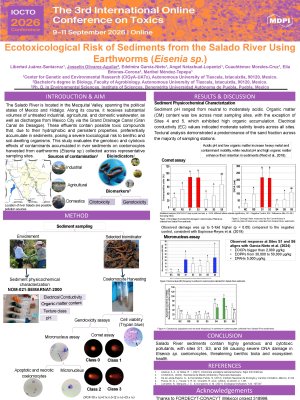
The Salado River is located in the Mezquital Valley, Mexico. Along its course, it receives large volumes of wastewater from industrial, agricultural, and mining activities, as well as effluents originating from Mexico City through the Grand Drainage Canal. These discharges contain toxic substances that, due to their physicochemical properties, accumulate in river sediments, posing a potential risk to organisms inhabiting this ecosystem. The aim of this study was to evaluate the genotoxic effects of contaminants accumulated in the sediments on the coelomocytes of earthworms (Eisenia sp.) collected from the river.
Methods
Ten earthworms (Eisenia sp.) were collected from each of five sampling sites distributed along the Salado River. In the laboratory, the organisms were placed in an extrusion solution to obtain coelomocytes. Genotoxicity was assessed using the micronucleus and comet assays. Cell viability was determined by the trypan blue exclusion test, and cytotoxicity was evaluated using the neutral red uptake assay. Statistical analyses were performed by comparing each sampling site with a reference site and a negative control using analysis of variance (ANOVA) followed by Tukey's post hoc test, with a significance level of p < 0.05.
Results
Earthworms collected from the Salado River exhibited cell viability greater than 80%, with no evidence of cytotoxic effects among sampling sites. DNA damage was detected through a statistically significant increase (p < 0.05) in both micronucleus frequency and DNA fragmentation compared with the reference site and the negative control.
Conclusions
The results indicate the presence of compounds with genotoxic potential in the river sediments, representing a risk to aquatic and terrestrial biota and potentially affecting overall ecosystem health.
Keywords
Eisenia sp.
genotoxicity
cytotoxicity
contamination
Poster
Cartel Cientifico Biol. Josselin Olivarez_compressed.pdf
Biochemical stress responses in Procambarus clarkii exposed to pristine and aged glitter
Coastal to Oceanic Comparison of Plastic Additive Accumulation in Northeast Atlantic Top Predator Sharks