Event submissions
Published
This submission belongs to the session 2. Wildlife Ecotoxicology, Sentinel Species, and Ecosystem Health of the event The 3rd International Online Conference on Toxics
Published date
04 Sep, 2026
Academic Editor
'%3e%3cpath%20d='M12.6657%2010.9104C12.4185%2010.325%2012.0599%209.79327%2011.6097%209.34482C11.1609%208.89508%2010.6293%208.5365%2010.0442%208.28888C10.0389%208.28626%2010.0337%208.28495%2010.0285%208.28233C10.8446%207.69279%2011.3752%206.73249%2011.3752%205.64904C11.3752%203.8542%209.92103%202.39999%208.1262%202.39999C6.33136%202.39999%204.87715%203.8542%204.87715%205.64904C4.87715%206.73249%205.40774%207.69279%206.22393%208.28364C6.21869%208.28626%206.21345%208.28757%206.20821%208.29019C5.62129%208.5378%205.09463%208.89284%204.64265%209.34613C4.1929%209.79493%203.83432%2010.3266%203.58671%2010.9117C3.34345%2011.4845%203.21226%2012.0987%203.20023%2012.7209C3.19988%2012.7349%203.20233%2012.7488%203.20744%2012.7619C3.21255%2012.7749%203.22022%2012.7867%203.22998%2012.7968C3.23975%2012.8068%203.25142%2012.8147%203.26431%2012.8202C3.2772%2012.8256%203.29105%2012.8284%203.30504%2012.8284H4.09109C4.14874%2012.8284%204.19459%2012.7825%204.1959%2012.7262C4.2221%2011.7148%204.62823%2010.7676%205.34617%2010.0497C6.08899%209.30683%207.0755%208.89808%208.1262%208.89808C9.17689%208.89808%2010.1634%209.30683%2010.9062%2010.0497C11.6242%2010.7676%2012.0303%2011.7148%2012.0565%2012.7262C12.0578%2012.7838%2012.1037%2012.8284%2012.1613%2012.8284H12.9474C12.9613%2012.8284%2012.9752%2012.8256%2012.9881%2012.8202C13.001%2012.8147%2013.0126%2012.8068%2013.0224%2012.7968C13.0322%2012.7867%2013.0398%2012.7749%2013.0449%2012.7619C13.0501%2012.7488%2013.0525%2012.7349%2013.0522%2012.7209C13.0391%2012.0947%2012.9094%2011.4855%2012.6657%2010.9104ZM8.1262%207.9024C7.52486%207.9024%206.9589%207.6679%206.53312%207.24211C6.10733%206.81633%205.87283%206.25037%205.87283%205.64904C5.87283%205.0477%206.10733%204.48174%206.53312%204.05596C6.9589%203.63018%207.52486%203.39567%208.1262%203.39567C8.72753%203.39567%209.29349%203.63018%209.71927%204.05596C10.1451%204.48174%2010.3796%205.0477%2010.3796%205.64904C10.3796%206.25037%2010.1451%206.81633%209.71927%207.24211C9.29349%207.6679%208.72753%207.9024%208.1262%207.9024Z'%20fill='%235D1EE1'/%3e%3c/g%3e%3c/svg%3e) Jose V. Tarazona
Jose V. TarazonaCitation
Sophia Vidal, Fábio Sousa, Jynn Eaton, Paloma Rodrigues, Eliana Mesquita, OCCURRENCE AND BIOACCUMULATION OF PFAS IN BIVALVE MOLLUSKS: A SYSTEMATIC REVIEW, in Proceedings of The 3rd International Online Conference on Toxics, 9 September–11 September 2026, MDPI: Basel, Switzerland
Share
Email
Facebook
Twitter
LinkedIn
OCCURRENCE AND BIOACCUMULATION OF PFAS IN BIVALVE MOLLUSKS: A SYSTEMATIC REVIEW
'%3e%3cpath%20d='M12.6647%2010.9104C12.4176%2010.325%2012.0589%209.7933%2011.6088%209.34485C11.16%208.89511%2010.6283%208.53653%2010.0432%208.28891C10.038%208.28629%2010.0327%208.28498%2010.0275%208.28236C10.8437%207.69282%2011.3743%206.73252%2011.3743%205.64907C11.3743%203.85423%209.92005%202.40002%208.12522%202.40002C6.33038%202.40002%204.87618%203.85423%204.87618%205.64907C4.87618%206.73252%205.40677%207.69282%206.22296%208.28367C6.21772%208.28629%206.21248%208.2876%206.20724%208.29022C5.62031%208.53783%205.09365%208.89287%204.64167%209.34616C4.19192%209.79496%203.83334%2010.3266%203.58573%2010.9117C3.34247%2011.4846%203.21128%2012.0987%203.19925%2012.721C3.1989%2012.735%203.20135%2012.7489%203.20646%2012.7619C3.21157%2012.7749%203.21924%2012.7868%203.22901%2012.7968C3.23877%2012.8068%203.25045%2012.8148%203.26334%2012.8202C3.27623%2012.8256%203.29007%2012.8284%203.30406%2012.8284H4.09012C4.14776%2012.8284%204.19362%2012.7825%204.19493%2012.7262C4.22113%2011.7148%204.62726%2010.7676%205.34519%2010.0497C6.08802%209.30686%207.07452%208.89811%208.12522%208.89811C9.17592%208.89811%2010.1624%209.30686%2010.9052%2010.0497C11.6232%2010.7676%2012.0293%2011.7148%2012.0555%2012.7262C12.0568%2012.7839%2012.1027%2012.8284%2012.1603%2012.8284H12.9464C12.9604%2012.8284%2012.9742%2012.8256%2012.9871%2012.8202C13%2012.8148%2013.0117%2012.8068%2013.0214%2012.7968C13.0312%2012.7868%2013.0389%2012.7749%2013.044%2012.7619C13.0491%2012.7489%2013.0515%2012.735%2013.0512%2012.721C13.0381%2012.0947%2012.9084%2011.4856%2012.6647%2010.9104ZM8.12522%207.90243C7.52388%207.90243%206.95792%207.66793%206.53214%207.24215C6.10636%206.81636%205.87185%206.2504%205.87185%205.64907C5.87185%205.04773%206.10636%204.48177%206.53214%204.05599C6.95792%203.63021%207.52388%203.3957%208.12522%203.3957C8.72655%203.3957%209.29252%203.63021%209.7183%204.05599C10.1441%204.48177%2010.3786%205.04773%2010.3786%205.64907C10.3786%206.2504%2010.1441%206.81636%209.7183%207.24215C9.29252%207.66793%208.72655%207.90243%208.12522%207.90243Z'%20fill='%235D1EE1'/%3e%3c/g%3e%3c/svg%3e)
Sophia Vidal 1
Fábio Sousa 2
Jynn Eaton 3
Paloma Rodrigues 4
Eliana Mesquita 5
1. Departamento de Tecnologia dos Alimentos (MTA), UFF - Universidade Federal Fluminense, Niterói
2. UFF - Universidade Federal Fluminense, Niterói
3. Diretório Acadêmico Vital Brazil Filho (DAVBF), UFF - Universidade Federal Fluminense, Niterói
4. Tecnologia dos Alimentos, UFF - Universidade Federal Fluminense, Niterói
5. Programa de Pós-Graduação em Medicina Veterinária, UFF - Universidade Federal Fluminense, Niterói
Abstract
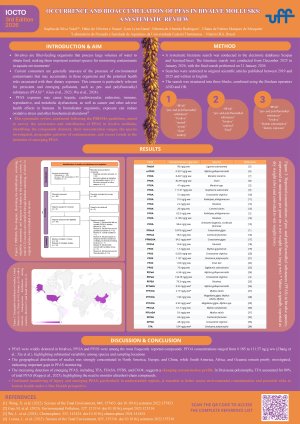
Per- and polyfluoroalkyl substances (PFAS) are persistent environmental contaminants that have been widely detected in aquatic ecosystems and seafood. Due to their filter-feeding behavior and bioaccumulation capacity, bivalve mollusks are considered important bioindicators of environmental contamination. This systematic review aimed to evaluate the occurrence and distribution of PFAS in bivalve mollusks and identify recent trends in contamination profiles. A systematic literature search was conducted in the Scopus and ScienceDirect databases, including original articles published between 2019 and 2025. After screening and eligibility assessment, 34 studies were included in the review. Most studies were conducted in North America, Europe, and China, revealing a significant geographic bias and limited information from developing regions. Legacy PFAS compounds, especially perfluorooctanoic acid (PFOA) and perfluorooctane sulfonate (PFOS), were the most frequently reported contaminants, while an increasing number of recent investigations reported emerging compounds such as including trifluoroacetic acid (TFA), FHxSA, PFBS and C6O4. PFOA concentrations ranged from 0.185 to 111.57 ng/g wet weight (ww), while PFOS concentrations ranged from 0.002 to 1137 ng/g ww, demonstrating substantial variability among species and locations. The most frequently investigated species were, Mytilus galloprovincialis, Crassostrea virginica, and Ruditapes philippinarum. The findings confirm the widespread occurrence of PFAS in bivalves and highlight concerns regarding environmental persistence and food safety. The increasing detection of replacement compounds emphasizes the need for continued monitoring and further investigation of their ecological and toxicological implications under a One Health perspective.
Keywords
perfluoroalkyl substances
emerging contaminants
aquatic pollution
shellfish
bioindicators
Poster
BANNER - CONTAMINANTES BIVALVES.pdf
Coastal to Oceanic Comparison of Plastic Additive Accumulation in Northeast Atlantic Top Predator Sharks
Ecological assessment of two Portuguese estuaries under contrasting urban pressure: Douro vs Lima