Event submissions
Published
This submission belongs to the session 2. Wildlife Ecotoxicology, Sentinel Species, and Ecosystem Health of the event The 3rd International Online Conference on Toxics
Published date
04 Sep, 2026
Academic Editor
'%3e%3cpath%20d='M12.6657%2010.9104C12.4185%2010.325%2012.0599%209.79327%2011.6097%209.34482C11.1609%208.89508%2010.6293%208.5365%2010.0442%208.28888C10.0389%208.28626%2010.0337%208.28495%2010.0285%208.28233C10.8446%207.69279%2011.3752%206.73249%2011.3752%205.64904C11.3752%203.8542%209.92103%202.39999%208.1262%202.39999C6.33136%202.39999%204.87715%203.8542%204.87715%205.64904C4.87715%206.73249%205.40774%207.69279%206.22393%208.28364C6.21869%208.28626%206.21345%208.28757%206.20821%208.29019C5.62129%208.5378%205.09463%208.89284%204.64265%209.34613C4.1929%209.79493%203.83432%2010.3266%203.58671%2010.9117C3.34345%2011.4845%203.21226%2012.0987%203.20023%2012.7209C3.19988%2012.7349%203.20233%2012.7488%203.20744%2012.7619C3.21255%2012.7749%203.22022%2012.7867%203.22998%2012.7968C3.23975%2012.8068%203.25142%2012.8147%203.26431%2012.8202C3.2772%2012.8256%203.29105%2012.8284%203.30504%2012.8284H4.09109C4.14874%2012.8284%204.19459%2012.7825%204.1959%2012.7262C4.2221%2011.7148%204.62823%2010.7676%205.34617%2010.0497C6.08899%209.30683%207.0755%208.89808%208.1262%208.89808C9.17689%208.89808%2010.1634%209.30683%2010.9062%2010.0497C11.6242%2010.7676%2012.0303%2011.7148%2012.0565%2012.7262C12.0578%2012.7838%2012.1037%2012.8284%2012.1613%2012.8284H12.9474C12.9613%2012.8284%2012.9752%2012.8256%2012.9881%2012.8202C13.001%2012.8147%2013.0126%2012.8068%2013.0224%2012.7968C13.0322%2012.7867%2013.0398%2012.7749%2013.0449%2012.7619C13.0501%2012.7488%2013.0525%2012.7349%2013.0522%2012.7209C13.0391%2012.0947%2012.9094%2011.4855%2012.6657%2010.9104ZM8.1262%207.9024C7.52486%207.9024%206.9589%207.6679%206.53312%207.24211C6.10733%206.81633%205.87283%206.25037%205.87283%205.64904C5.87283%205.0477%206.10733%204.48174%206.53312%204.05596C6.9589%203.63018%207.52486%203.39567%208.1262%203.39567C8.72753%203.39567%209.29349%203.63018%209.71927%204.05596C10.1451%204.48174%2010.3796%205.0477%2010.3796%205.64904C10.3796%206.25037%2010.1451%206.81633%209.71927%207.24211C9.29349%207.6679%208.72753%207.9024%208.1262%207.9024Z'%20fill='%235D1EE1'/%3e%3c/g%3e%3c/svg%3e) Jose V. Tarazona
Jose V. TarazonaCitation
Samuel Fernandes Santos, Marina Dolbeth, Sara C. Antunes, Ecological assessment of two Portuguese estuaries under contrasting urban pressure: Douro vs Lima, in Proceedings of The 3rd International Online Conference on Toxics, 9 September–11 September 2026, MDPI: Basel, Switzerland
Share
Email
Facebook
Twitter
LinkedIn
Ecological assessment of two Portuguese estuaries under contrasting urban pressure: Douro vs Lima
'%3e%3cpath%20d='M12.6647%2010.9104C12.4176%2010.325%2012.0589%209.7933%2011.6088%209.34485C11.16%208.89511%2010.6283%208.53653%2010.0432%208.28891C10.038%208.28629%2010.0327%208.28498%2010.0275%208.28236C10.8437%207.69282%2011.3743%206.73252%2011.3743%205.64907C11.3743%203.85423%209.92005%202.40002%208.12522%202.40002C6.33038%202.40002%204.87618%203.85423%204.87618%205.64907C4.87618%206.73252%205.40677%207.69282%206.22296%208.28367C6.21772%208.28629%206.21248%208.2876%206.20724%208.29022C5.62031%208.53783%205.09365%208.89287%204.64167%209.34616C4.19192%209.79496%203.83334%2010.3266%203.58573%2010.9117C3.34247%2011.4846%203.21128%2012.0987%203.19925%2012.721C3.1989%2012.735%203.20135%2012.7489%203.20646%2012.7619C3.21157%2012.7749%203.21924%2012.7868%203.22901%2012.7968C3.23877%2012.8068%203.25045%2012.8148%203.26334%2012.8202C3.27623%2012.8256%203.29007%2012.8284%203.30406%2012.8284H4.09012C4.14776%2012.8284%204.19362%2012.7825%204.19493%2012.7262C4.22113%2011.7148%204.62726%2010.7676%205.34519%2010.0497C6.08802%209.30686%207.07452%208.89811%208.12522%208.89811C9.17592%208.89811%2010.1624%209.30686%2010.9052%2010.0497C11.6232%2010.7676%2012.0293%2011.7148%2012.0555%2012.7262C12.0568%2012.7839%2012.1027%2012.8284%2012.1603%2012.8284H12.9464C12.9604%2012.8284%2012.9742%2012.8256%2012.9871%2012.8202C13%2012.8148%2013.0117%2012.8068%2013.0214%2012.7968C13.0312%2012.7868%2013.0389%2012.7749%2013.044%2012.7619C13.0491%2012.7489%2013.0515%2012.735%2013.0512%2012.721C13.0381%2012.0947%2012.9084%2011.4856%2012.6647%2010.9104ZM8.12522%207.90243C7.52388%207.90243%206.95792%207.66793%206.53214%207.24215C6.10636%206.81636%205.87185%206.2504%205.87185%205.64907C5.87185%205.04773%206.10636%204.48177%206.53214%204.05599C6.95792%203.63021%207.52388%203.3957%208.12522%203.3957C8.72655%203.3957%209.29252%203.63021%209.7183%204.05599C10.1441%204.48177%2010.3786%205.04773%2010.3786%205.64907C10.3786%206.2504%2010.1441%206.81636%209.7183%207.24215C9.29252%207.66793%208.72655%207.90243%208.12522%207.90243Z'%20fill='%235D1EE1'/%3e%3c/g%3e%3c/svg%3e)
Samuel Fernandes Santos 1
Marina Dolbeth 2

Sara C. Antunes 1,2
1. Department of Biology, Faculty of Science (FCUP), University of Porto, 4169-007 Porto, Portugal
2. Interdisciplinary Centre for Marine and Environmental Research (CIIMAR), University of Porto, Leixões Cruise Terminal, 4450-208 Matosinhos, Portugal
Abstract
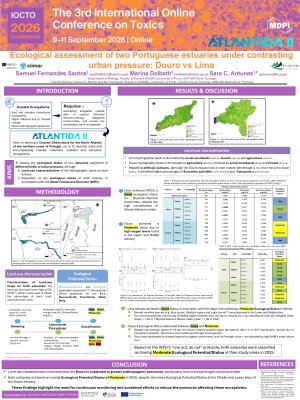
Background: Monitoring estuarine habitats has become an increasing priority, as ongoing urban development in surrounding areas has intensified the pressure already affecting these ecosystems. Therefore, this study aims to assess the ecological status of two estuaries subjected to contrasting levels of urban pressure: the Douro estuary, a highly urbanized ecosystem, and the Lima estuary, a less disturbed ecosystem mainly impacted by port activities. Methods: The characterization of the surrounding areas of both estuaries was carried out using the Land Occupation Map of Portugal. Three sampling sites were established in each estuary, corresponding to the lower, middle and upper reaches, with sampling campaigns in the Winter and Summer of 2025-2026. At each site, water and sediment samples were collected to evaluate nutrient concentrations, macroinvertebrate communities, organic matter content and sediment granulometry. All data were analysed in accordance with the Water Framework Directive. Results: Land-use characterization indicated that the Douro basin characterized by agricultural and forest areas (59%), with artificial areas (>5%) being concentrated close to the Douro estuary. The Lima basin is a more heterogeneous landscape, dominated by forest areas (64%), with considerable artificial (16%) and agricultural areas (15%). Nutrient concentrations reached only a good ecological status, primarily constrained by high PO43- concentrations exceeding reference values (>0.110). Macroinvertebrate community was more impacted in the Douro estuary, with lower diversity and dominated by tolerant species (e.g. Peringia ulvae), while the Lima estuary had sensitive species to polluted conditions (e.g. Abra tenuis), especially during Summer. Overall, the Douro estuary had coarser sediments (>55%) than the Lima which was muddier (36%), and both possessed low organic matter content (<5%). Conclusions: The influence of anthropogenic pressures was more pronounced in the Douro estuary than in the Lima estuary. Nevertheless, the ecological status for the analysed parameters achieved a classification of moderate in both systems.
Keywords
Water Framework Directive
Transitional water body
Ecological status
Poster
Poster- Toxics - Santos et al.pdf
OCCURRENCE AND BIOACCUMULATION OF PFAS IN BIVALVE MOLLUSKS: A SYSTEMATIC REVIEW
From streets to streams: Insights on the ecotoxicological effects of stormwater runoff on Danio rerio embryos