Event submissions
Published
This submission belongs to the session 2. Wildlife Ecotoxicology, Sentinel Species, and Ecosystem Health of the event The 3rd International Online Conference on Toxics
Published date
04 Sep, 2026
Academic Editor
'%3e%3cpath%20d='M12.6657%2010.9104C12.4185%2010.325%2012.0599%209.79327%2011.6097%209.34482C11.1609%208.89508%2010.6293%208.5365%2010.0442%208.28888C10.0389%208.28626%2010.0337%208.28495%2010.0285%208.28233C10.8446%207.69279%2011.3752%206.73249%2011.3752%205.64904C11.3752%203.8542%209.92103%202.39999%208.1262%202.39999C6.33136%202.39999%204.87715%203.8542%204.87715%205.64904C4.87715%206.73249%205.40774%207.69279%206.22393%208.28364C6.21869%208.28626%206.21345%208.28757%206.20821%208.29019C5.62129%208.5378%205.09463%208.89284%204.64265%209.34613C4.1929%209.79493%203.83432%2010.3266%203.58671%2010.9117C3.34345%2011.4845%203.21226%2012.0987%203.20023%2012.7209C3.19988%2012.7349%203.20233%2012.7488%203.20744%2012.7619C3.21255%2012.7749%203.22022%2012.7867%203.22998%2012.7968C3.23975%2012.8068%203.25142%2012.8147%203.26431%2012.8202C3.2772%2012.8256%203.29105%2012.8284%203.30504%2012.8284H4.09109C4.14874%2012.8284%204.19459%2012.7825%204.1959%2012.7262C4.2221%2011.7148%204.62823%2010.7676%205.34617%2010.0497C6.08899%209.30683%207.0755%208.89808%208.1262%208.89808C9.17689%208.89808%2010.1634%209.30683%2010.9062%2010.0497C11.6242%2010.7676%2012.0303%2011.7148%2012.0565%2012.7262C12.0578%2012.7838%2012.1037%2012.8284%2012.1613%2012.8284H12.9474C12.9613%2012.8284%2012.9752%2012.8256%2012.9881%2012.8202C13.001%2012.8147%2013.0126%2012.8068%2013.0224%2012.7968C13.0322%2012.7867%2013.0398%2012.7749%2013.0449%2012.7619C13.0501%2012.7488%2013.0525%2012.7349%2013.0522%2012.7209C13.0391%2012.0947%2012.9094%2011.4855%2012.6657%2010.9104ZM8.1262%207.9024C7.52486%207.9024%206.9589%207.6679%206.53312%207.24211C6.10733%206.81633%205.87283%206.25037%205.87283%205.64904C5.87283%205.0477%206.10733%204.48174%206.53312%204.05596C6.9589%203.63018%207.52486%203.39567%208.1262%203.39567C8.72753%203.39567%209.29349%203.63018%209.71927%204.05596C10.1451%204.48174%2010.3796%205.0477%2010.3796%205.64904C10.3796%206.25037%2010.1451%206.81633%209.71927%207.24211C9.29349%207.6679%208.72753%207.9024%208.1262%207.9024Z'%20fill='%235D1EE1'/%3e%3c/g%3e%3c/svg%3e) Jose V. Tarazona
Jose V. TarazonaCitation
Ana S. Oliveira, Bárbara S. Diogo, Sara C. Antunes, From streets to streams: Insights on the ecotoxicological effects of stormwater runoff on Danio rerio embryos, in Proceedings of The 3rd International Online Conference on Toxics, 9 September–11 September 2026, MDPI: Basel, Switzerland
Share
Email
Facebook
Twitter
LinkedIn
From streets to streams: Insights on the ecotoxicological effects of stormwater runoff on Danio rerio embryos
'%3e%3cpath%20d='M12.6647%2010.9104C12.4176%2010.325%2012.0589%209.7933%2011.6088%209.34485C11.16%208.89511%2010.6283%208.53653%2010.0432%208.28891C10.038%208.28629%2010.0327%208.28498%2010.0275%208.28236C10.8437%207.69282%2011.3743%206.73252%2011.3743%205.64907C11.3743%203.85423%209.92005%202.40002%208.12522%202.40002C6.33038%202.40002%204.87618%203.85423%204.87618%205.64907C4.87618%206.73252%205.40677%207.69282%206.22296%208.28367C6.21772%208.28629%206.21248%208.2876%206.20724%208.29022C5.62031%208.53783%205.09365%208.89287%204.64167%209.34616C4.19192%209.79496%203.83334%2010.3266%203.58573%2010.9117C3.34247%2011.4846%203.21128%2012.0987%203.19925%2012.721C3.1989%2012.735%203.20135%2012.7489%203.20646%2012.7619C3.21157%2012.7749%203.21924%2012.7868%203.22901%2012.7968C3.23877%2012.8068%203.25045%2012.8148%203.26334%2012.8202C3.27623%2012.8256%203.29007%2012.8284%203.30406%2012.8284H4.09012C4.14776%2012.8284%204.19362%2012.7825%204.19493%2012.7262C4.22113%2011.7148%204.62726%2010.7676%205.34519%2010.0497C6.08802%209.30686%207.07452%208.89811%208.12522%208.89811C9.17592%208.89811%2010.1624%209.30686%2010.9052%2010.0497C11.6232%2010.7676%2012.0293%2011.7148%2012.0555%2012.7262C12.0568%2012.7839%2012.1027%2012.8284%2012.1603%2012.8284H12.9464C12.9604%2012.8284%2012.9742%2012.8256%2012.9871%2012.8202C13%2012.8148%2013.0117%2012.8068%2013.0214%2012.7968C13.0312%2012.7868%2013.0389%2012.7749%2013.044%2012.7619C13.0491%2012.7489%2013.0515%2012.735%2013.0512%2012.721C13.0381%2012.0947%2012.9084%2011.4856%2012.6647%2010.9104ZM8.12522%207.90243C7.52388%207.90243%206.95792%207.66793%206.53214%207.24215C6.10636%206.81636%205.87185%206.2504%205.87185%205.64907C5.87185%205.04773%206.10636%204.48177%206.53214%204.05599C6.95792%203.63021%207.52388%203.3957%208.12522%203.3957C8.72655%203.3957%209.29252%203.63021%209.7183%204.05599C10.1441%204.48177%2010.3786%205.04773%2010.3786%205.64907C10.3786%206.2504%2010.1441%206.81636%209.7183%207.24215C9.29252%207.66793%208.72655%207.90243%208.12522%207.90243Z'%20fill='%235D1EE1'/%3e%3c/g%3e%3c/svg%3e)
Ana S. Oliveira 1

Bárbara S. Diogo 1,2,3

Sara C. Antunes 1,3
1. Department of Biology, Faculty of Sciences (FCUP), University of Porto, 4169-007 Porto, Portugal
2. Instituto de Ciências Biomédicas de Abel Salazar (ICBAS), University of Porto, 4050-313 Porto, Portugal
3. Interdisciplinary Centre of Marine and Environmental Research (CIIMAR), University of Porto, Terminal de Cruzeiros do Porto de Leixões, 4450-208 Matosinhos, Portugal
Abstract
Background: Stormwater runoff from urban areas is an alarming issue to aquatic ecosystems due to its capacity to transport a wide range of contaminants threatening aquatic organisms and compromising the ecosystem integrity. This study aims to evaluate the ecotoxicological effects of stormwater in Danio rerio embryos. Methods: Water samples were collected from three water bodies: Este river, Sousa river and Vale das flores stream. In each site, sampling took place in the upstream, stormwater outlet and downstream locations. Acute fish embryo toxicity assays were performed, evaluating survival, hatching success, and morphological alterations after 96 h in unfiltered water samples. Sub-individual parameters were also evaluated through the analysis of oxidative stress biomarkers (catalase – CAT, and glutathione S-transferases – GSTs activities, and thiobarbituric acid reactive substances – TBARS levels), neurotoxicity (acetylcholinesterase - AChE activity), and cellular energy allocation (CEA). Results: All sampling sites induced morphological abnormalities in D. rerio embryos (e.g., body curvature, hemagglutination and pericardial edema). Higher frequencies were observed in Este and Vale das Flores samples (5-25%). Sousa samples impaired embryo hatching, and caused highest mortality (>95%). Biomarkers responses varied among the studied water bodies. In the Este river, antioxidant system alterations suggest defensive mechanisms activation against oxidative damage, while changes in AChE activity indicate neurotoxic effects. Sousa samples evoked a pronounced toxic response, characterized by enhanced lipid peroxidation alongside alterations in AChE activity and CEA, indicating both oxidative damage and neurotoxicity. Vale das Flores samples caused occasional alterations in TBARS levels and CEA, nonetheless, consistent neurotoxic effects were observed. Conclusions: The results revealed distinct toxicity profiles among the urban-influenced water bodies. Sousa samples exerted the most severe effects on embryonic development. These findings highlight the sensitivity of early life stages to urban-associated stressors and reinforce the importance of incorporating ecotoxicological bioassays into monitoring strategies, improving the assessment/management of urban freshwater ecosystems.
Keywords
Water quality
Rainwater
Aquatic Ecosystems
Ecotoxicology
Zebrafish
Biomarkers
Poster
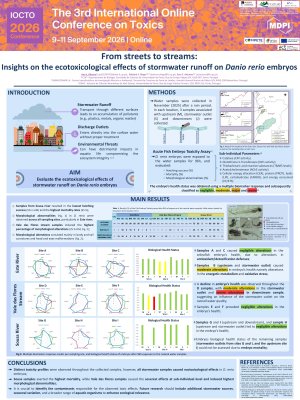
Ana S. Oliveira et al., - Poster for the 3rd International Online Conference on Toxics.pdf
Ecological assessment of two Portuguese estuaries under contrasting urban pressure: Douro vs Lima
Developmental and biochemical responses of Danio rerio embryos exposed to cyanobacteria