Event submissions
Published
This submission belongs to the session 2. Wildlife Ecotoxicology, Sentinel Species, and Ecosystem Health of the event The 3rd International Online Conference on Toxics
Published date
04 Sep, 2026
Academic Editor
'%3e%3cpath%20d='M12.6657%2010.9104C12.4185%2010.325%2012.0599%209.79327%2011.6097%209.34482C11.1609%208.89508%2010.6293%208.5365%2010.0442%208.28888C10.0389%208.28626%2010.0337%208.28495%2010.0285%208.28233C10.8446%207.69279%2011.3752%206.73249%2011.3752%205.64904C11.3752%203.8542%209.92103%202.39999%208.1262%202.39999C6.33136%202.39999%204.87715%203.8542%204.87715%205.64904C4.87715%206.73249%205.40774%207.69279%206.22393%208.28364C6.21869%208.28626%206.21345%208.28757%206.20821%208.29019C5.62129%208.5378%205.09463%208.89284%204.64265%209.34613C4.1929%209.79493%203.83432%2010.3266%203.58671%2010.9117C3.34345%2011.4845%203.21226%2012.0987%203.20023%2012.7209C3.19988%2012.7349%203.20233%2012.7488%203.20744%2012.7619C3.21255%2012.7749%203.22022%2012.7867%203.22998%2012.7968C3.23975%2012.8068%203.25142%2012.8147%203.26431%2012.8202C3.2772%2012.8256%203.29105%2012.8284%203.30504%2012.8284H4.09109C4.14874%2012.8284%204.19459%2012.7825%204.1959%2012.7262C4.2221%2011.7148%204.62823%2010.7676%205.34617%2010.0497C6.08899%209.30683%207.0755%208.89808%208.1262%208.89808C9.17689%208.89808%2010.1634%209.30683%2010.9062%2010.0497C11.6242%2010.7676%2012.0303%2011.7148%2012.0565%2012.7262C12.0578%2012.7838%2012.1037%2012.8284%2012.1613%2012.8284H12.9474C12.9613%2012.8284%2012.9752%2012.8256%2012.9881%2012.8202C13.001%2012.8147%2013.0126%2012.8068%2013.0224%2012.7968C13.0322%2012.7867%2013.0398%2012.7749%2013.0449%2012.7619C13.0501%2012.7488%2013.0525%2012.7349%2013.0522%2012.7209C13.0391%2012.0947%2012.9094%2011.4855%2012.6657%2010.9104ZM8.1262%207.9024C7.52486%207.9024%206.9589%207.6679%206.53312%207.24211C6.10733%206.81633%205.87283%206.25037%205.87283%205.64904C5.87283%205.0477%206.10733%204.48174%206.53312%204.05596C6.9589%203.63018%207.52486%203.39567%208.1262%203.39567C8.72753%203.39567%209.29349%203.63018%209.71927%204.05596C10.1451%204.48174%2010.3796%205.0477%2010.3796%205.64904C10.3796%206.25037%2010.1451%206.81633%209.71927%207.24211C9.29349%207.6679%208.72753%207.9024%208.1262%207.9024Z'%20fill='%235D1EE1'/%3e%3c/g%3e%3c/svg%3e) Jose V. Tarazona
Jose V. TarazonaCitation
Ivo Pinto, Luísa Azevedo, Sara C. Antunes, Developmental and biochemical responses of Danio rerio embryos exposed to cyanobacteria, in Proceedings of The 3rd International Online Conference on Toxics, 9 September–11 September 2026, MDPI: Basel, Switzerland
Share
Email
Facebook
Twitter
LinkedIn
Developmental and biochemical responses of Danio rerio embryos exposed to cyanobacteria
'%3e%3cpath%20d='M12.6647%2010.9104C12.4176%2010.325%2012.0589%209.7933%2011.6088%209.34485C11.16%208.89511%2010.6283%208.53653%2010.0432%208.28891C10.038%208.28629%2010.0327%208.28498%2010.0275%208.28236C10.8437%207.69282%2011.3743%206.73252%2011.3743%205.64907C11.3743%203.85423%209.92005%202.40002%208.12522%202.40002C6.33038%202.40002%204.87618%203.85423%204.87618%205.64907C4.87618%206.73252%205.40677%207.69282%206.22296%208.28367C6.21772%208.28629%206.21248%208.2876%206.20724%208.29022C5.62031%208.53783%205.09365%208.89287%204.64167%209.34616C4.19192%209.79496%203.83334%2010.3266%203.58573%2010.9117C3.34247%2011.4846%203.21128%2012.0987%203.19925%2012.721C3.1989%2012.735%203.20135%2012.7489%203.20646%2012.7619C3.21157%2012.7749%203.21924%2012.7868%203.22901%2012.7968C3.23877%2012.8068%203.25045%2012.8148%203.26334%2012.8202C3.27623%2012.8256%203.29007%2012.8284%203.30406%2012.8284H4.09012C4.14776%2012.8284%204.19362%2012.7825%204.19493%2012.7262C4.22113%2011.7148%204.62726%2010.7676%205.34519%2010.0497C6.08802%209.30686%207.07452%208.89811%208.12522%208.89811C9.17592%208.89811%2010.1624%209.30686%2010.9052%2010.0497C11.6232%2010.7676%2012.0293%2011.7148%2012.0555%2012.7262C12.0568%2012.7839%2012.1027%2012.8284%2012.1603%2012.8284H12.9464C12.9604%2012.8284%2012.9742%2012.8256%2012.9871%2012.8202C13%2012.8148%2013.0117%2012.8068%2013.0214%2012.7968C13.0312%2012.7868%2013.0389%2012.7749%2013.044%2012.7619C13.0491%2012.7489%2013.0515%2012.735%2013.0512%2012.721C13.0381%2012.0947%2012.9084%2011.4856%2012.6647%2010.9104ZM8.12522%207.90243C7.52388%207.90243%206.95792%207.66793%206.53214%207.24215C6.10636%206.81636%205.87185%206.2504%205.87185%205.64907C5.87185%205.04773%206.10636%204.48177%206.53214%204.05599C6.95792%203.63021%207.52388%203.3957%208.12522%203.3957C8.72655%203.3957%209.29252%203.63021%209.7183%204.05599C10.1441%204.48177%2010.3786%205.04773%2010.3786%205.64907C10.3786%206.2504%2010.1441%206.81636%209.7183%207.24215C9.29252%207.66793%208.72655%207.90243%208.12522%207.90243Z'%20fill='%235D1EE1'/%3e%3c/g%3e%3c/svg%3e)
Ivo Pinto 1,2,3,4
Luísa Azevedo 1,3,5

Sara C. Antunes 2,4
1. Instituto de Ciências Biomédicas de Abel Salazar (ICBAS), University of Porto, 4050-313 Porto, Portugal
2. Interdisciplinary Centre of Marine and Environmental Research (CIIMAR), University of Porto, Terminal de Cruzeiros do Porto de Leixões, 4450-208 Matosinhos, Portugal
3. Unit for Multidisciplinary Research in Biomedicine, School of Medicine and Biomedical Sciences, University of Porto, Rua Jorge Viterbo Ferreira 228, 4050-313 Porto, Portugal;
4. Department of Biology, Faculty of Sciences (FCUP), University of Porto, 4169-007 Porto, Portugal
5. Laboratory for Integrative and Translational Research in Population Health, Rua das Taipas 135, 4050-600 Porto, Portugal.
Abstract
Freshwater ecosystems are increasingly threatened by cyanobacteria blooms, which degrade water quality and affect aquatic organisms. Early life stages of fish are sensitive to environmental stressors and are therefore well suitable for ecotoxicological assessment. This study evaluated the effects of cyanobacteria on early developmental stages of Danio rerio embryos. Fish Embryo Acute Toxicity tests were conducted using the cyanobacteria Aphanizomenon flos-aquae and Microcystis aeruginosa to assess developmental endpoints and physiological responses, including oxidative stress, neurotoxicity, and energy metabolism. Embryos were exposed to cyanobacterial cell concentrations of 1.9 × 10⁴ (low risk), 7.5×10⁴ (medium risk), 1.5×10⁵ (high risk), 3.0×10⁵ (high risk), and 1.2×10⁶ (very high risk), according to World Health Organization. No mortality or effects on embryo size were observed across the treatments. Hatching was first recorded at 72 h, in agreement with standard guidelines, and after 96 h complete hatching occurred in all treatments except at the highest M. aeruginosa concentration (95%). Morphological abnormalities were absent at early stages and remained generally low throughout the assay. A. flos-aquae induced only minor and transient alterations, such as hemagglutination and spinal curvatures, whereas M. aeruginosa caused a higher frequency and diversity of abnormalities, including hypopigmentation, pericardial oedema, hemagglutination, spinal curvature, and absence of pectoral fins. A. flos-aquae exposure resulted in decreased catalase and glutathione S-transferases activities, while M. aeruginosa induced increases, suggesting activation of antioxidant and detoxification pathways. Lipid peroxidation levels and acetylcholinesterase activity remained largely unchanged, indicating limited oxidative damage and no clear neurotoxicity effects. Electron transport system activity increased under both exposures, reflecting elevated metabolic demand. Overall, both cyanobacteria elicited organism-level effects, while sub-individual responses revealed clear species-specific patterns, with M. aeruginosa causing stronger embryotoxic and physiological stress responses. These findings support the integration of sub-lethal endpoints into environmental monitoring, improving cyanobacteria risk assessment and ecosystem health evaluation.
Keywords
Water quality
Aphanizomenon flos-aquae
Microcystis aeruginosa
Fish Embryo Acute Toxicity
Zebrafish
Poster
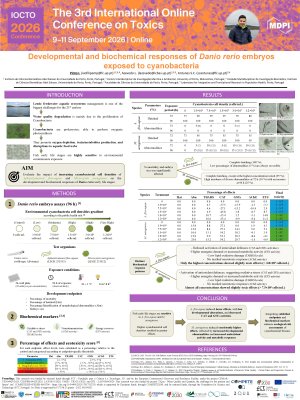
Pinto et al. Toxics_Poster.pdf
From streets to streams: Insights on the ecotoxicological effects of stormwater runoff on Danio rerio embryos
Effects of Arsenic Exposure on Oxidative and Cellular Stress in Lymnaea stagnalis