Event submissions
Published
This submission belongs to the session 2. Wildlife Ecotoxicology, Sentinel Species, and Ecosystem Health of the event The 3rd International Online Conference on Toxics
Published date
04 Sep, 2026
Academic Editor
'%3e%3cpath%20d='M12.6657%2010.9104C12.4185%2010.325%2012.0599%209.79327%2011.6097%209.34482C11.1609%208.89508%2010.6293%208.5365%2010.0442%208.28888C10.0389%208.28626%2010.0337%208.28495%2010.0285%208.28233C10.8446%207.69279%2011.3752%206.73249%2011.3752%205.64904C11.3752%203.8542%209.92103%202.39999%208.1262%202.39999C6.33136%202.39999%204.87715%203.8542%204.87715%205.64904C4.87715%206.73249%205.40774%207.69279%206.22393%208.28364C6.21869%208.28626%206.21345%208.28757%206.20821%208.29019C5.62129%208.5378%205.09463%208.89284%204.64265%209.34613C4.1929%209.79493%203.83432%2010.3266%203.58671%2010.9117C3.34345%2011.4845%203.21226%2012.0987%203.20023%2012.7209C3.19988%2012.7349%203.20233%2012.7488%203.20744%2012.7619C3.21255%2012.7749%203.22022%2012.7867%203.22998%2012.7968C3.23975%2012.8068%203.25142%2012.8147%203.26431%2012.8202C3.2772%2012.8256%203.29105%2012.8284%203.30504%2012.8284H4.09109C4.14874%2012.8284%204.19459%2012.7825%204.1959%2012.7262C4.2221%2011.7148%204.62823%2010.7676%205.34617%2010.0497C6.08899%209.30683%207.0755%208.89808%208.1262%208.89808C9.17689%208.89808%2010.1634%209.30683%2010.9062%2010.0497C11.6242%2010.7676%2012.0303%2011.7148%2012.0565%2012.7262C12.0578%2012.7838%2012.1037%2012.8284%2012.1613%2012.8284H12.9474C12.9613%2012.8284%2012.9752%2012.8256%2012.9881%2012.8202C13.001%2012.8147%2013.0126%2012.8068%2013.0224%2012.7968C13.0322%2012.7867%2013.0398%2012.7749%2013.0449%2012.7619C13.0501%2012.7488%2013.0525%2012.7349%2013.0522%2012.7209C13.0391%2012.0947%2012.9094%2011.4855%2012.6657%2010.9104ZM8.1262%207.9024C7.52486%207.9024%206.9589%207.6679%206.53312%207.24211C6.10733%206.81633%205.87283%206.25037%205.87283%205.64904C5.87283%205.0477%206.10733%204.48174%206.53312%204.05596C6.9589%203.63018%207.52486%203.39567%208.1262%203.39567C8.72753%203.39567%209.29349%203.63018%209.71927%204.05596C10.1451%204.48174%2010.3796%205.0477%2010.3796%205.64904C10.3796%206.25037%2010.1451%206.81633%209.71927%207.24211C9.29349%207.6679%208.72753%207.9024%208.1262%207.9024Z'%20fill='%235D1EE1'/%3e%3c/g%3e%3c/svg%3e) Jose V. Tarazona
Jose V. TarazonaCitation
Sabrina Balsamo, Teresa Chianese, Luigi Rosati, Rosaria Scudiero, Hepatic and Reproductive Toxicity of Glyphosate Exposure in the Terrestrial Bioindicator Podarcis siculus, in Proceedings of The 3rd International Online Conference on Toxics, 9 September–11 September 2026, MDPI: Basel, Switzerland
Share
Email
Facebook
Twitter
LinkedIn
Hepatic and Reproductive Toxicity of Glyphosate Exposure in the Terrestrial Bioindicator Podarcis siculus
'%3e%3cpath%20d='M12.6647%2010.9104C12.4176%2010.325%2012.0589%209.7933%2011.6088%209.34485C11.16%208.89511%2010.6283%208.53653%2010.0432%208.28891C10.038%208.28629%2010.0327%208.28498%2010.0275%208.28236C10.8437%207.69282%2011.3743%206.73252%2011.3743%205.64907C11.3743%203.85423%209.92005%202.40002%208.12522%202.40002C6.33038%202.40002%204.87618%203.85423%204.87618%205.64907C4.87618%206.73252%205.40677%207.69282%206.22296%208.28367C6.21772%208.28629%206.21248%208.2876%206.20724%208.29022C5.62031%208.53783%205.09365%208.89287%204.64167%209.34616C4.19192%209.79496%203.83334%2010.3266%203.58573%2010.9117C3.34247%2011.4846%203.21128%2012.0987%203.19925%2012.721C3.1989%2012.735%203.20135%2012.7489%203.20646%2012.7619C3.21157%2012.7749%203.21924%2012.7868%203.22901%2012.7968C3.23877%2012.8068%203.25045%2012.8148%203.26334%2012.8202C3.27623%2012.8256%203.29007%2012.8284%203.30406%2012.8284H4.09012C4.14776%2012.8284%204.19362%2012.7825%204.19493%2012.7262C4.22113%2011.7148%204.62726%2010.7676%205.34519%2010.0497C6.08802%209.30686%207.07452%208.89811%208.12522%208.89811C9.17592%208.89811%2010.1624%209.30686%2010.9052%2010.0497C11.6232%2010.7676%2012.0293%2011.7148%2012.0555%2012.7262C12.0568%2012.7839%2012.1027%2012.8284%2012.1603%2012.8284H12.9464C12.9604%2012.8284%2012.9742%2012.8256%2012.9871%2012.8202C13%2012.8148%2013.0117%2012.8068%2013.0214%2012.7968C13.0312%2012.7868%2013.0389%2012.7749%2013.044%2012.7619C13.0491%2012.7489%2013.0515%2012.735%2013.0512%2012.721C13.0381%2012.0947%2012.9084%2011.4856%2012.6647%2010.9104ZM8.12522%207.90243C7.52388%207.90243%206.95792%207.66793%206.53214%207.24215C6.10636%206.81636%205.87185%206.2504%205.87185%205.64907C5.87185%205.04773%206.10636%204.48177%206.53214%204.05599C6.95792%203.63021%207.52388%203.3957%208.12522%203.3957C8.72655%203.3957%209.29252%203.63021%209.7183%204.05599C10.1441%204.48177%2010.3786%205.04773%2010.3786%205.64907C10.3786%206.2504%2010.1441%206.81636%209.7183%207.24215C9.29252%207.66793%208.72655%207.90243%208.12522%207.90243Z'%20fill='%235D1EE1'/%3e%3c/g%3e%3c/svg%3e)
Sabrina Balsamo 1
Teresa Chianese 1

Luigi Rosati 1

Rosaria Scudiero 1
1. Department of Biology, University of Naples Federico II, Via Cinthia, Edificio 7, 80126 Naples, Italy
Abstract
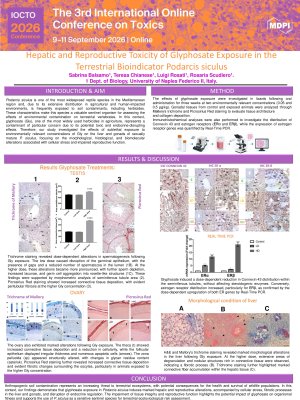
Soil contamination represents a critical threat to terrestrial biodiversity, yet wild vertebrates remain underutilized in environmental risk assessments. This study evaluates the field lizard Podarcis siculus as a resilient wild model organism to investigate the hepatic and reproductive toxicity of the widely used herbicide glyphosate (Gly). Sexually mature specimens of both sexes were orally exposed to two environmentally relevant concentrations of Gly (0.05 and 0.5 µg/kg body weight) for three weeks on alternate days. Following euthanasia, the liver and gonads were processed for multidisciplinary morphological, histochemical, and biomolecular analyses.
The results revealed severe tissue impairment and cellular stress across all treated groups, starting from the lowest concentration tested. Histological observations highlighted a marked disorganization of the tissue architecture. Extensive collagen deposition was recorded between hepatocytes and sinusoids in the liver, as well as between ovarian follicles and seminiferous tubules, indicating a generalized fibrotic process. In the liver, a distinct increase in granules of glycogen, melanin, and lipofuscin was observed. Reproductive tissues showed dramatic alterations; males exhibited impaired spermatogenesis, characterized by a reduction in spermatozoa along with thinning and gaps in the seminiferous tubule walls. In females, a severe disorganization of the follicular theca, granulosa, and zona pellucida occurred, accompanied by the proliferation of small follicular stem cells and apoptosis of pyriform cells.
Biochemically, cellular stress was confirmed by the overexpression of superoxide dismutase 1, glutathione peroxidase 1, and metallothionein. Furthermore, Gly acted as a potent endocrine disruptor, altering the expression and localization of estrogen receptors alpha and beta in all examined tissues. This xenoestrogenic effect was confirmed by the aberrant induction of vitellogenin synthesis in the male liver. In conclusion, sublethal glyphosate exposure severely compromises tissue integrity, glucose metabolism, and fertility in P. siculus, validating this species as a sensitive sentinel for terrestrial ecotoxicology.
Keywords
Glyphosate
Reproductive Toxicology
Endocrine Disruption
Liver Fibrosis
Reptiles
Podarcis siculus.
Poster
poster Balsamo Sabrina.pdf
Effects of Arsenic Exposure on Oxidative and Cellular Stress in Lymnaea stagnalis
Assessment of Pb neurotoxicity in European brown bears: Evidence from Pb–Ca associations and oxidative stress biomarkers