Event submissions
Published
This submission belongs to the session 2. Wildlife Ecotoxicology, Sentinel Species, and Ecosystem Health of the event The 3rd International Online Conference on Toxics
Published date
04 Sep, 2026
Academic Editor
'%3e%3cpath%20d='M12.6657%2010.9104C12.4185%2010.325%2012.0599%209.79327%2011.6097%209.34482C11.1609%208.89508%2010.6293%208.5365%2010.0442%208.28888C10.0389%208.28626%2010.0337%208.28495%2010.0285%208.28233C10.8446%207.69279%2011.3752%206.73249%2011.3752%205.64904C11.3752%203.8542%209.92103%202.39999%208.1262%202.39999C6.33136%202.39999%204.87715%203.8542%204.87715%205.64904C4.87715%206.73249%205.40774%207.69279%206.22393%208.28364C6.21869%208.28626%206.21345%208.28757%206.20821%208.29019C5.62129%208.5378%205.09463%208.89284%204.64265%209.34613C4.1929%209.79493%203.83432%2010.3266%203.58671%2010.9117C3.34345%2011.4845%203.21226%2012.0987%203.20023%2012.7209C3.19988%2012.7349%203.20233%2012.7488%203.20744%2012.7619C3.21255%2012.7749%203.22022%2012.7867%203.22998%2012.7968C3.23975%2012.8068%203.25142%2012.8147%203.26431%2012.8202C3.2772%2012.8256%203.29105%2012.8284%203.30504%2012.8284H4.09109C4.14874%2012.8284%204.19459%2012.7825%204.1959%2012.7262C4.2221%2011.7148%204.62823%2010.7676%205.34617%2010.0497C6.08899%209.30683%207.0755%208.89808%208.1262%208.89808C9.17689%208.89808%2010.1634%209.30683%2010.9062%2010.0497C11.6242%2010.7676%2012.0303%2011.7148%2012.0565%2012.7262C12.0578%2012.7838%2012.1037%2012.8284%2012.1613%2012.8284H12.9474C12.9613%2012.8284%2012.9752%2012.8256%2012.9881%2012.8202C13.001%2012.8147%2013.0126%2012.8068%2013.0224%2012.7968C13.0322%2012.7867%2013.0398%2012.7749%2013.0449%2012.7619C13.0501%2012.7488%2013.0525%2012.7349%2013.0522%2012.7209C13.0391%2012.0947%2012.9094%2011.4855%2012.6657%2010.9104ZM8.1262%207.9024C7.52486%207.9024%206.9589%207.6679%206.53312%207.24211C6.10733%206.81633%205.87283%206.25037%205.87283%205.64904C5.87283%205.0477%206.10733%204.48174%206.53312%204.05596C6.9589%203.63018%207.52486%203.39567%208.1262%203.39567C8.72753%203.39567%209.29349%203.63018%209.71927%204.05596C10.1451%204.48174%2010.3796%205.0477%2010.3796%205.64904C10.3796%206.25037%2010.1451%206.81633%209.71927%207.24211C9.29349%207.6679%208.72753%207.9024%208.1262%207.9024Z'%20fill='%235D1EE1'/%3e%3c/g%3e%3c/svg%3e) Jose V. Tarazona
Jose V. TarazonaCitation
Suzana Žunec, Dubravka Rašić, Maja Lazarus, Ankica Sekovanić, Agnieszka Sergiel, Đuro Huber, Assessment of Pb neurotoxicity in European brown bears: Evidence from Pb–Ca associations and oxidative stress biomarkers, in Proceedings of The 3rd International Online Conference on Toxics, 9 September–11 September 2026, MDPI: Basel, Switzerland
Share
Email
Facebook
Twitter
LinkedIn
Assessment of Pb neurotoxicity in European brown bears: Evidence from Pb–Ca associations and oxidative stress biomarkers

Suzana Žunec 1
'%3e%3cpath%20d='M12.6647%2010.9104C12.4176%2010.325%2012.0589%209.7933%2011.6088%209.34485C11.16%208.89511%2010.6283%208.53653%2010.0432%208.28891C10.038%208.28629%2010.0327%208.28498%2010.0275%208.28236C10.8437%207.69282%2011.3743%206.73252%2011.3743%205.64907C11.3743%203.85423%209.92005%202.40002%208.12522%202.40002C6.33038%202.40002%204.87618%203.85423%204.87618%205.64907C4.87618%206.73252%205.40677%207.69282%206.22296%208.28367C6.21772%208.28629%206.21248%208.2876%206.20724%208.29022C5.62031%208.53783%205.09365%208.89287%204.64167%209.34616C4.19192%209.79496%203.83334%2010.3266%203.58573%2010.9117C3.34247%2011.4846%203.21128%2012.0987%203.19925%2012.721C3.1989%2012.735%203.20135%2012.7489%203.20646%2012.7619C3.21157%2012.7749%203.21924%2012.7868%203.22901%2012.7968C3.23877%2012.8068%203.25045%2012.8148%203.26334%2012.8202C3.27623%2012.8256%203.29007%2012.8284%203.30406%2012.8284H4.09012C4.14776%2012.8284%204.19362%2012.7825%204.19493%2012.7262C4.22113%2011.7148%204.62726%2010.7676%205.34519%2010.0497C6.08802%209.30686%207.07452%208.89811%208.12522%208.89811C9.17592%208.89811%2010.1624%209.30686%2010.9052%2010.0497C11.6232%2010.7676%2012.0293%2011.7148%2012.0555%2012.7262C12.0568%2012.7839%2012.1027%2012.8284%2012.1603%2012.8284H12.9464C12.9604%2012.8284%2012.9742%2012.8256%2012.9871%2012.8202C13%2012.8148%2013.0117%2012.8068%2013.0214%2012.7968C13.0312%2012.7868%2013.0389%2012.7749%2013.044%2012.7619C13.0491%2012.7489%2013.0515%2012.735%2013.0512%2012.721C13.0381%2012.0947%2012.9084%2011.4856%2012.6647%2010.9104ZM8.12522%207.90243C7.52388%207.90243%206.95792%207.66793%206.53214%207.24215C6.10636%206.81636%205.87185%206.2504%205.87185%205.64907C5.87185%205.04773%206.10636%204.48177%206.53214%204.05599C6.95792%203.63021%207.52388%203.3957%208.12522%203.3957C8.72655%203.3957%209.29252%203.63021%209.7183%204.05599C10.1441%204.48177%2010.3786%205.04773%2010.3786%205.64907C10.3786%206.2504%2010.1441%206.81636%209.7183%207.24215C9.29252%207.66793%208.72655%207.90243%208.12522%207.90243Z'%20fill='%235D1EE1'/%3e%3c/g%3e%3c/svg%3e)
Dubravka Rašić 1

Maja Lazarus 2
Ankica Sekovanić 2
Agnieszka Sergiel 3
Đuro Huber 4
1. Division of Toxicology, Institute for Medical Research and Occupational Health, Zagreb, Croatia
2. Division of Occupational and Environmental Health, Institute for Medical Research and Occupational Health, Zagreb, Croatia
3. Department of Wildlife Conservation, Institute of Nature Conservation of Polish Academy of Sciences, Kraków, Poland
4. Department of Biology, University of Zagreb Faculty of Veterinary Medicine, Zagreb, Croatia
Abstract
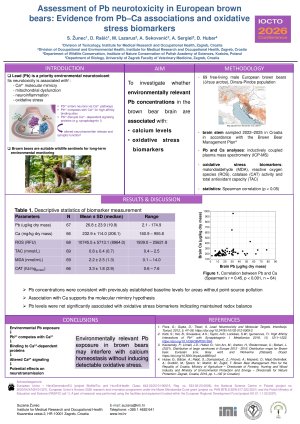
Throughout the last decades, our research group has monitored non-essential trace element levels in brown bears (Ursus arctos) from the Dinara-Pindos population to assess exposure to these environmental pollutants, their impact on health, and the risk of chronic toxicity. Lead (Pb) is a high-priority neurotoxicant whose mechanisms of toxicity include molecular mimicry, oxidative stress, mitochondrial dysfunction and neuroinflammation. Given the brain’s limited capacity to compensate for toxic damage, this study aimed to investigate the most probable mechanisms by examining the associations between Pb and calcium (Ca) levels as well as biomarkers of oxidative stress. Brain stem samples were collected from 69 free-living brown bears hunted in Croatia between 2022 and 2025 in accordance with the Brown Bear Management Plan. Elements were quantified by inductively coupled plasma-mass spectrometry (ICP-MS). Levels of oxidative stress biomarkers malondialdehyde (MDA), reactive oxygen species (ROS), catalase (CAT) activity and total antioxidant capacity (TAC) were measured in tissue homogenates. Brain Pb levels (mean ± SD, median, range: 26.8 ± 23.9, 19.9, 2.11–175 μg/kg dry mass) did not exceed values considered normal for cattle (used as a reference due to the lack of species-specific reference values). A moderate positive association was observed between Pb and the essential Ca (Spearman’s r = 0.45, p = 0.000172, n = 64). This correlation may reflect divalent cation mimicry, whereby Pb²⁺ mimics Ca²⁺ by binding to similar sites and entering cells via Ca²⁺ channels. No significant relationships were observed between Pb levels and the investigated oxidative stress biomarkers thereby implying successful maintenance of redox balance in conditions of environmental exposure. This study suggests that Pb levels detected in the bear brain are unlikely to induce oxidative stress, while confirming an association between Pb and Ca, a key essential element involved in brain function.
Keywords
brown bear
biomonitoring
brain
trace elements
redox homeostasis
Poster
186505_Poster_Suzana Žunec.pdf
Hepatic and Reproductive Toxicity of Glyphosate Exposure in the Terrestrial Bioindicator Podarcis siculus
Bioaccumulation of trace metals and oxidative stress responses in Apis mellifera across different land use types