Event submissions
Published
This submission belongs to the session 2. Wildlife Ecotoxicology, Sentinel Species, and Ecosystem Health of the event The 3rd International Online Conference on Toxics
Published date
04 Sep, 2026
Academic Editor
'%3e%3cpath%20d='M12.6657%2010.9104C12.4185%2010.325%2012.0599%209.79327%2011.6097%209.34482C11.1609%208.89508%2010.6293%208.5365%2010.0442%208.28888C10.0389%208.28626%2010.0337%208.28495%2010.0285%208.28233C10.8446%207.69279%2011.3752%206.73249%2011.3752%205.64904C11.3752%203.8542%209.92103%202.39999%208.1262%202.39999C6.33136%202.39999%204.87715%203.8542%204.87715%205.64904C4.87715%206.73249%205.40774%207.69279%206.22393%208.28364C6.21869%208.28626%206.21345%208.28757%206.20821%208.29019C5.62129%208.5378%205.09463%208.89284%204.64265%209.34613C4.1929%209.79493%203.83432%2010.3266%203.58671%2010.9117C3.34345%2011.4845%203.21226%2012.0987%203.20023%2012.7209C3.19988%2012.7349%203.20233%2012.7488%203.20744%2012.7619C3.21255%2012.7749%203.22022%2012.7867%203.22998%2012.7968C3.23975%2012.8068%203.25142%2012.8147%203.26431%2012.8202C3.2772%2012.8256%203.29105%2012.8284%203.30504%2012.8284H4.09109C4.14874%2012.8284%204.19459%2012.7825%204.1959%2012.7262C4.2221%2011.7148%204.62823%2010.7676%205.34617%2010.0497C6.08899%209.30683%207.0755%208.89808%208.1262%208.89808C9.17689%208.89808%2010.1634%209.30683%2010.9062%2010.0497C11.6242%2010.7676%2012.0303%2011.7148%2012.0565%2012.7262C12.0578%2012.7838%2012.1037%2012.8284%2012.1613%2012.8284H12.9474C12.9613%2012.8284%2012.9752%2012.8256%2012.9881%2012.8202C13.001%2012.8147%2013.0126%2012.8068%2013.0224%2012.7968C13.0322%2012.7867%2013.0398%2012.7749%2013.0449%2012.7619C13.0501%2012.7488%2013.0525%2012.7349%2013.0522%2012.7209C13.0391%2012.0947%2012.9094%2011.4855%2012.6657%2010.9104ZM8.1262%207.9024C7.52486%207.9024%206.9589%207.6679%206.53312%207.24211C6.10733%206.81633%205.87283%206.25037%205.87283%205.64904C5.87283%205.0477%206.10733%204.48174%206.53312%204.05596C6.9589%203.63018%207.52486%203.39567%208.1262%203.39567C8.72753%203.39567%209.29349%203.63018%209.71927%204.05596C10.1451%204.48174%2010.3796%205.0477%2010.3796%205.64904C10.3796%206.25037%2010.1451%206.81633%209.71927%207.24211C9.29349%207.6679%208.72753%207.9024%208.1262%207.9024Z'%20fill='%235D1EE1'/%3e%3c/g%3e%3c/svg%3e) Jose V. Tarazona
Jose V. TarazonaCitation
Barbara Caldaroni, Matteo Pallottini, Roberta Selvaggi, David Michele Cappelletti, Federica Bruschi, Chiara Petroselli, Sara Futia, Tiziano Gardi, Enzo Goretti, Rebecca Gentile, Antonia Concetta Elia, Bioaccumulation of trace metals and oxidative stress responses in Apis mellifera across different land use types, in Proceedings of The 3rd International Online Conference on Toxics, 9 September–11 September 2026, MDPI: Basel, Switzerland
Share
Email
Facebook
Twitter
LinkedIn
Bioaccumulation of trace metals and oxidative stress responses in Apis mellifera across different land use types
'%3e%3cpath%20d='M12.6647%2010.9104C12.4176%2010.325%2012.0589%209.7933%2011.6088%209.34485C11.16%208.89511%2010.6283%208.53653%2010.0432%208.28891C10.038%208.28629%2010.0327%208.28498%2010.0275%208.28236C10.8437%207.69282%2011.3743%206.73252%2011.3743%205.64907C11.3743%203.85423%209.92005%202.40002%208.12522%202.40002C6.33038%202.40002%204.87618%203.85423%204.87618%205.64907C4.87618%206.73252%205.40677%207.69282%206.22296%208.28367C6.21772%208.28629%206.21248%208.2876%206.20724%208.29022C5.62031%208.53783%205.09365%208.89287%204.64167%209.34616C4.19192%209.79496%203.83334%2010.3266%203.58573%2010.9117C3.34247%2011.4846%203.21128%2012.0987%203.19925%2012.721C3.1989%2012.735%203.20135%2012.7489%203.20646%2012.7619C3.21157%2012.7749%203.21924%2012.7868%203.22901%2012.7968C3.23877%2012.8068%203.25045%2012.8148%203.26334%2012.8202C3.27623%2012.8256%203.29007%2012.8284%203.30406%2012.8284H4.09012C4.14776%2012.8284%204.19362%2012.7825%204.19493%2012.7262C4.22113%2011.7148%204.62726%2010.7676%205.34519%2010.0497C6.08802%209.30686%207.07452%208.89811%208.12522%208.89811C9.17592%208.89811%2010.1624%209.30686%2010.9052%2010.0497C11.6232%2010.7676%2012.0293%2011.7148%2012.0555%2012.7262C12.0568%2012.7839%2012.1027%2012.8284%2012.1603%2012.8284H12.9464C12.9604%2012.8284%2012.9742%2012.8256%2012.9871%2012.8202C13%2012.8148%2013.0117%2012.8068%2013.0214%2012.7968C13.0312%2012.7868%2013.0389%2012.7749%2013.044%2012.7619C13.0491%2012.7489%2013.0515%2012.735%2013.0512%2012.721C13.0381%2012.0947%2012.9084%2011.4856%2012.6647%2010.9104ZM8.12522%207.90243C7.52388%207.90243%206.95792%207.66793%206.53214%207.24215C6.10636%206.81636%205.87185%206.2504%205.87185%205.64907C5.87185%205.04773%206.10636%204.48177%206.53214%204.05599C6.95792%203.63021%207.52388%203.3957%208.12522%203.3957C8.72655%203.3957%209.29252%203.63021%209.7183%204.05599C10.1441%204.48177%2010.3786%205.04773%2010.3786%205.64907C10.3786%206.2504%2010.1441%206.81636%209.7183%207.24215C9.29252%207.66793%208.72655%207.90243%208.12522%207.90243Z'%20fill='%235D1EE1'/%3e%3c/g%3e%3c/svg%3e)
Barbara Caldaroni 1
Matteo Pallottini 1
Roberta Selvaggi 1

David Michele Cappelletti 1
Federica Bruschi 1
Chiara Petroselli 1
Sara Futia 1
Tiziano Gardi 2
Enzo Goretti 1
Rebecca Gentile 1

Antonia Concetta Elia 1
1. Department of Chemistry, Biology and Biotechnology, University of Perugia, Perugia
2. Dipartimento di Scienze Agrarie, University of Perugia, Borgo XX Giugno, Perugia, PG - 06121, Italy
Abstract
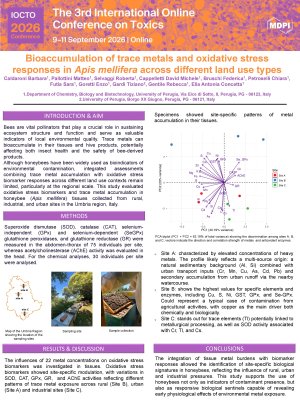
Bees are vital pollinators that play a crucial role in sustaining ecosystem structure and function and serve as valuable indicators of local environmental quality. Trace metals can bioaccumulate in their tissues and hive products, potentially affecting both insect health and the safety of bee-derived products. Although honeybees have been widely used as bioindicators of environmental contamination, integrated assessments combining trace metal accumulation with oxidative stress biomarker responses across different land use contexts remain limited, particularly at the regional scale. This study evaluated oxidative stress biomarkers and trace metal accumulation in honeybee (Apis mellifera) tissues collected from rural, industrial and urban sites in the Umbria region, Italy, using a total of 30 (trace metals) and 75 (biomarkers) individuals per site. Specimens showed site-specific patterns of metal accumulation in their tissues. In the rural site, higher Cu concentrations were detected, likely associated with agricultural activities. Conversely, the urban site was characterized by elevated Cd and Pb levels, probably related to vehicular traffic, while the industrial site exhibited higher Tl concentrations, potentially linked to metallurgical processing. The influences of trace metal concentrations on oxidative stress biomarkers were investigated in the abdomen-thorax tissues and in the heads. Oxidative stress biomarkers showed site-specific modulation, with variations in superoxide dismutase, catalase, glutathione peroxidase, glutathione reductase and cholinesterase activities reflecting different patterns of trace metal exposure across rural, urban and industrial sites. Overall, the integration of tissue metal burdens with biomarker responses allowed the identification of site-specific biological signatures in honeybees, reflecting the influence of rural, urban and industrial pressures. This evidence supports the use of honeybees not only as indicators of contaminant presence, but also as responsive biological sentinels capable of revealing early physiological effects of environmental metal exposure.
Keywords
Honey bee
oxidative stress biomarkers
trace metals
land use
Poster
Poster Caldaroni et al. Toxic 2026.pdf
Assessment of Pb neurotoxicity in European brown bears: Evidence from Pb–Ca associations and oxidative stress biomarkers
Integrated Ecotoxicological Assessment of Hematological, Oxidative Stress, Genotoxic, and Histopathological Biomarkers in Bighead Carp (Aristichthys nobilis) Exposed to Bisphenol A