Event submissions
Published
This submission belongs to the session 2. Wildlife Ecotoxicology, Sentinel Species, and Ecosystem Health of the event The 3rd International Online Conference on Toxics
Published date
04 Sep, 2026
Academic Editor
'%3e%3cpath%20d='M12.6657%2010.9104C12.4185%2010.325%2012.0599%209.79327%2011.6097%209.34482C11.1609%208.89508%2010.6293%208.5365%2010.0442%208.28888C10.0389%208.28626%2010.0337%208.28495%2010.0285%208.28233C10.8446%207.69279%2011.3752%206.73249%2011.3752%205.64904C11.3752%203.8542%209.92103%202.39999%208.1262%202.39999C6.33136%202.39999%204.87715%203.8542%204.87715%205.64904C4.87715%206.73249%205.40774%207.69279%206.22393%208.28364C6.21869%208.28626%206.21345%208.28757%206.20821%208.29019C5.62129%208.5378%205.09463%208.89284%204.64265%209.34613C4.1929%209.79493%203.83432%2010.3266%203.58671%2010.9117C3.34345%2011.4845%203.21226%2012.0987%203.20023%2012.7209C3.19988%2012.7349%203.20233%2012.7488%203.20744%2012.7619C3.21255%2012.7749%203.22022%2012.7867%203.22998%2012.7968C3.23975%2012.8068%203.25142%2012.8147%203.26431%2012.8202C3.2772%2012.8256%203.29105%2012.8284%203.30504%2012.8284H4.09109C4.14874%2012.8284%204.19459%2012.7825%204.1959%2012.7262C4.2221%2011.7148%204.62823%2010.7676%205.34617%2010.0497C6.08899%209.30683%207.0755%208.89808%208.1262%208.89808C9.17689%208.89808%2010.1634%209.30683%2010.9062%2010.0497C11.6242%2010.7676%2012.0303%2011.7148%2012.0565%2012.7262C12.0578%2012.7838%2012.1037%2012.8284%2012.1613%2012.8284H12.9474C12.9613%2012.8284%2012.9752%2012.8256%2012.9881%2012.8202C13.001%2012.8147%2013.0126%2012.8068%2013.0224%2012.7968C13.0322%2012.7867%2013.0398%2012.7749%2013.0449%2012.7619C13.0501%2012.7488%2013.0525%2012.7349%2013.0522%2012.7209C13.0391%2012.0947%2012.9094%2011.4855%2012.6657%2010.9104ZM8.1262%207.9024C7.52486%207.9024%206.9589%207.6679%206.53312%207.24211C6.10733%206.81633%205.87283%206.25037%205.87283%205.64904C5.87283%205.0477%206.10733%204.48174%206.53312%204.05596C6.9589%203.63018%207.52486%203.39567%208.1262%203.39567C8.72753%203.39567%209.29349%203.63018%209.71927%204.05596C10.1451%204.48174%2010.3796%205.0477%2010.3796%205.64904C10.3796%206.25037%2010.1451%206.81633%209.71927%207.24211C9.29349%207.6679%208.72753%207.9024%208.1262%207.9024Z'%20fill='%235D1EE1'/%3e%3c/g%3e%3c/svg%3e) Jose V. Tarazona
Jose V. TarazonaCitation
Esmeralda Sierra Romano, Rafael Valencia-Quintana, Mirta Milić, Juana Sánchez-Alarcón, Optimisation of coelomocyte extrusion for genotoxicity biomonitoring in Eisenia fétida, in Proceedings of The 3rd International Online Conference on Toxics, 9 September–11 September 2026, MDPI: Basel, Switzerland
Share
Email
Facebook
Twitter
LinkedIn
Optimisation of coelomocyte extrusion for genotoxicity biomonitoring in Eisenia fétida
'%3e%3cpath%20d='M12.6647%2010.9104C12.4176%2010.325%2012.0589%209.7933%2011.6088%209.34485C11.16%208.89511%2010.6283%208.53653%2010.0432%208.28891C10.038%208.28629%2010.0327%208.28498%2010.0275%208.28236C10.8437%207.69282%2011.3743%206.73252%2011.3743%205.64907C11.3743%203.85423%209.92005%202.40002%208.12522%202.40002C6.33038%202.40002%204.87618%203.85423%204.87618%205.64907C4.87618%206.73252%205.40677%207.69282%206.22296%208.28367C6.21772%208.28629%206.21248%208.2876%206.20724%208.29022C5.62031%208.53783%205.09365%208.89287%204.64167%209.34616C4.19192%209.79496%203.83334%2010.3266%203.58573%2010.9117C3.34247%2011.4846%203.21128%2012.0987%203.19925%2012.721C3.1989%2012.735%203.20135%2012.7489%203.20646%2012.7619C3.21157%2012.7749%203.21924%2012.7868%203.22901%2012.7968C3.23877%2012.8068%203.25045%2012.8148%203.26334%2012.8202C3.27623%2012.8256%203.29007%2012.8284%203.30406%2012.8284H4.09012C4.14776%2012.8284%204.19362%2012.7825%204.19493%2012.7262C4.22113%2011.7148%204.62726%2010.7676%205.34519%2010.0497C6.08802%209.30686%207.07452%208.89811%208.12522%208.89811C9.17592%208.89811%2010.1624%209.30686%2010.9052%2010.0497C11.6232%2010.7676%2012.0293%2011.7148%2012.0555%2012.7262C12.0568%2012.7839%2012.1027%2012.8284%2012.1603%2012.8284H12.9464C12.9604%2012.8284%2012.9742%2012.8256%2012.9871%2012.8202C13%2012.8148%2013.0117%2012.8068%2013.0214%2012.7968C13.0312%2012.7868%2013.0389%2012.7749%2013.044%2012.7619C13.0491%2012.7489%2013.0515%2012.735%2013.0512%2012.721C13.0381%2012.0947%2012.9084%2011.4856%2012.6647%2010.9104ZM8.12522%207.90243C7.52388%207.90243%206.95792%207.66793%206.53214%207.24215C6.10636%206.81636%205.87185%206.2504%205.87185%205.64907C5.87185%205.04773%206.10636%204.48177%206.53214%204.05599C6.95792%203.63021%207.52388%203.3957%208.12522%203.3957C8.72655%203.3957%209.29252%203.63021%209.7183%204.05599C10.1441%204.48177%2010.3786%205.04773%2010.3786%205.64907C10.3786%206.2504%2010.1441%206.81636%209.7183%207.24215C9.29252%207.66793%208.72655%207.90243%208.12522%207.90243Z'%20fill='%235D1EE1'/%3e%3c/g%3e%3c/svg%3e)
Esmeralda Sierra Romano 1

Rafael Valencia-Quintana 2

Mirta Milić 3
Juana Sánchez-Alarcón 2
1. Licenciatura en Biología, Facultad de Agrobiología, Universidad Autónoma de Tlaxcala, Tlaxcala, México
2. Laboratorio “Rafael Villalobos-Pietrini” de Toxicología Genómica y Química Ambiental, Facultad de Agrobiología, Universidad Autónoma de Tlaxcala, Tlaxcala, México
3. Division of Toxicology, Institute for Medical Research and Occupational Health, Zagreb, Croatia
Abstract
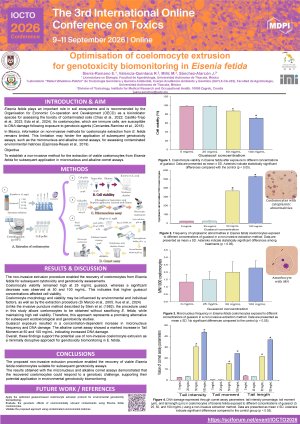
Environmental xenobiotics accumulate in terrestrial ecosystems, and some of these compounds can induce cytotoxic and genotoxic effects in exposed organisms. Their toxicity, persistence, and bioaccumulation in food chains have necessitated the use of sensitive methods to assess genetic damage in bioindicator organisms, such as Eisenia fetida, which has been recognised as a sentinel species for soil ecotoxicology. However, standardised non-invasive methods for obtaining viable coelomocytes suitable for genotoxicity assays remain limited. The objective of this study was to standardise a methodology for coelomocyte extraction from Eisenia fetida for application in micronucleus (MN) and alkaline comet assays. Adult organisms were exposed to an extrusion solution supplemented with guaiacol at concentrations of 0, 25, 50, and 100 mg/mL. Cell viability was determined using the trypan blue exclusion test, while micronucleus frequency and DNA fragmentation parameters were evaluated by optical and fluorescence microscopy, respectively. In the comet assay with software, we measured tail length, tail intensity and tail moment. Statistical analyses were performed using Kruskal-Wallis and one-way ANOVA tests (p < 0.05). The extrusion solution, supplemented with 25 mg/mL guaiacol, maintained high cell viability (98%) and DNA integrity while reducing interference from coelomic mucus, thereby improving the visualisation and quantification of coelomocytes. Conversely, exposure to 50 and 100 mg/mL guaiacol resulted in a significant increase in cytoplasmic abnormalities and DNA migration parameters, and a significant decrease in cell viability. This study demonstrates that supplementation with 25 mg/mL guaiacol provides an efficient and non-invasive method for obtaining viable coelomocytes without inducing detectable cytotoxic or genotoxic effects. The optimised protocol represents a useful methodological tool for future biomonitoring and ecotoxicological studies employing MN and comet assays in E. fetida.
Keywords
ecotoxicology
biomonitoring
coelomocytes
comet assay
micronucleus assay
soil biomarkers
genotoxicity
Poster
ICTO POSTER Esmeralda Sierra Romano English _26082_260828_191012.pdf
Integrated Ecotoxicological Assessment of Hematological, Oxidative Stress, Genotoxic, and Histopathological Biomarkers in Bighead Carp (Aristichthys nobilis) Exposed to Bisphenol A
Biomarkers of DNA damage in common carp inhabiting an agriculturally impacted lake in Mexico