Event submissions
Published
This submission belongs to the session 2. Wildlife Ecotoxicology, Sentinel Species, and Ecosystem Health of the event The 3rd International Online Conference on Toxics
Published date
04 Sep, 2026
Academic Editor
'%3e%3cpath%20d='M12.6657%2010.9104C12.4185%2010.325%2012.0599%209.79327%2011.6097%209.34482C11.1609%208.89508%2010.6293%208.5365%2010.0442%208.28888C10.0389%208.28626%2010.0337%208.28495%2010.0285%208.28233C10.8446%207.69279%2011.3752%206.73249%2011.3752%205.64904C11.3752%203.8542%209.92103%202.39999%208.1262%202.39999C6.33136%202.39999%204.87715%203.8542%204.87715%205.64904C4.87715%206.73249%205.40774%207.69279%206.22393%208.28364C6.21869%208.28626%206.21345%208.28757%206.20821%208.29019C5.62129%208.5378%205.09463%208.89284%204.64265%209.34613C4.1929%209.79493%203.83432%2010.3266%203.58671%2010.9117C3.34345%2011.4845%203.21226%2012.0987%203.20023%2012.7209C3.19988%2012.7349%203.20233%2012.7488%203.20744%2012.7619C3.21255%2012.7749%203.22022%2012.7867%203.22998%2012.7968C3.23975%2012.8068%203.25142%2012.8147%203.26431%2012.8202C3.2772%2012.8256%203.29105%2012.8284%203.30504%2012.8284H4.09109C4.14874%2012.8284%204.19459%2012.7825%204.1959%2012.7262C4.2221%2011.7148%204.62823%2010.7676%205.34617%2010.0497C6.08899%209.30683%207.0755%208.89808%208.1262%208.89808C9.17689%208.89808%2010.1634%209.30683%2010.9062%2010.0497C11.6242%2010.7676%2012.0303%2011.7148%2012.0565%2012.7262C12.0578%2012.7838%2012.1037%2012.8284%2012.1613%2012.8284H12.9474C12.9613%2012.8284%2012.9752%2012.8256%2012.9881%2012.8202C13.001%2012.8147%2013.0126%2012.8068%2013.0224%2012.7968C13.0322%2012.7867%2013.0398%2012.7749%2013.0449%2012.7619C13.0501%2012.7488%2013.0525%2012.7349%2013.0522%2012.7209C13.0391%2012.0947%2012.9094%2011.4855%2012.6657%2010.9104ZM8.1262%207.9024C7.52486%207.9024%206.9589%207.6679%206.53312%207.24211C6.10733%206.81633%205.87283%206.25037%205.87283%205.64904C5.87283%205.0477%206.10733%204.48174%206.53312%204.05596C6.9589%203.63018%207.52486%203.39567%208.1262%203.39567C8.72753%203.39567%209.29349%203.63018%209.71927%204.05596C10.1451%204.48174%2010.3796%205.0477%2010.3796%205.64904C10.3796%206.25037%2010.1451%206.81633%209.71927%207.24211C9.29349%207.6679%208.72753%207.9024%208.1262%207.9024Z'%20fill='%235D1EE1'/%3e%3c/g%3e%3c/svg%3e) Jose V. Tarazona
Jose V. TarazonaCitation
Hadia Benhalima, Tabet Trirat, Hana Sbartai, Ibtissem Sbartai, Biomonitoring Soil Health: Ecotoxicological Impact of Multi-Metal Mixtures on the Sentinel Earthworm Aporrectodea giardi, in Proceedings of The 3rd International Online Conference on Toxics, 9 September–11 September 2026, MDPI: Basel, Switzerland
Share
Email
Facebook
Twitter
LinkedIn
Biomonitoring Soil Health: Ecotoxicological Impact of Multi-Metal Mixtures on the Sentinel Earthworm Aporrectodea giardi
'%3e%3cpath%20d='M12.6647%2010.9104C12.4176%2010.325%2012.0589%209.7933%2011.6088%209.34485C11.16%208.89511%2010.6283%208.53653%2010.0432%208.28891C10.038%208.28629%2010.0327%208.28498%2010.0275%208.28236C10.8437%207.69282%2011.3743%206.73252%2011.3743%205.64907C11.3743%203.85423%209.92005%202.40002%208.12522%202.40002C6.33038%202.40002%204.87618%203.85423%204.87618%205.64907C4.87618%206.73252%205.40677%207.69282%206.22296%208.28367C6.21772%208.28629%206.21248%208.2876%206.20724%208.29022C5.62031%208.53783%205.09365%208.89287%204.64167%209.34616C4.19192%209.79496%203.83334%2010.3266%203.58573%2010.9117C3.34247%2011.4846%203.21128%2012.0987%203.19925%2012.721C3.1989%2012.735%203.20135%2012.7489%203.20646%2012.7619C3.21157%2012.7749%203.21924%2012.7868%203.22901%2012.7968C3.23877%2012.8068%203.25045%2012.8148%203.26334%2012.8202C3.27623%2012.8256%203.29007%2012.8284%203.30406%2012.8284H4.09012C4.14776%2012.8284%204.19362%2012.7825%204.19493%2012.7262C4.22113%2011.7148%204.62726%2010.7676%205.34519%2010.0497C6.08802%209.30686%207.07452%208.89811%208.12522%208.89811C9.17592%208.89811%2010.1624%209.30686%2010.9052%2010.0497C11.6232%2010.7676%2012.0293%2011.7148%2012.0555%2012.7262C12.0568%2012.7839%2012.1027%2012.8284%2012.1603%2012.8284H12.9464C12.9604%2012.8284%2012.9742%2012.8256%2012.9871%2012.8202C13%2012.8148%2013.0117%2012.8068%2013.0214%2012.7968C13.0312%2012.7868%2013.0389%2012.7749%2013.044%2012.7619C13.0491%2012.7489%2013.0515%2012.735%2013.0512%2012.721C13.0381%2012.0947%2012.9084%2011.4856%2012.6647%2010.9104ZM8.12522%207.90243C7.52388%207.90243%206.95792%207.66793%206.53214%207.24215C6.10636%206.81636%205.87185%206.2504%205.87185%205.64907C5.87185%205.04773%206.10636%204.48177%206.53214%204.05599C6.95792%203.63021%207.52388%203.3957%208.12522%203.3957C8.72655%203.3957%209.29252%203.63021%209.7183%204.05599C10.1441%204.48177%2010.3786%205.04773%2010.3786%205.64907C10.3786%206.2504%2010.1441%206.81636%209.7183%207.24215C9.29252%207.66793%208.72655%207.90243%208.12522%207.90243Z'%20fill='%235D1EE1'/%3e%3c/g%3e%3c/svg%3e)
Hadia Benhalima 1
Tabet Trirat 1
Hana Sbartai 2
Ibtissem Sbartai 2
1. Environmental Research Center (CRE), Annaba, 23000, Algeria
2. Laboratory of Cellular Toxicology, Department of Biology, Faculty of Sciences, Badji Mokhtar University, Annaba, Algeria
Abstract
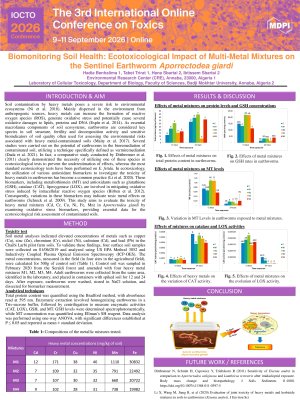
Introduction: Earthworms serve as critical sentinel species for assessing soil health and the ecological impact of chemical stressors. This study investigates the ecotoxicological response of the anecic earthworm Aporrectodea giardi to complex environmental mixtures of six heavy metals: cadmium (Cd), chromium (Cr), copper (Cu), nickel (Ni), iron (Fe), and manganese (Mn).
Methods: To simulate realistic soil contamination, four metallic mixtures (M1–M4) were tested over 12 and 24 days. These mixtures, based on agricultural field (Northeast Algeria), contained Cd, Cr, Cu, Ni, Mn, and Fe at specific concentrations (mg/kg): M1 (12, 171, 38, 46, 1110, 30832); M2 (7, 109, 32, 35, 791, 22492); M3 (7, 107, 30, 32, 660, 20722); and M4 (9, 102, 28, 31, 738, 19982). Biological responses were evaluated through oxidative stress biomarkers: total protein content, glutathione (GSH), metallothionein (MT), catalase (CAT), and lipoxygenase (LOX).
Results: Our findings reveal dynamic and concentration-dependent physiological responses. After 24 days, protein levels significantly decreased under the M3 treatment while increasing in all other conditions. Initial fluctuations in GSH and MT contents, marked by a decrease in M1/M4 and an increase in M2/M3 at 12 days, stabilized into a significant enhancement by day 24. CAT was inhibited in nearly all treatments except M3 (P > 0.05), while LOX was initially stimulated (M1, M2, M4) before declining across all conditions.
Conclusions: These findings demonstrate that multi-metal mixtures trigger oxidative stress, inducing adaptive responses through MT production and antioxidant defenses (GSH, LOX) to restore redox balance. Overall, the high sensitivity of A. giardi underscores its value as a sentinel species for risk assessment and the biomonitoring of metal-polluted soil ecosystems.
Keywords
Sentinel species
Aporrectodea giardi
heavy metal mixtures
oxidative stress biomarkers
soil health biomonitoring
Poster
Poster earthworms.pdf
Biomarkers of DNA damage in common carp inhabiting an agriculturally impacted lake in Mexico
Transgenerational impacts of TBBPA on the freshwater snail Lymnaea stagnalis