Event submissions
Published
This submission belongs to the session 2. Wildlife Ecotoxicology, Sentinel Species, and Ecosystem Health of the event The 3rd International Online Conference on Toxics
Published date
04 Sep, 2026
Academic Editor
'%3e%3cpath%20d='M12.6657%2010.9104C12.4185%2010.325%2012.0599%209.79327%2011.6097%209.34482C11.1609%208.89508%2010.6293%208.5365%2010.0442%208.28888C10.0389%208.28626%2010.0337%208.28495%2010.0285%208.28233C10.8446%207.69279%2011.3752%206.73249%2011.3752%205.64904C11.3752%203.8542%209.92103%202.39999%208.1262%202.39999C6.33136%202.39999%204.87715%203.8542%204.87715%205.64904C4.87715%206.73249%205.40774%207.69279%206.22393%208.28364C6.21869%208.28626%206.21345%208.28757%206.20821%208.29019C5.62129%208.5378%205.09463%208.89284%204.64265%209.34613C4.1929%209.79493%203.83432%2010.3266%203.58671%2010.9117C3.34345%2011.4845%203.21226%2012.0987%203.20023%2012.7209C3.19988%2012.7349%203.20233%2012.7488%203.20744%2012.7619C3.21255%2012.7749%203.22022%2012.7867%203.22998%2012.7968C3.23975%2012.8068%203.25142%2012.8147%203.26431%2012.8202C3.2772%2012.8256%203.29105%2012.8284%203.30504%2012.8284H4.09109C4.14874%2012.8284%204.19459%2012.7825%204.1959%2012.7262C4.2221%2011.7148%204.62823%2010.7676%205.34617%2010.0497C6.08899%209.30683%207.0755%208.89808%208.1262%208.89808C9.17689%208.89808%2010.1634%209.30683%2010.9062%2010.0497C11.6242%2010.7676%2012.0303%2011.7148%2012.0565%2012.7262C12.0578%2012.7838%2012.1037%2012.8284%2012.1613%2012.8284H12.9474C12.9613%2012.8284%2012.9752%2012.8256%2012.9881%2012.8202C13.001%2012.8147%2013.0126%2012.8068%2013.0224%2012.7968C13.0322%2012.7867%2013.0398%2012.7749%2013.0449%2012.7619C13.0501%2012.7488%2013.0525%2012.7349%2013.0522%2012.7209C13.0391%2012.0947%2012.9094%2011.4855%2012.6657%2010.9104ZM8.1262%207.9024C7.52486%207.9024%206.9589%207.6679%206.53312%207.24211C6.10733%206.81633%205.87283%206.25037%205.87283%205.64904C5.87283%205.0477%206.10733%204.48174%206.53312%204.05596C6.9589%203.63018%207.52486%203.39567%208.1262%203.39567C8.72753%203.39567%209.29349%203.63018%209.71927%204.05596C10.1451%204.48174%2010.3796%205.0477%2010.3796%205.64904C10.3796%206.25037%2010.1451%206.81633%209.71927%207.24211C9.29349%207.6679%208.72753%207.9024%208.1262%207.9024Z'%20fill='%235D1EE1'/%3e%3c/g%3e%3c/svg%3e) Jose V. Tarazona
Jose V. TarazonaCitation
Rafael Pereira dos Santos, Beatriz Diniz Lopes, A. Duciene Feitosa Lima, Tamyris de Aquino Gondim, Flávia Yoshie Yamamoto, Rivelino Martins Cavalcante, Ecotoxico-lipidomics in fish under field conditions: a systematic review of lipid-based responses to environmental contamination, in Proceedings of The 3rd International Online Conference on Toxics, 9 September–11 September 2026, MDPI: Basel, Switzerland
Share
Email
Facebook
Twitter
LinkedIn
Ecotoxico-lipidomics in fish under field conditions: a systematic review of lipid-based responses to environmental contamination

Rafael Pereira dos Santos 1
'%3e%3cpath%20d='M12.6647%2010.9104C12.4176%2010.325%2012.0589%209.7933%2011.6088%209.34485C11.16%208.89511%2010.6283%208.53653%2010.0432%208.28891C10.038%208.28629%2010.0327%208.28498%2010.0275%208.28236C10.8437%207.69282%2011.3743%206.73252%2011.3743%205.64907C11.3743%203.85423%209.92005%202.40002%208.12522%202.40002C6.33038%202.40002%204.87618%203.85423%204.87618%205.64907C4.87618%206.73252%205.40677%207.69282%206.22296%208.28367C6.21772%208.28629%206.21248%208.2876%206.20724%208.29022C5.62031%208.53783%205.09365%208.89287%204.64167%209.34616C4.19192%209.79496%203.83334%2010.3266%203.58573%2010.9117C3.34247%2011.4846%203.21128%2012.0987%203.19925%2012.721C3.1989%2012.735%203.20135%2012.7489%203.20646%2012.7619C3.21157%2012.7749%203.21924%2012.7868%203.22901%2012.7968C3.23877%2012.8068%203.25045%2012.8148%203.26334%2012.8202C3.27623%2012.8256%203.29007%2012.8284%203.30406%2012.8284H4.09012C4.14776%2012.8284%204.19362%2012.7825%204.19493%2012.7262C4.22113%2011.7148%204.62726%2010.7676%205.34519%2010.0497C6.08802%209.30686%207.07452%208.89811%208.12522%208.89811C9.17592%208.89811%2010.1624%209.30686%2010.9052%2010.0497C11.6232%2010.7676%2012.0293%2011.7148%2012.0555%2012.7262C12.0568%2012.7839%2012.1027%2012.8284%2012.1603%2012.8284H12.9464C12.9604%2012.8284%2012.9742%2012.8256%2012.9871%2012.8202C13%2012.8148%2013.0117%2012.8068%2013.0214%2012.7968C13.0312%2012.7868%2013.0389%2012.7749%2013.044%2012.7619C13.0491%2012.7489%2013.0515%2012.735%2013.0512%2012.721C13.0381%2012.0947%2012.9084%2011.4856%2012.6647%2010.9104ZM8.12522%207.90243C7.52388%207.90243%206.95792%207.66793%206.53214%207.24215C6.10636%206.81636%205.87185%206.2504%205.87185%205.64907C5.87185%205.04773%206.10636%204.48177%206.53214%204.05599C6.95792%203.63021%207.52388%203.3957%208.12522%203.3957C8.72655%203.3957%209.29252%203.63021%209.7183%204.05599C10.1441%204.48177%2010.3786%205.04773%2010.3786%205.64907C10.3786%206.2504%2010.1441%206.81636%209.7183%207.24215C9.29252%207.66793%208.72655%207.90243%208.12522%207.90243Z'%20fill='%235D1EE1'/%3e%3c/g%3e%3c/svg%3e)
Beatriz Diniz Lopes 1
A. Duciene Feitosa Lima 1
Tamyris de Aquino Gondim 1
Flávia Yoshie Yamamoto 1
Rivelino Martins Cavalcante 1
1. Laboratory for Assessment of Organic Contaminants (LACOr), Institute of Marine Sciences-Federal University of Ceará (LABOMAR-UFC), Av. Abolição, 3207-Meireles, 60165-081, Fortaleza, CE, Brazil
Abstract
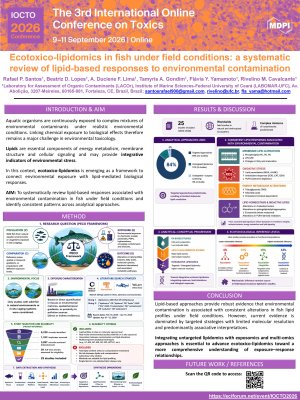
Aquatic organisms are continuously exposed to complex mixtures of environmental contaminants, making it challenging to link exposure to biological effects under realistic conditions. Lipids play central roles in energy metabolism, membrane structure, and cellular signaling, and can act as integrative indicators of environmental stress. Lipidomics has emerged as a powerful tool to capture integrated metabolic responses, supporting the development of ecotoxico-lipidomics as an emerging framework linking environmental exposure to lipid-mediated effects. This study aimed to systematically review lipid-based responses in fish under field conditions and identify consistent patterns across analytical approaches. A systematic literature review was conducted using a structured PECO framework. Searches were performed in Web of Science, PubMed, ScienceDirect, and Wiley Online Library using keywords related to lipidomics, fish, and contamination (last updated in April 2026). Studies were included if they assessed lipid profiles (fatty acids, lipid classes, or molecular species) in wild-caught or in situ exposed fish and examined associations with environmental contamination. Following screening and eligibility assessment, 25 studies were included. Most studies (84%) employed targeted approaches, primarily focusing on fatty acids or bulk lipid classes, whereas only a few applied untargeted lipidomics. Consistent patterns across studies included reductions in long-chain polyunsaturated fatty acids and increases in saturated and monounsaturated fatty acids, along with alterations in membrane and storage lipids. These responses were associated with metals, persistent organic pollutants, and wastewater-derived compounds. Most studies provided associative or functional interpretations, while mechanistic insights remained limited. Nevertheless, these patterns can be interpreted within an ecotoxico-lipidomics perspective. Lipid-based approaches provide robust insights into the effects of environmental contamination in fish under field conditions, but current evidence is dominated by targeted strategies with limited molecular resolution. Integrating untargeted lipidomics with exposomic and multi-omics data will be essential to advance ecotoxico-lipidomics as an emerging comprehensive and integrative approach.
Keywords
ecotoxicology
biomonitoring
aquatic pollution
exposomics
Poster
Poster IOCTO2026 Rafael Santos.pdf
Retrospective study of seagull poisonings in central Portugal: can marine phycotoxins be involved?
The Impact of Cigarette Filters on Aquatic Ecosystems Using Daphnids as Model Organisms