Event submissions
Published
This submission belongs to the session 3. Innovating Toxicology: NAMs and Computational Tools for Next-Generation Risk Assessment of the event The 3rd International Online Conference on Toxics
Published date
04 Sep, 2026
Academic Editor
'%3e%3cpath%20d='M12.6657%2010.9104C12.4185%2010.325%2012.0599%209.79327%2011.6097%209.34482C11.1609%208.89508%2010.6293%208.5365%2010.0442%208.28888C10.0389%208.28626%2010.0337%208.28495%2010.0285%208.28233C10.8446%207.69279%2011.3752%206.73249%2011.3752%205.64904C11.3752%203.8542%209.92103%202.39999%208.1262%202.39999C6.33136%202.39999%204.87715%203.8542%204.87715%205.64904C4.87715%206.73249%205.40774%207.69279%206.22393%208.28364C6.21869%208.28626%206.21345%208.28757%206.20821%208.29019C5.62129%208.5378%205.09463%208.89284%204.64265%209.34613C4.1929%209.79493%203.83432%2010.3266%203.58671%2010.9117C3.34345%2011.4845%203.21226%2012.0987%203.20023%2012.7209C3.19988%2012.7349%203.20233%2012.7488%203.20744%2012.7619C3.21255%2012.7749%203.22022%2012.7867%203.22998%2012.7968C3.23975%2012.8068%203.25142%2012.8147%203.26431%2012.8202C3.2772%2012.8256%203.29105%2012.8284%203.30504%2012.8284H4.09109C4.14874%2012.8284%204.19459%2012.7825%204.1959%2012.7262C4.2221%2011.7148%204.62823%2010.7676%205.34617%2010.0497C6.08899%209.30683%207.0755%208.89808%208.1262%208.89808C9.17689%208.89808%2010.1634%209.30683%2010.9062%2010.0497C11.6242%2010.7676%2012.0303%2011.7148%2012.0565%2012.7262C12.0578%2012.7838%2012.1037%2012.8284%2012.1613%2012.8284H12.9474C12.9613%2012.8284%2012.9752%2012.8256%2012.9881%2012.8202C13.001%2012.8147%2013.0126%2012.8068%2013.0224%2012.7968C13.0322%2012.7867%2013.0398%2012.7749%2013.0449%2012.7619C13.0501%2012.7488%2013.0525%2012.7349%2013.0522%2012.7209C13.0391%2012.0947%2012.9094%2011.4855%2012.6657%2010.9104ZM8.1262%207.9024C7.52486%207.9024%206.9589%207.6679%206.53312%207.24211C6.10733%206.81633%205.87283%206.25037%205.87283%205.64904C5.87283%205.0477%206.10733%204.48174%206.53312%204.05596C6.9589%203.63018%207.52486%203.39567%208.1262%203.39567C8.72753%203.39567%209.29349%203.63018%209.71927%204.05596C10.1451%204.48174%2010.3796%205.0477%2010.3796%205.64904C10.3796%206.25037%2010.1451%206.81633%209.71927%207.24211C9.29349%207.6679%208.72753%207.9024%208.1262%207.9024Z'%20fill='%235D1EE1'/%3e%3c/g%3e%3c/svg%3e) Emilio Benfenati
Emilio BenfenatiCitation
Sezen Yılmaz Sarıaltın, Can Özgür Yalçın, Integrated in Silico Assessment of Environmental and Human Toxicity of Carbamazepine as a Pseudo-persistent Emerging Contaminant, in Proceedings of The 3rd International Online Conference on Toxics, 9 September–11 September 2026, MDPI: Basel, Switzerland
Share
Email
Facebook
Twitter
LinkedIn
Integrated in Silico Assessment of Environmental and Human Toxicity of Carbamazepine as a Pseudo-persistent Emerging Contaminant
'%3e%3cpath%20d='M12.6647%2010.9104C12.4176%2010.325%2012.0589%209.7933%2011.6088%209.34485C11.16%208.89511%2010.6283%208.53653%2010.0432%208.28891C10.038%208.28629%2010.0327%208.28498%2010.0275%208.28236C10.8437%207.69282%2011.3743%206.73252%2011.3743%205.64907C11.3743%203.85423%209.92005%202.40002%208.12522%202.40002C6.33038%202.40002%204.87618%203.85423%204.87618%205.64907C4.87618%206.73252%205.40677%207.69282%206.22296%208.28367C6.21772%208.28629%206.21248%208.2876%206.20724%208.29022C5.62031%208.53783%205.09365%208.89287%204.64167%209.34616C4.19192%209.79496%203.83334%2010.3266%203.58573%2010.9117C3.34247%2011.4846%203.21128%2012.0987%203.19925%2012.721C3.1989%2012.735%203.20135%2012.7489%203.20646%2012.7619C3.21157%2012.7749%203.21924%2012.7868%203.22901%2012.7968C3.23877%2012.8068%203.25045%2012.8148%203.26334%2012.8202C3.27623%2012.8256%203.29007%2012.8284%203.30406%2012.8284H4.09012C4.14776%2012.8284%204.19362%2012.7825%204.19493%2012.7262C4.22113%2011.7148%204.62726%2010.7676%205.34519%2010.0497C6.08802%209.30686%207.07452%208.89811%208.12522%208.89811C9.17592%208.89811%2010.1624%209.30686%2010.9052%2010.0497C11.6232%2010.7676%2012.0293%2011.7148%2012.0555%2012.7262C12.0568%2012.7839%2012.1027%2012.8284%2012.1603%2012.8284H12.9464C12.9604%2012.8284%2012.9742%2012.8256%2012.9871%2012.8202C13%2012.8148%2013.0117%2012.8068%2013.0214%2012.7968C13.0312%2012.7868%2013.0389%2012.7749%2013.044%2012.7619C13.0491%2012.7489%2013.0515%2012.735%2013.0512%2012.721C13.0381%2012.0947%2012.9084%2011.4856%2012.6647%2010.9104ZM8.12522%207.90243C7.52388%207.90243%206.95792%207.66793%206.53214%207.24215C6.10636%206.81636%205.87185%206.2504%205.87185%205.64907C5.87185%205.04773%206.10636%204.48177%206.53214%204.05599C6.95792%203.63021%207.52388%203.3957%208.12522%203.3957C8.72655%203.3957%209.29252%203.63021%209.7183%204.05599C10.1441%204.48177%2010.3786%205.04773%2010.3786%205.64907C10.3786%206.2504%2010.1441%206.81636%209.7183%207.24215C9.29252%207.66793%208.72655%207.90243%208.12522%207.90243Z'%20fill='%235D1EE1'/%3e%3c/g%3e%3c/svg%3e)
Sezen Yılmaz Sarıaltın 1
Can Özgür Yalçın 2
1. Ankara University, Faculty of Pharmacy, Department of Pharmaceutical Toxicology, Ankara, Türkiye
2. Karadeniz Technical University, Faculty of Pharmacy, Department of Pharmaceutical Toxicology, Trabzon, Türkiye
Abstract
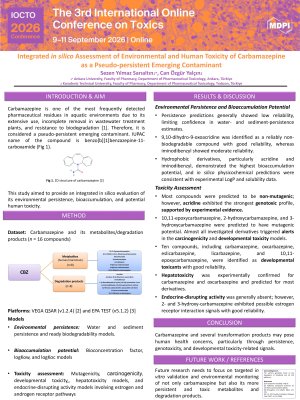
Introduction: Carbamazepine is one of the most frequently detected pharmaceutical residues in aquatic environments due to its extensive use, incomplete removal in wastewater treatment plants, and resistance to biodegradation. Therefore, it is considered a pseudo-persistent emerging contaminant. This study aimed to provide an integrated in silico evaluation of its environmental persistence, bioaccumulation, and potential human toxicity.
Methods: Carbamazepine and its metabolites/degradation products (n = 16 compounds) were evaluated using VEGA QSAR (v1.2.4) and EPA TEST (v5.1.2). Environmental persistence was assessed through water and sediment persistence and ready biodegradability models. Bioaccumulation potential was evaluated using bioconcentration factor (BCF), logKow, and logKoc. Toxicity assessment focused on mutagenicity, developmental toxicity, carcinogenicity, hepatotoxicity, and endocrine-disrupting activity involving estrogen and androgen receptor pathways.
Results: Persistence predictions generally showed low reliability, limiting confidence in water- and sediment-persistence estimates. However, 9,10-dihydro-9-oxoacridine was identified as a reliably non-biodegradable compound with good reliability (GR), whereas iminodibenzyl showed moderate reliability. Hydrophobic derivatives, particularly acridine and iminodibenzyl, demonstrated the highest bioaccumulation potential, and in silico physicochemical predictions were consistent with experimental LogP and solubility data. Most compounds were predicted to be non-mutagenic; however, acridine exhibited the strongest genotoxic profile, supported by experimental evidence. Additionally, 10,11-epoxycarbamazepine, 2-hydroxycarbamazepine, and 3-hydroxycarbamazepine showed predicted mutagenic potential. Almost all investigated derivatives triggered alerts in the carcinogenicity and developmental toxicity models. Ten compounds, including carbamazepine, oxcarbazepine, eslicarbazepine, licarbazepine, and 10,11-epoxycarbamazepine, were identified as developmental toxicants with GR. Hepatotoxicity was experimentally confirmed for carbamazepine and oxcarbazepine and predicted for most derivatives. Endocrine-disrupting activity was generally absent; however, 2- and 3-hydroxy-carbamazepine exhibited possible estrogen receptor interaction signals with GR.
Conclusions: Carbamazepine and several transformation products may pose human health concerns, particularly through persistence, genotoxicity, and developmental toxicity-related signals. These findings demonstrate the utility of integrated in silico approaches for prioritizing pharmaceutical contaminants and their metabolites.
Keywords
carbamazepine
degradation
human toxicity
in silico
pseudo-persistent
Poster
IOCTO2026-poster_SYS.pdf
Spatio-temporal dynamics of arsenic and its relationship with physicochemical parameters in the Tampamachoco lagoon, Veracruz, Mexico
Mechanistic Convergence of the Chemical Exposome in Nephrotoxicity: A Systems Toxicology Network Approach