Event submissions
Published
This submission belongs to the session 3. Innovating Toxicology: NAMs and Computational Tools for Next-Generation Risk Assessment of the event The 3rd International Online Conference on Toxics
Published date
04 Sep, 2026
Academic Editor
'%3e%3cpath%20d='M12.6657%2010.9104C12.4185%2010.325%2012.0599%209.79327%2011.6097%209.34482C11.1609%208.89508%2010.6293%208.5365%2010.0442%208.28888C10.0389%208.28626%2010.0337%208.28495%2010.0285%208.28233C10.8446%207.69279%2011.3752%206.73249%2011.3752%205.64904C11.3752%203.8542%209.92103%202.39999%208.1262%202.39999C6.33136%202.39999%204.87715%203.8542%204.87715%205.64904C4.87715%206.73249%205.40774%207.69279%206.22393%208.28364C6.21869%208.28626%206.21345%208.28757%206.20821%208.29019C5.62129%208.5378%205.09463%208.89284%204.64265%209.34613C4.1929%209.79493%203.83432%2010.3266%203.58671%2010.9117C3.34345%2011.4845%203.21226%2012.0987%203.20023%2012.7209C3.19988%2012.7349%203.20233%2012.7488%203.20744%2012.7619C3.21255%2012.7749%203.22022%2012.7867%203.22998%2012.7968C3.23975%2012.8068%203.25142%2012.8147%203.26431%2012.8202C3.2772%2012.8256%203.29105%2012.8284%203.30504%2012.8284H4.09109C4.14874%2012.8284%204.19459%2012.7825%204.1959%2012.7262C4.2221%2011.7148%204.62823%2010.7676%205.34617%2010.0497C6.08899%209.30683%207.0755%208.89808%208.1262%208.89808C9.17689%208.89808%2010.1634%209.30683%2010.9062%2010.0497C11.6242%2010.7676%2012.0303%2011.7148%2012.0565%2012.7262C12.0578%2012.7838%2012.1037%2012.8284%2012.1613%2012.8284H12.9474C12.9613%2012.8284%2012.9752%2012.8256%2012.9881%2012.8202C13.001%2012.8147%2013.0126%2012.8068%2013.0224%2012.7968C13.0322%2012.7867%2013.0398%2012.7749%2013.0449%2012.7619C13.0501%2012.7488%2013.0525%2012.7349%2013.0522%2012.7209C13.0391%2012.0947%2012.9094%2011.4855%2012.6657%2010.9104ZM8.1262%207.9024C7.52486%207.9024%206.9589%207.6679%206.53312%207.24211C6.10733%206.81633%205.87283%206.25037%205.87283%205.64904C5.87283%205.0477%206.10733%204.48174%206.53312%204.05596C6.9589%203.63018%207.52486%203.39567%208.1262%203.39567C8.72753%203.39567%209.29349%203.63018%209.71927%204.05596C10.1451%204.48174%2010.3796%205.0477%2010.3796%205.64904C10.3796%206.25037%2010.1451%206.81633%209.71927%207.24211C9.29349%207.6679%208.72753%207.9024%208.1262%207.9024Z'%20fill='%235D1EE1'/%3e%3c/g%3e%3c/svg%3e) Emilio Benfenati
Emilio BenfenatiCitation
Meera Ramani, Argel Islas-Robles, Kayla Dailey, Courtney Nabua, Clair Cheng, Baovi Ly, Victoria Brandalise-Lough, Gertrude-Emilia Costin, Pushing the Limits: Expanding the Applicability Domain of EpiSensA for Skin Sensitization Assessment, in Proceedings of The 3rd International Online Conference on Toxics, 9 September–11 September 2026, MDPI: Basel, Switzerland
Share
Email
Facebook
Twitter
LinkedIn
Pushing the Limits: Expanding the Applicability Domain of EpiSensA for Skin Sensitization Assessment
'%3e%3cpath%20d='M12.6647%2010.9104C12.4176%2010.325%2012.0589%209.7933%2011.6088%209.34485C11.16%208.89511%2010.6283%208.53653%2010.0432%208.28891C10.038%208.28629%2010.0327%208.28498%2010.0275%208.28236C10.8437%207.69282%2011.3743%206.73252%2011.3743%205.64907C11.3743%203.85423%209.92005%202.40002%208.12522%202.40002C6.33038%202.40002%204.87618%203.85423%204.87618%205.64907C4.87618%206.73252%205.40677%207.69282%206.22296%208.28367C6.21772%208.28629%206.21248%208.2876%206.20724%208.29022C5.62031%208.53783%205.09365%208.89287%204.64167%209.34616C4.19192%209.79496%203.83334%2010.3266%203.58573%2010.9117C3.34247%2011.4846%203.21128%2012.0987%203.19925%2012.721C3.1989%2012.735%203.20135%2012.7489%203.20646%2012.7619C3.21157%2012.7749%203.21924%2012.7868%203.22901%2012.7968C3.23877%2012.8068%203.25045%2012.8148%203.26334%2012.8202C3.27623%2012.8256%203.29007%2012.8284%203.30406%2012.8284H4.09012C4.14776%2012.8284%204.19362%2012.7825%204.19493%2012.7262C4.22113%2011.7148%204.62726%2010.7676%205.34519%2010.0497C6.08802%209.30686%207.07452%208.89811%208.12522%208.89811C9.17592%208.89811%2010.1624%209.30686%2010.9052%2010.0497C11.6232%2010.7676%2012.0293%2011.7148%2012.0555%2012.7262C12.0568%2012.7839%2012.1027%2012.8284%2012.1603%2012.8284H12.9464C12.9604%2012.8284%2012.9742%2012.8256%2012.9871%2012.8202C13%2012.8148%2013.0117%2012.8068%2013.0214%2012.7968C13.0312%2012.7868%2013.0389%2012.7749%2013.044%2012.7619C13.0491%2012.7489%2013.0515%2012.735%2013.0512%2012.721C13.0381%2012.0947%2012.9084%2011.4856%2012.6647%2010.9104ZM8.12522%207.90243C7.52388%207.90243%206.95792%207.66793%206.53214%207.24215C6.10636%206.81636%205.87185%206.2504%205.87185%205.64907C5.87185%205.04773%206.10636%204.48177%206.53214%204.05599C6.95792%203.63021%207.52388%203.3957%208.12522%203.3957C8.72655%203.3957%209.29252%203.63021%209.7183%204.05599C10.1441%204.48177%2010.3786%205.04773%2010.3786%205.64907C10.3786%206.2504%2010.1441%206.81636%209.7183%207.24215C9.29252%207.66793%208.72655%207.90243%208.12522%207.90243Z'%20fill='%235D1EE1'/%3e%3c/g%3e%3c/svg%3e)
Meera Ramani 1
Argel Islas-Robles 1
Kayla Dailey 1
Courtney Nabua 1
Clair Cheng 1
Baovi Ly 1
Victoria Brandalise-Lough 1
Gertrude-Emilia Costin 1
1. Department of Skin Sensitization, Institute for In Vitro Sciences, Inc. (IIVS), Gaithersburg, MD 20878, USA
Abstract
Introduction:
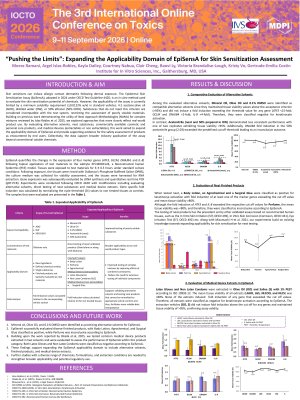
Skin sensitization is an immune-mediated process leading to allergic contact dermatitis following dermal exposure to chemicals. The Epidermal Skin Sensitization Assay (EpiSensA) is an in vitro assay adopted in 2024 by OECD to assess skin sensitization potential. The assay evaluates keratinocyte activation, which is the second key event in the skin sensitization adverse outcome pathway. The current applicability of the assay is limited by a minimum solubility requirement (≥0.0122% w/v) in validated vehicles such as 4:1 acetone:olive oil (AOO), distilled water, or 50% ethanol. Chemicals not meeting this criterion are considered incompatible with the test system.
Methods:
The EpiSensA quantifies changes of expression in marker genes (ATF3, GCLM, DNAJB4, and IL-8) following topical chemical exposure to a reconstructed human epidermis (RhE) model. Our experiments assessed strategies to expand the applicability domain of EpiSensA by evaluating alternative solvents, conducting testing of neat materials (to mimic consumer exposure), and assessing the skin sensitization potential of medical device extracts.
Results:
Alternative solvents including mineral oil, olive oil, dimethyl sulfoxide (DMSO), saline, and acetonitrile were evaluated. Of these, mineral oil and olive oil were identified as compatible with the EpiSensA, maintaining tissue viability >95% and gene induction below established positivity thresholds (ATF3 <15‑fold; GCLM and DNAJB4 <2‑fold; IL‑8 <4‑fold). A body lotion and a perfume were tested neat and predicted to be positive, based on increased expression of ATF3 and IL-8 in both products, and DNAJB4 in the lotion. Olive oil-based extracts of latex gloves and non‑latex condoms, prepared according to ISO 10993‑12, did not exceed classification thresholds and thus were classified as negative in the assay.
Conclusion:
These findings suggest the potential to expand the EpiSensA applicability domain to include alternative solvents, neat materials, and medical device extracts, while highlighting key considerations and the need for further evaluation for regulatory application.
Keywords
skin sensitization
in vitro
toxicology
EpiSensA
hazard assessment
reconstructed human epidermis
allergic contact dermatitis
Poster
IOCTO 2026_ Ramani.pdf
GC–MS Characterization, Brine Shrimp Lethality, and In Silico Toxicity Prediction of Alkaloid Fractions from the Stem Bark of Nauclea diderrichii
How Optimization of Skin Sensitization and Photoirritation Assays are Advancing in vitro Photoallergy Assessment