Event submissions
Published
This submission belongs to the session 3. Innovating Toxicology: NAMs and Computational Tools for Next-Generation Risk Assessment of the event The 3rd International Online Conference on Toxics
Published date
04 Sep, 2026
Academic Editor
'%3e%3cpath%20d='M12.6657%2010.9104C12.4185%2010.325%2012.0599%209.79327%2011.6097%209.34482C11.1609%208.89508%2010.6293%208.5365%2010.0442%208.28888C10.0389%208.28626%2010.0337%208.28495%2010.0285%208.28233C10.8446%207.69279%2011.3752%206.73249%2011.3752%205.64904C11.3752%203.8542%209.92103%202.39999%208.1262%202.39999C6.33136%202.39999%204.87715%203.8542%204.87715%205.64904C4.87715%206.73249%205.40774%207.69279%206.22393%208.28364C6.21869%208.28626%206.21345%208.28757%206.20821%208.29019C5.62129%208.5378%205.09463%208.89284%204.64265%209.34613C4.1929%209.79493%203.83432%2010.3266%203.58671%2010.9117C3.34345%2011.4845%203.21226%2012.0987%203.20023%2012.7209C3.19988%2012.7349%203.20233%2012.7488%203.20744%2012.7619C3.21255%2012.7749%203.22022%2012.7867%203.22998%2012.7968C3.23975%2012.8068%203.25142%2012.8147%203.26431%2012.8202C3.2772%2012.8256%203.29105%2012.8284%203.30504%2012.8284H4.09109C4.14874%2012.8284%204.19459%2012.7825%204.1959%2012.7262C4.2221%2011.7148%204.62823%2010.7676%205.34617%2010.0497C6.08899%209.30683%207.0755%208.89808%208.1262%208.89808C9.17689%208.89808%2010.1634%209.30683%2010.9062%2010.0497C11.6242%2010.7676%2012.0303%2011.7148%2012.0565%2012.7262C12.0578%2012.7838%2012.1037%2012.8284%2012.1613%2012.8284H12.9474C12.9613%2012.8284%2012.9752%2012.8256%2012.9881%2012.8202C13.001%2012.8147%2013.0126%2012.8068%2013.0224%2012.7968C13.0322%2012.7867%2013.0398%2012.7749%2013.0449%2012.7619C13.0501%2012.7488%2013.0525%2012.7349%2013.0522%2012.7209C13.0391%2012.0947%2012.9094%2011.4855%2012.6657%2010.9104ZM8.1262%207.9024C7.52486%207.9024%206.9589%207.6679%206.53312%207.24211C6.10733%206.81633%205.87283%206.25037%205.87283%205.64904C5.87283%205.0477%206.10733%204.48174%206.53312%204.05596C6.9589%203.63018%207.52486%203.39567%208.1262%203.39567C8.72753%203.39567%209.29349%203.63018%209.71927%204.05596C10.1451%204.48174%2010.3796%205.0477%2010.3796%205.64904C10.3796%206.25037%2010.1451%206.81633%209.71927%207.24211C9.29349%207.6679%208.72753%207.9024%208.1262%207.9024Z'%20fill='%235D1EE1'/%3e%3c/g%3e%3c/svg%3e) Emilio Benfenati
Emilio BenfenatiCitation
Anne Josiele de Lima Vital, Barbara Moreira Amaral, Raphael do Rego Pacheco Santos, João Paulo Ataíde Martins, Carlos Tagliati, Exploring the mechanistic connection between nephrotoxicity and aquatic toxicity: an approach using structure-based computational alerts, in Proceedings of The 3rd International Online Conference on Toxics, 9 September–11 September 2026, MDPI: Basel, Switzerland
Share
Email
Facebook
Twitter
LinkedIn
Exploring the mechanistic connection between nephrotoxicity and aquatic toxicity: an approach using structure-based computational alerts
'%3e%3cpath%20d='M12.6647%2010.9104C12.4176%2010.325%2012.0589%209.7933%2011.6088%209.34485C11.16%208.89511%2010.6283%208.53653%2010.0432%208.28891C10.038%208.28629%2010.0327%208.28498%2010.0275%208.28236C10.8437%207.69282%2011.3743%206.73252%2011.3743%205.64907C11.3743%203.85423%209.92005%202.40002%208.12522%202.40002C6.33038%202.40002%204.87618%203.85423%204.87618%205.64907C4.87618%206.73252%205.40677%207.69282%206.22296%208.28367C6.21772%208.28629%206.21248%208.2876%206.20724%208.29022C5.62031%208.53783%205.09365%208.89287%204.64167%209.34616C4.19192%209.79496%203.83334%2010.3266%203.58573%2010.9117C3.34247%2011.4846%203.21128%2012.0987%203.19925%2012.721C3.1989%2012.735%203.20135%2012.7489%203.20646%2012.7619C3.21157%2012.7749%203.21924%2012.7868%203.22901%2012.7968C3.23877%2012.8068%203.25045%2012.8148%203.26334%2012.8202C3.27623%2012.8256%203.29007%2012.8284%203.30406%2012.8284H4.09012C4.14776%2012.8284%204.19362%2012.7825%204.19493%2012.7262C4.22113%2011.7148%204.62726%2010.7676%205.34519%2010.0497C6.08802%209.30686%207.07452%208.89811%208.12522%208.89811C9.17592%208.89811%2010.1624%209.30686%2010.9052%2010.0497C11.6232%2010.7676%2012.0293%2011.7148%2012.0555%2012.7262C12.0568%2012.7839%2012.1027%2012.8284%2012.1603%2012.8284H12.9464C12.9604%2012.8284%2012.9742%2012.8256%2012.9871%2012.8202C13%2012.8148%2013.0117%2012.8068%2013.0214%2012.7968C13.0312%2012.7868%2013.0389%2012.7749%2013.044%2012.7619C13.0491%2012.7489%2013.0515%2012.735%2013.0512%2012.721C13.0381%2012.0947%2012.9084%2011.4856%2012.6647%2010.9104ZM8.12522%207.90243C7.52388%207.90243%206.95792%207.66793%206.53214%207.24215C6.10636%206.81636%205.87185%206.2504%205.87185%205.64907C5.87185%205.04773%206.10636%204.48177%206.53214%204.05599C6.95792%203.63021%207.52388%203.3957%208.12522%203.3957C8.72655%203.3957%209.29252%203.63021%209.7183%204.05599C10.1441%204.48177%2010.3786%205.04773%2010.3786%205.64907C10.3786%206.2504%2010.1441%206.81636%209.7183%207.24215C9.29252%207.66793%208.72655%207.90243%208.12522%207.90243Z'%20fill='%235D1EE1'/%3e%3c/g%3e%3c/svg%3e)
Anne Josiele de Lima Vital 1
Barbara Moreira Amaral 1
Raphael do Rego Pacheco Santos 2
João Paulo Ataíde Martins 3
Carlos Tagliati 4
1. Bioinformatics, Federal University of Minas Gerais, Pampulha
2. Federal University of Minas Gerais, Pampulha
3. Physical chemistry, Federal University of Minas Gerais, Pampulha
4. School of Pharmacy, Federal University of Minas Gerais, Pampulha
Abstract
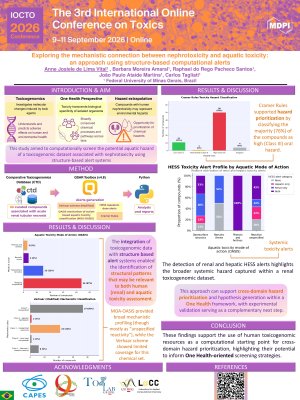
Toxicogenomics investigates molecular changes induced by toxic agents to understand and predict adverse effects on human and environmental health. The toxicity of chemical compounds may transcend the biological specificity of isolated organisms, aligning with the One Health concept. Because chemically driven processes are broadly conserved across taxa, compounds associated with human nephrotoxicity may also represent environmental hazards, supporting a One Health perspective for hazard prioritization. Therefore, this study aimed to computationally screen the potential aquatic hazard of a toxicogenomic dataset associated with nephrotoxicity using structure-based alert systems. Sixty-six compounds associated with acute renal tubular necrosis were retrieved from the Comparative Toxicogenomics Database (CTD), an integrated resource of toxicological, toxicogenomic, and pathway data, and submitted to the OECD QSAR Toolbox (v4.8) using four alert systems: Verhaar scheme (Modified); OASIS mechanism of action-based aquatic toxicity classification (MOA-OASIS); Cramer Rules; and HESS repeated-dose alerts, parsed for renal and hepatic structural indicators. All compounds received a MOA-OASIS assignment, with 67% falling into the “Reactive unspecified” category, indicating limited mechanistic resolution for this class of electrophilic nephrotoxicants. Narcotic modes of action accounted for 29%, consistent with potential mechanisms involving nonspecific membrane interactions. Under the Verhaar scheme, 44% were assigned to defined classes, while 56% remained unclassifiable. The Cramer Rules classified 76% as high hazard. HESS alerts identified 41 compounds with explicit renal toxicity indicators, of which 25 also received a "Reactive unspecified" aquatic MOA. The results suggest that structural features associated with nephrotoxicity may also be relevant to aquatic hazard assessment and provide mechanistic hypotheses based on shared structure-derived indicators. Given that the analysis relied exclusively on structure-based alerts, these findings should be regarded as hypothesis-generating rather than evidence of shared biological mechanisms. These findings support the use of toxicogenomic resources and computational screening for One Health-oriented hazard prioritization.
Keywords
predictive toxicology
bioinformatics
NAMs
toxicogenomics
Poster
poster_iocto_corrigido.pdf
How Optimization of Skin Sensitization and Photoirritation Assays are Advancing in vitro Photoallergy Assessment
Optimization of ICP-MS/MS-based methodology for multielemental analysis in follicular fluid: new approaches in female infertility research