Event submissions
Published
This submission belongs to the session 3. Innovating Toxicology: NAMs and Computational Tools for Next-Generation Risk Assessment of the event The 3rd International Online Conference on Toxics
Published date
04 Sep, 2026
Academic Editor
'%3e%3cpath%20d='M12.6657%2010.9104C12.4185%2010.325%2012.0599%209.79327%2011.6097%209.34482C11.1609%208.89508%2010.6293%208.5365%2010.0442%208.28888C10.0389%208.28626%2010.0337%208.28495%2010.0285%208.28233C10.8446%207.69279%2011.3752%206.73249%2011.3752%205.64904C11.3752%203.8542%209.92103%202.39999%208.1262%202.39999C6.33136%202.39999%204.87715%203.8542%204.87715%205.64904C4.87715%206.73249%205.40774%207.69279%206.22393%208.28364C6.21869%208.28626%206.21345%208.28757%206.20821%208.29019C5.62129%208.5378%205.09463%208.89284%204.64265%209.34613C4.1929%209.79493%203.83432%2010.3266%203.58671%2010.9117C3.34345%2011.4845%203.21226%2012.0987%203.20023%2012.7209C3.19988%2012.7349%203.20233%2012.7488%203.20744%2012.7619C3.21255%2012.7749%203.22022%2012.7867%203.22998%2012.7968C3.23975%2012.8068%203.25142%2012.8147%203.26431%2012.8202C3.2772%2012.8256%203.29105%2012.8284%203.30504%2012.8284H4.09109C4.14874%2012.8284%204.19459%2012.7825%204.1959%2012.7262C4.2221%2011.7148%204.62823%2010.7676%205.34617%2010.0497C6.08899%209.30683%207.0755%208.89808%208.1262%208.89808C9.17689%208.89808%2010.1634%209.30683%2010.9062%2010.0497C11.6242%2010.7676%2012.0303%2011.7148%2012.0565%2012.7262C12.0578%2012.7838%2012.1037%2012.8284%2012.1613%2012.8284H12.9474C12.9613%2012.8284%2012.9752%2012.8256%2012.9881%2012.8202C13.001%2012.8147%2013.0126%2012.8068%2013.0224%2012.7968C13.0322%2012.7867%2013.0398%2012.7749%2013.0449%2012.7619C13.0501%2012.7488%2013.0525%2012.7349%2013.0522%2012.7209C13.0391%2012.0947%2012.9094%2011.4855%2012.6657%2010.9104ZM8.1262%207.9024C7.52486%207.9024%206.9589%207.6679%206.53312%207.24211C6.10733%206.81633%205.87283%206.25037%205.87283%205.64904C5.87283%205.0477%206.10733%204.48174%206.53312%204.05596C6.9589%203.63018%207.52486%203.39567%208.1262%203.39567C8.72753%203.39567%209.29349%203.63018%209.71927%204.05596C10.1451%204.48174%2010.3796%205.0477%2010.3796%205.64904C10.3796%206.25037%2010.1451%206.81633%209.71927%207.24211C9.29349%207.6679%208.72753%207.9024%208.1262%207.9024Z'%20fill='%235D1EE1'/%3e%3c/g%3e%3c/svg%3e) Emilio Benfenati
Emilio BenfenatiCitation
Jakeb Phillips, Argel Islas-Robles, Gretchen Ritacco, Allison Hilberer, Chaitra Deodhar, Victoria Brandalise-Lough, Kayla Dailey, Clair Cheng, Baovi Ly, Danielle Boltelho, Anne Marie Api, Optimization of the Human Cell Line Activation Test (h-CLAT) for the Identification of Photo-Allergens, in Proceedings of The 3rd International Online Conference on Toxics, 9 September–11 September 2026, MDPI: Basel, Switzerland
Share
Email
Facebook
Twitter
LinkedIn
Optimization of the Human Cell Line Activation Test (h-CLAT) for the Identification of Photo-Allergens
'%3e%3cpath%20d='M12.6647%2010.9104C12.4176%2010.325%2012.0589%209.7933%2011.6088%209.34485C11.16%208.89511%2010.6283%208.53653%2010.0432%208.28891C10.038%208.28629%2010.0327%208.28498%2010.0275%208.28236C10.8437%207.69282%2011.3743%206.73252%2011.3743%205.64907C11.3743%203.85423%209.92005%202.40002%208.12522%202.40002C6.33038%202.40002%204.87618%203.85423%204.87618%205.64907C4.87618%206.73252%205.40677%207.69282%206.22296%208.28367C6.21772%208.28629%206.21248%208.2876%206.20724%208.29022C5.62031%208.53783%205.09365%208.89287%204.64167%209.34616C4.19192%209.79496%203.83334%2010.3266%203.58573%2010.9117C3.34247%2011.4846%203.21128%2012.0987%203.19925%2012.721C3.1989%2012.735%203.20135%2012.7489%203.20646%2012.7619C3.21157%2012.7749%203.21924%2012.7868%203.22901%2012.7968C3.23877%2012.8068%203.25045%2012.8148%203.26334%2012.8202C3.27623%2012.8256%203.29007%2012.8284%203.30406%2012.8284H4.09012C4.14776%2012.8284%204.19362%2012.7825%204.19493%2012.7262C4.22113%2011.7148%204.62726%2010.7676%205.34519%2010.0497C6.08802%209.30686%207.07452%208.89811%208.12522%208.89811C9.17592%208.89811%2010.1624%209.30686%2010.9052%2010.0497C11.6232%2010.7676%2012.0293%2011.7148%2012.0555%2012.7262C12.0568%2012.7839%2012.1027%2012.8284%2012.1603%2012.8284H12.9464C12.9604%2012.8284%2012.9742%2012.8256%2012.9871%2012.8202C13%2012.8148%2013.0117%2012.8068%2013.0214%2012.7968C13.0312%2012.7868%2013.0389%2012.7749%2013.044%2012.7619C13.0491%2012.7489%2013.0515%2012.735%2013.0512%2012.721C13.0381%2012.0947%2012.9084%2011.4856%2012.6647%2010.9104ZM8.12522%207.90243C7.52388%207.90243%206.95792%207.66793%206.53214%207.24215C6.10636%206.81636%205.87185%206.2504%205.87185%205.64907C5.87185%205.04773%206.10636%204.48177%206.53214%204.05599C6.95792%203.63021%207.52388%203.3957%208.12522%203.3957C8.72655%203.3957%209.29252%203.63021%209.7183%204.05599C10.1441%204.48177%2010.3786%205.04773%2010.3786%205.64907C10.3786%206.2504%2010.1441%206.81636%209.7183%207.24215C9.29252%207.66793%208.72655%207.90243%208.12522%207.90243Z'%20fill='%235D1EE1'/%3e%3c/g%3e%3c/svg%3e)
Jakeb Phillips 1
Argel Islas-Robles 1
Gretchen Ritacco 2
Allison Hilberer 1
Chaitra Deodhar 2
Victoria Brandalise-Lough 1
Kayla Dailey 1
Clair Cheng 1
Baovi Ly 1
Danielle Boltelho 2
Anne Marie Api 2
1. Institute for In Vitro Sciences, Gaithersburg, MD, USA
2. The Research Institute for Fragrance Materials, Mahwah, NJ, USA
Abstract
Photosensitization refers to light-induced adverse tissue effects resulting from exposure to photoreactive chemicals in combination with ultraviolet (UV) or visible light. Unlike phototoxicity, photoallergy is an immune-mediated delayed hypersensitivity reaction in which light transforms a chemical into a sensitizer capable of activating dendritic cells and inducing allergic contact dermatitis. To support the development of new approach methodologies (NAMs) for photoallergy assessment, this study optimized the human Cell Line Activation Test (h-CLAT) for use with UVA exposure.
The photo-h-CLAT was established by incorporating UVA irradiation (1.7 ± 0.2 mW/cm²; total dose 5 J/cm²) into the standard h-CLAT framework (OECD TG 442E) using THP-1 cells. Four sequential method iterations were evaluated to optimize assay performance and reproducibility. Modifications included changes to pre- and post-exposure incubation periods, rinsing procedures, antibody incubation time, and preparation of test chemicals in either DPBS or phenol red–free medium. Chlorpromazine hydrochloride (CPZ) was tested at multiple concentrations to monitor assay sensitivity and consistency. Following treatment, cells were stained for CD54 and CD86 expression and analyzed by flow cytometry. Compounds were classified as positive when the light-to-dark relative fluorescence intensity ratio was ≥2.0 for CD54 or ≥1.5 for CD86.
CPZ consistently exceeded the CD54 threshold under UVA exposure and was established as a reliable positive control. Following optimization, the photo-h-CLAT correctly identified 9 of 10 reference chemicals with compelling evidence of photoallergenicity. These findings highlight the potential of the photo-h-CLAT as a NAM for identifying photoallergens and support its further refinement and evaluation.
Keywords
allergic contact dermatitis
in vitro
h-CLAT
photoallegen
phototoxicity
skin sensitization
hazard assessment
NAMs
Poster
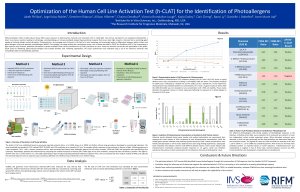
Photo h-CLAT SOT 2026.pdf
Optimization of ICP-MS/MS-based methodology for multielemental analysis in follicular fluid: new approaches in female infertility research
ZODDs: A Zebrafish Organ-Specific and Dose-Response Database for Environmental Chemical Mixtures