Event submissions
Published
This submission belongs to the session 3. Innovating Toxicology: NAMs and Computational Tools for Next-Generation Risk Assessment of the event The 3rd International Online Conference on Toxics
Published date
04 Sep, 2026
Academic Editor
'%3e%3cpath%20d='M12.6657%2010.9104C12.4185%2010.325%2012.0599%209.79327%2011.6097%209.34482C11.1609%208.89508%2010.6293%208.5365%2010.0442%208.28888C10.0389%208.28626%2010.0337%208.28495%2010.0285%208.28233C10.8446%207.69279%2011.3752%206.73249%2011.3752%205.64904C11.3752%203.8542%209.92103%202.39999%208.1262%202.39999C6.33136%202.39999%204.87715%203.8542%204.87715%205.64904C4.87715%206.73249%205.40774%207.69279%206.22393%208.28364C6.21869%208.28626%206.21345%208.28757%206.20821%208.29019C5.62129%208.5378%205.09463%208.89284%204.64265%209.34613C4.1929%209.79493%203.83432%2010.3266%203.58671%2010.9117C3.34345%2011.4845%203.21226%2012.0987%203.20023%2012.7209C3.19988%2012.7349%203.20233%2012.7488%203.20744%2012.7619C3.21255%2012.7749%203.22022%2012.7867%203.22998%2012.7968C3.23975%2012.8068%203.25142%2012.8147%203.26431%2012.8202C3.2772%2012.8256%203.29105%2012.8284%203.30504%2012.8284H4.09109C4.14874%2012.8284%204.19459%2012.7825%204.1959%2012.7262C4.2221%2011.7148%204.62823%2010.7676%205.34617%2010.0497C6.08899%209.30683%207.0755%208.89808%208.1262%208.89808C9.17689%208.89808%2010.1634%209.30683%2010.9062%2010.0497C11.6242%2010.7676%2012.0303%2011.7148%2012.0565%2012.7262C12.0578%2012.7838%2012.1037%2012.8284%2012.1613%2012.8284H12.9474C12.9613%2012.8284%2012.9752%2012.8256%2012.9881%2012.8202C13.001%2012.8147%2013.0126%2012.8068%2013.0224%2012.7968C13.0322%2012.7867%2013.0398%2012.7749%2013.0449%2012.7619C13.0501%2012.7488%2013.0525%2012.7349%2013.0522%2012.7209C13.0391%2012.0947%2012.9094%2011.4855%2012.6657%2010.9104ZM8.1262%207.9024C7.52486%207.9024%206.9589%207.6679%206.53312%207.24211C6.10733%206.81633%205.87283%206.25037%205.87283%205.64904C5.87283%205.0477%206.10733%204.48174%206.53312%204.05596C6.9589%203.63018%207.52486%203.39567%208.1262%203.39567C8.72753%203.39567%209.29349%203.63018%209.71927%204.05596C10.1451%204.48174%2010.3796%205.0477%2010.3796%205.64904C10.3796%206.25037%2010.1451%206.81633%209.71927%207.24211C9.29349%207.6679%208.72753%207.9024%208.1262%207.9024Z'%20fill='%235D1EE1'/%3e%3c/g%3e%3c/svg%3e) Emilio Benfenati
Emilio BenfenatiCitation
Margarida Vilaça, Rosária Seabra, Maria João Rocha, Célia Lopes, Eduardo Rocha, Aryl hydrocarbon receptor pathway activation in fish hepatocytes exposed to fire-associated contaminants under elevated temperature, in Proceedings of The 3rd International Online Conference on Toxics, 9 September–11 September 2026, MDPI: Basel, Switzerland
Share
Email
Facebook
Twitter
LinkedIn
Aryl hydrocarbon receptor pathway activation in fish hepatocytes exposed to fire-associated contaminants under elevated temperature
'%3e%3cpath%20d='M12.6647%2010.9104C12.4176%2010.325%2012.0589%209.7933%2011.6088%209.34485C11.16%208.89511%2010.6283%208.53653%2010.0432%208.28891C10.038%208.28629%2010.0327%208.28498%2010.0275%208.28236C10.8437%207.69282%2011.3743%206.73252%2011.3743%205.64907C11.3743%203.85423%209.92005%202.40002%208.12522%202.40002C6.33038%202.40002%204.87618%203.85423%204.87618%205.64907C4.87618%206.73252%205.40677%207.69282%206.22296%208.28367C6.21772%208.28629%206.21248%208.2876%206.20724%208.29022C5.62031%208.53783%205.09365%208.89287%204.64167%209.34616C4.19192%209.79496%203.83334%2010.3266%203.58573%2010.9117C3.34247%2011.4846%203.21128%2012.0987%203.19925%2012.721C3.1989%2012.735%203.20135%2012.7489%203.20646%2012.7619C3.21157%2012.7749%203.21924%2012.7868%203.22901%2012.7968C3.23877%2012.8068%203.25045%2012.8148%203.26334%2012.8202C3.27623%2012.8256%203.29007%2012.8284%203.30406%2012.8284H4.09012C4.14776%2012.8284%204.19362%2012.7825%204.19493%2012.7262C4.22113%2011.7148%204.62726%2010.7676%205.34519%2010.0497C6.08802%209.30686%207.07452%208.89811%208.12522%208.89811C9.17592%208.89811%2010.1624%209.30686%2010.9052%2010.0497C11.6232%2010.7676%2012.0293%2011.7148%2012.0555%2012.7262C12.0568%2012.7839%2012.1027%2012.8284%2012.1603%2012.8284H12.9464C12.9604%2012.8284%2012.9742%2012.8256%2012.9871%2012.8202C13%2012.8148%2013.0117%2012.8068%2013.0214%2012.7968C13.0312%2012.7868%2013.0389%2012.7749%2013.044%2012.7619C13.0491%2012.7489%2013.0515%2012.735%2013.0512%2012.721C13.0381%2012.0947%2012.9084%2011.4856%2012.6647%2010.9104ZM8.12522%207.90243C7.52388%207.90243%206.95792%207.66793%206.53214%207.24215C6.10636%206.81636%205.87185%206.2504%205.87185%205.64907C5.87185%205.04773%206.10636%204.48177%206.53214%204.05599C6.95792%203.63021%207.52388%203.3957%208.12522%203.3957C8.72655%203.3957%209.29252%203.63021%209.7183%204.05599C10.1441%204.48177%2010.3786%205.04773%2010.3786%205.64907C10.3786%206.2504%2010.1441%206.81636%209.7183%207.24215C9.29252%207.66793%208.72655%207.90243%208.12522%207.90243Z'%20fill='%235D1EE1'/%3e%3c/g%3e%3c/svg%3e)
Margarida Vilaça 1,2
Rosária Seabra 1,2

Maria João Rocha 1,2
Célia Lopes 1,2

Eduardo Rocha 1,2
1. Laboratory of Histology and Embryology - School of Medicine and Biomedical Sciences (ICBAS), University of Porto, Porto
2. Group of Animal Morphology and Toxicology, Interdisciplinary Centre of Marine and Environmental Research (CIIMAR/CIMAR), University of Porto, Porto
Abstract
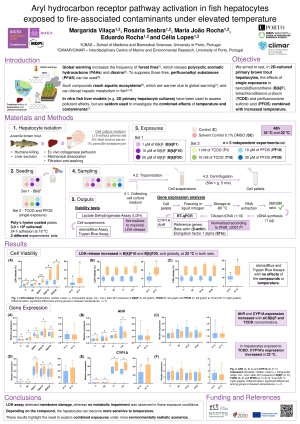
Global warming has increased wildfire frequency, contributing to the accumulation of pollutants such as polycyclic aromatic hydrocarbons (PAHs) and dioxins. Firefighting activities further contribute to the release of harmful substances, including perfluoroalkyl substances (PFAS) used in fire suppression. Such compounds reach aquatic ecosystems and can disrupt hepatic metabolism in fish. Rising water temperatures due to global warming may also affect detoxification processes. In vitro fish liver models have been used to assess pollutant effects, but are seldom used to investigate the combined effects of temperature and contaminants. This study evaluated whether increased temperature modulates cytochrome P450 1A (CYP1A) activation induced by the aryl hydrocarbon receptor (AhR) ligands tetrachlorodibenzo-p-dioxin (TCDD) and benzo[k]fluoranthene (B[k]F). Effects of the PFAS perfluorooctane sulfonic acid (PFOS) were also assessed. Monolayer cultures of primary brown trout (Salmo trutta) hepatocytes (n = 5) were exposed (48 h) to B[k]F (1, 10, 20 µM), TCDD (1, 10 nM) and PFOS (10, 30 µM) at 18 °C and 22 °C, simulating a 4 °C increase during heat waves. Trypan blue, alamarBlue, and lactate dehydrogenase (LDH) viability assays were performed to assess exposure effects. RT-qPCR evaluated CYP1A and AhR expression. The two-way ANOVA revealed that B[k]F (10 and 20 µM), but not TCDD or PFOS, increased LDH leakage. Furthermore, higher temperature enhanced LDH release, with no differences in the other viability tests. All TCDD and B[k]F concentrations significantly increased CYP1A expression relative to controls, whereas AhR mRNA levels increased after TCDD and B[k]F (10 and 20 µM). PFOS did not change CYP1A or AhR expression. No temperature or interaction effects were detected. Overall, the model was responsive to B[k]F and TCDD but not to PFOS, and temperature only impacted LDH leakage under the tested conditions. These results highlight the need to explore combined exposures under more environmentally realistic scenarios.
Keywords
aryl hydrocarbon receptor
benzo[k]fluoranthene
cytochrome P450 1A
global warming
hepatocyte primary cultures
perfluorooctane sulfonic acid
tetrachlorodibenzo-p-dioxin
Poster
Poster_Sciforum-186263_Margarida_Vilaca.pdf
In silico assessment of the endocrine disrupting and genotoxic potential of bisguaiacols as possible bisphenol A alternatives
Colour-Encoded Gold Nanostructure-Based Lateral Flow Immunoassay with Smartphone-Based Digital Analysis for Rapid Mycotoxin Screening