Event submissions
Published
This submission belongs to the session 3. Innovating Toxicology: NAMs and Computational Tools for Next-Generation Risk Assessment of the event The 3rd International Online Conference on Toxics
Published date
04 Sep, 2026
Academic Editor
'%3e%3cpath%20d='M12.6657%2010.9104C12.4185%2010.325%2012.0599%209.79327%2011.6097%209.34482C11.1609%208.89508%2010.6293%208.5365%2010.0442%208.28888C10.0389%208.28626%2010.0337%208.28495%2010.0285%208.28233C10.8446%207.69279%2011.3752%206.73249%2011.3752%205.64904C11.3752%203.8542%209.92103%202.39999%208.1262%202.39999C6.33136%202.39999%204.87715%203.8542%204.87715%205.64904C4.87715%206.73249%205.40774%207.69279%206.22393%208.28364C6.21869%208.28626%206.21345%208.28757%206.20821%208.29019C5.62129%208.5378%205.09463%208.89284%204.64265%209.34613C4.1929%209.79493%203.83432%2010.3266%203.58671%2010.9117C3.34345%2011.4845%203.21226%2012.0987%203.20023%2012.7209C3.19988%2012.7349%203.20233%2012.7488%203.20744%2012.7619C3.21255%2012.7749%203.22022%2012.7867%203.22998%2012.7968C3.23975%2012.8068%203.25142%2012.8147%203.26431%2012.8202C3.2772%2012.8256%203.29105%2012.8284%203.30504%2012.8284H4.09109C4.14874%2012.8284%204.19459%2012.7825%204.1959%2012.7262C4.2221%2011.7148%204.62823%2010.7676%205.34617%2010.0497C6.08899%209.30683%207.0755%208.89808%208.1262%208.89808C9.17689%208.89808%2010.1634%209.30683%2010.9062%2010.0497C11.6242%2010.7676%2012.0303%2011.7148%2012.0565%2012.7262C12.0578%2012.7838%2012.1037%2012.8284%2012.1613%2012.8284H12.9474C12.9613%2012.8284%2012.9752%2012.8256%2012.9881%2012.8202C13.001%2012.8147%2013.0126%2012.8068%2013.0224%2012.7968C13.0322%2012.7867%2013.0398%2012.7749%2013.0449%2012.7619C13.0501%2012.7488%2013.0525%2012.7349%2013.0522%2012.7209C13.0391%2012.0947%2012.9094%2011.4855%2012.6657%2010.9104ZM8.1262%207.9024C7.52486%207.9024%206.9589%207.6679%206.53312%207.24211C6.10733%206.81633%205.87283%206.25037%205.87283%205.64904C5.87283%205.0477%206.10733%204.48174%206.53312%204.05596C6.9589%203.63018%207.52486%203.39567%208.1262%203.39567C8.72753%203.39567%209.29349%203.63018%209.71927%204.05596C10.1451%204.48174%2010.3796%205.0477%2010.3796%205.64904C10.3796%206.25037%2010.1451%206.81633%209.71927%207.24211C9.29349%207.6679%208.72753%207.9024%208.1262%207.9024Z'%20fill='%235D1EE1'/%3e%3c/g%3e%3c/svg%3e) Emilio Benfenati
Emilio BenfenatiCitation
Gayathree Thenuwara, Bilal Javed, Baljit Singh, Furong Tian, Colour-Encoded Gold Nanostructure-Based Lateral Flow Immunoassay with Smartphone-Based Digital Analysis for Rapid Mycotoxin Screening, in Proceedings of The 3rd International Online Conference on Toxics, 9 September–11 September 2026, MDPI: Basel, Switzerland
Share
Email
Facebook
Twitter
LinkedIn
Colour-Encoded Gold Nanostructure-Based Lateral Flow Immunoassay with Smartphone-Based Digital Analysis for Rapid Mycotoxin Screening
'%3e%3cpath%20d='M12.6647%2010.9104C12.4176%2010.325%2012.0589%209.7933%2011.6088%209.34485C11.16%208.89511%2010.6283%208.53653%2010.0432%208.28891C10.038%208.28629%2010.0327%208.28498%2010.0275%208.28236C10.8437%207.69282%2011.3743%206.73252%2011.3743%205.64907C11.3743%203.85423%209.92005%202.40002%208.12522%202.40002C6.33038%202.40002%204.87618%203.85423%204.87618%205.64907C4.87618%206.73252%205.40677%207.69282%206.22296%208.28367C6.21772%208.28629%206.21248%208.2876%206.20724%208.29022C5.62031%208.53783%205.09365%208.89287%204.64167%209.34616C4.19192%209.79496%203.83334%2010.3266%203.58573%2010.9117C3.34247%2011.4846%203.21128%2012.0987%203.19925%2012.721C3.1989%2012.735%203.20135%2012.7489%203.20646%2012.7619C3.21157%2012.7749%203.21924%2012.7868%203.22901%2012.7968C3.23877%2012.8068%203.25045%2012.8148%203.26334%2012.8202C3.27623%2012.8256%203.29007%2012.8284%203.30406%2012.8284H4.09012C4.14776%2012.8284%204.19362%2012.7825%204.19493%2012.7262C4.22113%2011.7148%204.62726%2010.7676%205.34519%2010.0497C6.08802%209.30686%207.07452%208.89811%208.12522%208.89811C9.17592%208.89811%2010.1624%209.30686%2010.9052%2010.0497C11.6232%2010.7676%2012.0293%2011.7148%2012.0555%2012.7262C12.0568%2012.7839%2012.1027%2012.8284%2012.1603%2012.8284H12.9464C12.9604%2012.8284%2012.9742%2012.8256%2012.9871%2012.8202C13%2012.8148%2013.0117%2012.8068%2013.0214%2012.7968C13.0312%2012.7868%2013.0389%2012.7749%2013.044%2012.7619C13.0491%2012.7489%2013.0515%2012.735%2013.0512%2012.721C13.0381%2012.0947%2012.9084%2011.4856%2012.6647%2010.9104ZM8.12522%207.90243C7.52388%207.90243%206.95792%207.66793%206.53214%207.24215C6.10636%206.81636%205.87185%206.2504%205.87185%205.64907C5.87185%205.04773%206.10636%204.48177%206.53214%204.05599C6.95792%203.63021%207.52388%203.3957%208.12522%203.3957C8.72655%203.3957%209.29252%203.63021%209.7183%204.05599C10.1441%204.48177%2010.3786%205.04773%2010.3786%205.64907C10.3786%206.2504%2010.1441%206.81636%209.7183%207.24215C9.29252%207.66793%208.72655%207.90243%208.12522%207.90243Z'%20fill='%235D1EE1'/%3e%3c/g%3e%3c/svg%3e)
Gayathree Thenuwara 1
Bilal Javed 1

Baljit Singh 2

Furong Tian 1
1. School of Food Science and Environmental Health, Technological University Dublin, Grangegorman, D07 ADY7 Dublin, Ireland
2. MiCRA Biodiagnostics Technology Gateway and Health, Engineering & Materials Science (HEMS) Research Hub, Technological University Dublin, D24 FKT9 Dublin
Abstract
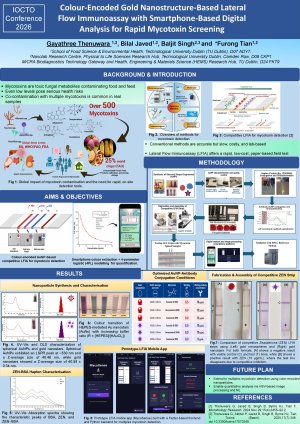
Mycotoxin contamination in food and feed remains a major challenge, particularly because multiple toxins can co-occur and complicate monitoring. Rapid screening methods are required to complement laboratory analysis and support timely on-site decision-making. In this work, a colour-encoded lateral flow immunoassay (LFIA) platform was developed using zearalenone (ZEN), aflatoxin B1 (AFB1), and fumonisin B1 (FB1), with the longer-term objective of enabling multiplex detection on a single test strip. To provide distinguishable optical signals for future multi-analyte detection, gold nanostructures with different morphologies were synthesised, including spherical gold nanoparticles with diameters of 20–40 nm, gold nanostars with overall sizes of ~88–140 nm, and gold nanoflowers with an overall size of ~100 nm. These nanomaterials were characterised by UV–Vis spectroscopy, dynamic light scattering (DLS), and scanning electron microscopy (SEM) to assess their optical behaviour, size distribution, morphology, and colloidal properties. Mycotoxin-specific hapten-protein conjugates were prepared and immobilised on LFIA test lines, while antibody-nanoparticle conjugation conditions were optimised through pH adjustment, antibody loading, and blocking strategies to obtain stable detection probes. Individual competitive LFIA strips were fabricated for ZEN, AFB1, and FB1 and evaluated as single-analyte systems. The assays produced clear visual responses, with toxin-dependent changes in test line intensity, confirming effective competitive binding and qualitative detection. To support objective interpretation, a prototype smartphone-based application was developed in Flutter for on-device digital analysis. The application allows users to select and display LFIA images alongside a reference image, automatically detect horizontal colour bands, extract average colour information, and analyse band signals using RGB/Hex values and HSV colour space. Detected bands are labelled by assigned line position, and test validity is assessed from control line presence. Overall, this work supports future multiplex LFIA development by integrating colour-encoded gold nanostructures, competitive immunoassay formats, and prototype digital analysis for rapid, on-site multi-mycotoxin screening in food safety applications.
Keywords
Keywords: Mycotoxins
Food contaminants
Zearalenone
Aflatoxin B1
Fumonisin B1
Lateral flow immunoassay
Colour-encoded gold nanostructures
Smartphone-based digital analysis
On-site toxin screening
Food safety.
Poster
Gayathree Thenuwara Poster_IOCTO 2026.pdf
Aryl hydrocarbon receptor pathway activation in fish hepatocytes exposed to fire-associated contaminants under elevated temperature
Filling Monitoring Gaps in Freshwater Pesticide Surveillance Using Random Forest Machine Learning