Event submissions
Published
This submission belongs to the session 4. Molecular and Cellular Mechanisms, Comparative Toxicology, and Multi-Omics Integration of the event The 3rd International Online Conference on Toxics
Published date
04 Sep, 2026
Academic Editor
'%3e%3cpath%20d='M12.6657%2010.9104C12.4185%2010.325%2012.0599%209.79327%2011.6097%209.34482C11.1609%208.89508%2010.6293%208.5365%2010.0442%208.28888C10.0389%208.28626%2010.0337%208.28495%2010.0285%208.28233C10.8446%207.69279%2011.3752%206.73249%2011.3752%205.64904C11.3752%203.8542%209.92103%202.39999%208.1262%202.39999C6.33136%202.39999%204.87715%203.8542%204.87715%205.64904C4.87715%206.73249%205.40774%207.69279%206.22393%208.28364C6.21869%208.28626%206.21345%208.28757%206.20821%208.29019C5.62129%208.5378%205.09463%208.89284%204.64265%209.34613C4.1929%209.79493%203.83432%2010.3266%203.58671%2010.9117C3.34345%2011.4845%203.21226%2012.0987%203.20023%2012.7209C3.19988%2012.7349%203.20233%2012.7488%203.20744%2012.7619C3.21255%2012.7749%203.22022%2012.7867%203.22998%2012.7968C3.23975%2012.8068%203.25142%2012.8147%203.26431%2012.8202C3.2772%2012.8256%203.29105%2012.8284%203.30504%2012.8284H4.09109C4.14874%2012.8284%204.19459%2012.7825%204.1959%2012.7262C4.2221%2011.7148%204.62823%2010.7676%205.34617%2010.0497C6.08899%209.30683%207.0755%208.89808%208.1262%208.89808C9.17689%208.89808%2010.1634%209.30683%2010.9062%2010.0497C11.6242%2010.7676%2012.0303%2011.7148%2012.0565%2012.7262C12.0578%2012.7838%2012.1037%2012.8284%2012.1613%2012.8284H12.9474C12.9613%2012.8284%2012.9752%2012.8256%2012.9881%2012.8202C13.001%2012.8147%2013.0126%2012.8068%2013.0224%2012.7968C13.0322%2012.7867%2013.0398%2012.7749%2013.0449%2012.7619C13.0501%2012.7488%2013.0525%2012.7349%2013.0522%2012.7209C13.0391%2012.0947%2012.9094%2011.4855%2012.6657%2010.9104ZM8.1262%207.9024C7.52486%207.9024%206.9589%207.6679%206.53312%207.24211C6.10733%206.81633%205.87283%206.25037%205.87283%205.64904C5.87283%205.0477%206.10733%204.48174%206.53312%204.05596C6.9589%203.63018%207.52486%203.39567%208.1262%203.39567C8.72753%203.39567%209.29349%203.63018%209.71927%204.05596C10.1451%204.48174%2010.3796%205.0477%2010.3796%205.64904C10.3796%206.25037%2010.1451%206.81633%209.71927%207.24211C9.29349%207.6679%208.72753%207.9024%208.1262%207.9024Z'%20fill='%235D1EE1'/%3e%3c/g%3e%3c/svg%3e) Yankai Xia
Yankai XiaCitation
Antônio Tonon Bissoli, Wender Rouver, Jéssyca Giesen, Juan Carvalho, Ana Alissa Borgonhone, Jones Graceli, Roger Lyrio Dos Santos, Effects of Exposure to Tributyltin on Endothelium-Dependent Vasodilation in Mesenteric Resistance Arteries of Wistar Rats, in Proceedings of The 3rd International Online Conference on Toxics, 9 September–11 September 2026, MDPI: Basel, Switzerland
Share
Email
Facebook
Twitter
LinkedIn
Effects of Exposure to Tributyltin on Endothelium-Dependent Vasodilation in Mesenteric Resistance Arteries of Wistar Rats
'%3e%3cpath%20d='M12.6647%2010.9104C12.4176%2010.325%2012.0589%209.7933%2011.6088%209.34485C11.16%208.89511%2010.6283%208.53653%2010.0432%208.28891C10.038%208.28629%2010.0327%208.28498%2010.0275%208.28236C10.8437%207.69282%2011.3743%206.73252%2011.3743%205.64907C11.3743%203.85423%209.92005%202.40002%208.12522%202.40002C6.33038%202.40002%204.87618%203.85423%204.87618%205.64907C4.87618%206.73252%205.40677%207.69282%206.22296%208.28367C6.21772%208.28629%206.21248%208.2876%206.20724%208.29022C5.62031%208.53783%205.09365%208.89287%204.64167%209.34616C4.19192%209.79496%203.83334%2010.3266%203.58573%2010.9117C3.34247%2011.4846%203.21128%2012.0987%203.19925%2012.721C3.1989%2012.735%203.20135%2012.7489%203.20646%2012.7619C3.21157%2012.7749%203.21924%2012.7868%203.22901%2012.7968C3.23877%2012.8068%203.25045%2012.8148%203.26334%2012.8202C3.27623%2012.8256%203.29007%2012.8284%203.30406%2012.8284H4.09012C4.14776%2012.8284%204.19362%2012.7825%204.19493%2012.7262C4.22113%2011.7148%204.62726%2010.7676%205.34519%2010.0497C6.08802%209.30686%207.07452%208.89811%208.12522%208.89811C9.17592%208.89811%2010.1624%209.30686%2010.9052%2010.0497C11.6232%2010.7676%2012.0293%2011.7148%2012.0555%2012.7262C12.0568%2012.7839%2012.1027%2012.8284%2012.1603%2012.8284H12.9464C12.9604%2012.8284%2012.9742%2012.8256%2012.9871%2012.8202C13%2012.8148%2013.0117%2012.8068%2013.0214%2012.7968C13.0312%2012.7868%2013.0389%2012.7749%2013.044%2012.7619C13.0491%2012.7489%2013.0515%2012.735%2013.0512%2012.721C13.0381%2012.0947%2012.9084%2011.4856%2012.6647%2010.9104ZM8.12522%207.90243C7.52388%207.90243%206.95792%207.66793%206.53214%207.24215C6.10636%206.81636%205.87185%206.2504%205.87185%205.64907C5.87185%205.04773%206.10636%204.48177%206.53214%204.05599C6.95792%203.63021%207.52388%203.3957%208.12522%203.3957C8.72655%203.3957%209.29252%203.63021%209.7183%204.05599C10.1441%204.48177%2010.3786%205.04773%2010.3786%205.64907C10.3786%206.2504%2010.1441%206.81636%209.7183%207.24215C9.29252%207.66793%208.72655%207.90243%208.12522%207.90243Z'%20fill='%235D1EE1'/%3e%3c/g%3e%3c/svg%3e)
Antônio Tonon Bissoli 1
Wender Rouver 2
Jéssyca Giesen 2
Juan Carvalho 3
Ana Alissa Borgonhone 4
Jones Graceli 5
Roger Lyrio Dos Santos 6
1. Ciências Biológicas pela, Universidade Federal do Espírito Santo, Vitória
2. Laboratório de Endocrinologia e Reatividade Vascular, Universidade Federal do Espírito San, Vitória
3. Enfermagem pela Faculdade Multivix Vitória, Centro Universitário Multivix Vitória, Vitória
4. Biomedicina course at Multivix, Centro Universitário Multivix Vitória, Vitória
5. Departamento de Morfologia, Universidade Federal do Espírito Santo, Vitória
6. Departamento de Ciências Fisiológicas, Universidade Federal do Espírito Santo, Vitória
Abstract
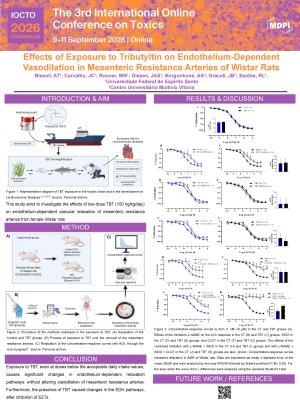
Tributyltin (TBT) is a persistent organic pollutant and endocrine disruptor associated with cardiovascular damage. Although the World Health Organization established an acceptable daily intake (ADI) of 250 ng/kg/day, evidence suggests that even low doses may induce vascular dysfunction. However, the effects of TBT on mesenteric resistance arteries (MRA) remain unclear. This study evaluated the effects of low-dose TBT exposure (100 ng/kg/day) on MRA vascular reactivity. Female Wistar rats (12 weeks old) were divided into two groups: CT — receiving vehicle solution (0.4 % ethanol), and TBT — receiving TBT (100 ng/kg/day), both administered via oral gavage. All experimental protocols were approved by the Institutional Ethics Committee (#19/2022). Mesenteric resistance arteries were isolated and mounted on a wire myograph for vascular reactivity analysis. Concentration-response curves to acetylcholine (ACh, 1 nM–10 μM) were obtained in vessels precontracted with phenylephrine (PE, 3 μM), as well as curves to PE (1 nM–100 μM), before and after incubation with L-NAME (300 μM), indomethacin (10 μM), or clotrimazole (0.75 μM). Data were analyzed using two-way ANOVA followed by Sidak’s post hoc test and Student’s t-test (p < 0.05). TBT exposure did not alter vasodilation (CT: 90.5 ± 2.9 %; TBT: 93.2 ± 3.1 %), but promoted changes in the epoxyeicosatrienoic acid (EET)-mediated relaxation pathway, reducing the maximum response (CT EET: 62.5 ± 6.3 %; TBT EET: 6.7 ± 2.5 %). In the nitric oxide pathway, the presence of TBT modified the maximum response (TBT: 93.2 ± 3.1 %; TBT L-NAME: 74.26 ± 5.5 %), unlike the CT group (CT: 90.6 ± 2.9 %; CT L-NAME: 80.4 ± 6.67 %). The remaining relaxation pathways remained similar. In conclusion, TBT alters vascular mechanisms even at doses below the ADI value.
Keywords
Tributyltin
Vascular Relaxation
Endothelium
Mesenteric Resistance Arteries.
Poster
Poster with Flashcards.pdf
“Oxidative DNA Damage and Repair Disruption Under Pesticide–Metal Co‑Exposure”
Low-Dose Tributyltin Exposure Induces Vascular Dysfunction and Oxidative Stress in Resistance Mesenteric Arteries of Wistar Rats