Event submissions
Published
This submission belongs to the session 4. Molecular and Cellular Mechanisms, Comparative Toxicology, and Multi-Omics Integration of the event The 3rd International Online Conference on Toxics
Published date
04 Sep, 2026
Academic Editor
'%3e%3cpath%20d='M12.6657%2010.9104C12.4185%2010.325%2012.0599%209.79327%2011.6097%209.34482C11.1609%208.89508%2010.6293%208.5365%2010.0442%208.28888C10.0389%208.28626%2010.0337%208.28495%2010.0285%208.28233C10.8446%207.69279%2011.3752%206.73249%2011.3752%205.64904C11.3752%203.8542%209.92103%202.39999%208.1262%202.39999C6.33136%202.39999%204.87715%203.8542%204.87715%205.64904C4.87715%206.73249%205.40774%207.69279%206.22393%208.28364C6.21869%208.28626%206.21345%208.28757%206.20821%208.29019C5.62129%208.5378%205.09463%208.89284%204.64265%209.34613C4.1929%209.79493%203.83432%2010.3266%203.58671%2010.9117C3.34345%2011.4845%203.21226%2012.0987%203.20023%2012.7209C3.19988%2012.7349%203.20233%2012.7488%203.20744%2012.7619C3.21255%2012.7749%203.22022%2012.7867%203.22998%2012.7968C3.23975%2012.8068%203.25142%2012.8147%203.26431%2012.8202C3.2772%2012.8256%203.29105%2012.8284%203.30504%2012.8284H4.09109C4.14874%2012.8284%204.19459%2012.7825%204.1959%2012.7262C4.2221%2011.7148%204.62823%2010.7676%205.34617%2010.0497C6.08899%209.30683%207.0755%208.89808%208.1262%208.89808C9.17689%208.89808%2010.1634%209.30683%2010.9062%2010.0497C11.6242%2010.7676%2012.0303%2011.7148%2012.0565%2012.7262C12.0578%2012.7838%2012.1037%2012.8284%2012.1613%2012.8284H12.9474C12.9613%2012.8284%2012.9752%2012.8256%2012.9881%2012.8202C13.001%2012.8147%2013.0126%2012.8068%2013.0224%2012.7968C13.0322%2012.7867%2013.0398%2012.7749%2013.0449%2012.7619C13.0501%2012.7488%2013.0525%2012.7349%2013.0522%2012.7209C13.0391%2012.0947%2012.9094%2011.4855%2012.6657%2010.9104ZM8.1262%207.9024C7.52486%207.9024%206.9589%207.6679%206.53312%207.24211C6.10733%206.81633%205.87283%206.25037%205.87283%205.64904C5.87283%205.0477%206.10733%204.48174%206.53312%204.05596C6.9589%203.63018%207.52486%203.39567%208.1262%203.39567C8.72753%203.39567%209.29349%203.63018%209.71927%204.05596C10.1451%204.48174%2010.3796%205.0477%2010.3796%205.64904C10.3796%206.25037%2010.1451%206.81633%209.71927%207.24211C9.29349%207.6679%208.72753%207.9024%208.1262%207.9024Z'%20fill='%235D1EE1'/%3e%3c/g%3e%3c/svg%3e) Yankai Xia
Yankai XiaCitation
JUAN CANDIDO CARVALHO, Antônio Tonon Bissoli, Ana Alissa Borgonhone, Wender Nascimento Rouver, Jéssyca Aparecida Soares Giesen, Jones Bernardes Graceli, Roger Lyrio Dos Santos, Low-Dose Tributyltin Exposure Induces Vascular Dysfunction and Oxidative Stress in Resistance Mesenteric Arteries of Wistar Rats, in Proceedings of The 3rd International Online Conference on Toxics, 9 September–11 September 2026, MDPI: Basel, Switzerland
Share
Email
Facebook
Twitter
LinkedIn
Low-Dose Tributyltin Exposure Induces Vascular Dysfunction and Oxidative Stress in Resistance Mesenteric Arteries of Wistar Rats
'%3e%3cpath%20d='M12.6647%2010.9104C12.4176%2010.325%2012.0589%209.7933%2011.6088%209.34485C11.16%208.89511%2010.6283%208.53653%2010.0432%208.28891C10.038%208.28629%2010.0327%208.28498%2010.0275%208.28236C10.8437%207.69282%2011.3743%206.73252%2011.3743%205.64907C11.3743%203.85423%209.92005%202.40002%208.12522%202.40002C6.33038%202.40002%204.87618%203.85423%204.87618%205.64907C4.87618%206.73252%205.40677%207.69282%206.22296%208.28367C6.21772%208.28629%206.21248%208.2876%206.20724%208.29022C5.62031%208.53783%205.09365%208.89287%204.64167%209.34616C4.19192%209.79496%203.83334%2010.3266%203.58573%2010.9117C3.34247%2011.4846%203.21128%2012.0987%203.19925%2012.721C3.1989%2012.735%203.20135%2012.7489%203.20646%2012.7619C3.21157%2012.7749%203.21924%2012.7868%203.22901%2012.7968C3.23877%2012.8068%203.25045%2012.8148%203.26334%2012.8202C3.27623%2012.8256%203.29007%2012.8284%203.30406%2012.8284H4.09012C4.14776%2012.8284%204.19362%2012.7825%204.19493%2012.7262C4.22113%2011.7148%204.62726%2010.7676%205.34519%2010.0497C6.08802%209.30686%207.07452%208.89811%208.12522%208.89811C9.17592%208.89811%2010.1624%209.30686%2010.9052%2010.0497C11.6232%2010.7676%2012.0293%2011.7148%2012.0555%2012.7262C12.0568%2012.7839%2012.1027%2012.8284%2012.1603%2012.8284H12.9464C12.9604%2012.8284%2012.9742%2012.8256%2012.9871%2012.8202C13%2012.8148%2013.0117%2012.8068%2013.0214%2012.7968C13.0312%2012.7868%2013.0389%2012.7749%2013.044%2012.7619C13.0491%2012.7489%2013.0515%2012.735%2013.0512%2012.721C13.0381%2012.0947%2012.9084%2011.4856%2012.6647%2010.9104ZM8.12522%207.90243C7.52388%207.90243%206.95792%207.66793%206.53214%207.24215C6.10636%206.81636%205.87185%206.2504%205.87185%205.64907C5.87185%205.04773%206.10636%204.48177%206.53214%204.05599C6.95792%203.63021%207.52388%203.3957%208.12522%203.3957C8.72655%203.3957%209.29252%203.63021%209.7183%204.05599C10.1441%204.48177%2010.3786%205.04773%2010.3786%205.64907C10.3786%206.2504%2010.1441%206.81636%209.7183%207.24215C9.29252%207.66793%208.72655%207.90243%208.12522%207.90243Z'%20fill='%235D1EE1'/%3e%3c/g%3e%3c/svg%3e)
JUAN CANDIDO CARVALHO 1
Antônio Tonon Bissoli 2
Ana Alissa Borgonhone 3
Wender Nascimento Rouver 4
Jéssyca Aparecida Soares Giesen 4
Jones Bernardes Graceli 5
Roger Lyrio Dos Santos 6
1. Enfermagem pela Faculdade Multivix Vitória, Centro Universitário Multivix Vitória, Vitória
2. Ciências Biológicas pela, Universidade Federal do Espírito Santo, Vitória
3. Biomedicina course at Multivix, Centro Universitário Multivix Vitória, Vitória
4. Laboratório de Endocrinologia e Reatividade Vascular, Universidade Federal do Espírito Santo, Vitória
5. Departamento de Morfologia, Universidade Federal do Espírito Santo, Vitória
6. Departamento de Ciências Fisiológicas, Universidade Federal do Espírito Santo, Vitória
Abstract
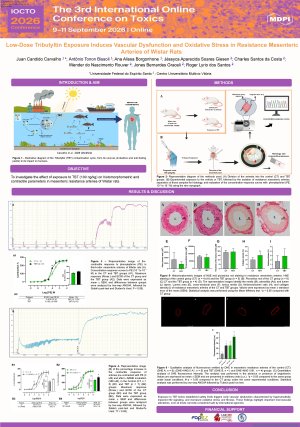
Introduction: Tributyltin (TBT) is a persistent organic pollutant with bioaccumulative potential. Although the tolerable daily intake is 250 ng/kg/day (WHO), recent evidence suggests cardiovascular toxicity at lower doses. This study investigated the functional and histomorphometric effects of low-dose TBT exposure on resistance mesenteric arteries in rats. Methods: Female Wistar rats were exposed orogastrically for 15 days to vehicle (CT) or TBT (100 ng/kg/day). Protocols were approved by the Ethics Committee (#19/2022). Vascular reactivity to phenylephrine (PE, 10⁻⁹–10⁻⁴ M) was assessed via wire myography before and after L-NAME (300 μM) incubation. Collagen area fractions and morphology were quantified via ImageJ/Fiji software after picrosirius red and H&E staining. Oxygen reactive species (ROS) were evaluated by DHE fluorescence. Data were analyzed using two-way ANOVA (vascular reactivity), Student’s t-test (histomorphometry), and one-way ANOVA (ROS), with Sidak’s/Tukey’s post-tests (p < 0.05). Results: TBT induced a leftward shift in the PE contraction curve (pEC50 CT: 5.8 ± 0.1; TBT: 6.2 ± 0.05), indicating increased vascular hypersensitivity. While L-NAME reduced EC50 in the CT group, the TBT group did not show a shift (EC50 6.2 ± 0.05 vs. 6.0 ± 0.14), suggesting impairment in the nitric oxide (NO) pathway. TBT exposure elevated basal ROS levels and increased pro-oxidant responsiveness to angiotensin II (CT: 25.33 ± 4.03 a.u.; TBT: 42.29 ± 3.21 a.u.). Histologically, TBT increased collagen deposition (15.33 ± 1.97 % vs. CT 10.33 ± 0.91%), although lumen and tunica media dimensions remained unchanged. Conclusion: Exposure to TBT below established safety limits triggers early vascular dysfunction characterized by hypersensitivity, impaired NO signaling, and increased oxidative stress and fibrosis. These findings highlight important microvascular alterations, even at levels currently considered safe by international agencies.
Keywords
Ecotoxicology
Environmental pollution
Health risk
Organostannic compounds
Vascular dysfunction.
Poster
poster- JUAN .pdf
Effects of Exposure to Tributyltin on Endothelium-Dependent Vasodilation in Mesenteric Resistance Arteries of Wistar Rats
Dose-Dependent Toxicity Assessment of Metronidazole in Developing Zebrafish (Danio rerio)