Event submissions
Published
This submission belongs to the session 4. Molecular and Cellular Mechanisms, Comparative Toxicology, and Multi-Omics Integration of the event The 3rd International Online Conference on Toxics
Published date
04 Sep, 2026
Academic Editor
'%3e%3cpath%20d='M12.6657%2010.9104C12.4185%2010.325%2012.0599%209.79327%2011.6097%209.34482C11.1609%208.89508%2010.6293%208.5365%2010.0442%208.28888C10.0389%208.28626%2010.0337%208.28495%2010.0285%208.28233C10.8446%207.69279%2011.3752%206.73249%2011.3752%205.64904C11.3752%203.8542%209.92103%202.39999%208.1262%202.39999C6.33136%202.39999%204.87715%203.8542%204.87715%205.64904C4.87715%206.73249%205.40774%207.69279%206.22393%208.28364C6.21869%208.28626%206.21345%208.28757%206.20821%208.29019C5.62129%208.5378%205.09463%208.89284%204.64265%209.34613C4.1929%209.79493%203.83432%2010.3266%203.58671%2010.9117C3.34345%2011.4845%203.21226%2012.0987%203.20023%2012.7209C3.19988%2012.7349%203.20233%2012.7488%203.20744%2012.7619C3.21255%2012.7749%203.22022%2012.7867%203.22998%2012.7968C3.23975%2012.8068%203.25142%2012.8147%203.26431%2012.8202C3.2772%2012.8256%203.29105%2012.8284%203.30504%2012.8284H4.09109C4.14874%2012.8284%204.19459%2012.7825%204.1959%2012.7262C4.2221%2011.7148%204.62823%2010.7676%205.34617%2010.0497C6.08899%209.30683%207.0755%208.89808%208.1262%208.89808C9.17689%208.89808%2010.1634%209.30683%2010.9062%2010.0497C11.6242%2010.7676%2012.0303%2011.7148%2012.0565%2012.7262C12.0578%2012.7838%2012.1037%2012.8284%2012.1613%2012.8284H12.9474C12.9613%2012.8284%2012.9752%2012.8256%2012.9881%2012.8202C13.001%2012.8147%2013.0126%2012.8068%2013.0224%2012.7968C13.0322%2012.7867%2013.0398%2012.7749%2013.0449%2012.7619C13.0501%2012.7488%2013.0525%2012.7349%2013.0522%2012.7209C13.0391%2012.0947%2012.9094%2011.4855%2012.6657%2010.9104ZM8.1262%207.9024C7.52486%207.9024%206.9589%207.6679%206.53312%207.24211C6.10733%206.81633%205.87283%206.25037%205.87283%205.64904C5.87283%205.0477%206.10733%204.48174%206.53312%204.05596C6.9589%203.63018%207.52486%203.39567%208.1262%203.39567C8.72753%203.39567%209.29349%203.63018%209.71927%204.05596C10.1451%204.48174%2010.3796%205.0477%2010.3796%205.64904C10.3796%206.25037%2010.1451%206.81633%209.71927%207.24211C9.29349%207.6679%208.72753%207.9024%208.1262%207.9024Z'%20fill='%235D1EE1'/%3e%3c/g%3e%3c/svg%3e) Yankai Xia
Yankai XiaCitation
Ana Karen Hernández-Nieto, Elvia Ortiz-Ortiz, Edelmira García-Nieto, Libertad Juárez-Santacruz, Senobia Rosalia Cruz-Lumbreras, Maribel Méndez-Tepepa, Roberto Galindo-Quiñones, Cuauhtémoc Morales-Cruz, Integrated Occupational Biomonitoring of Formaldehyde Exposure Using Buccal Cytome Biomarkers and Cognitive Screening in Hospital Pathology Workers, in Proceedings of The 3rd International Online Conference on Toxics, 9 September–11 September 2026, MDPI: Basel, Switzerland
Share
Email
Facebook
Twitter
LinkedIn
Integrated Occupational Biomonitoring of Formaldehyde Exposure Using Buccal Cytome Biomarkers and Cognitive Screening in Hospital Pathology Workers
'%3e%3cpath%20d='M12.6647%2010.9104C12.4176%2010.325%2012.0589%209.7933%2011.6088%209.34485C11.16%208.89511%2010.6283%208.53653%2010.0432%208.28891C10.038%208.28629%2010.0327%208.28498%2010.0275%208.28236C10.8437%207.69282%2011.3743%206.73252%2011.3743%205.64907C11.3743%203.85423%209.92005%202.40002%208.12522%202.40002C6.33038%202.40002%204.87618%203.85423%204.87618%205.64907C4.87618%206.73252%205.40677%207.69282%206.22296%208.28367C6.21772%208.28629%206.21248%208.2876%206.20724%208.29022C5.62031%208.53783%205.09365%208.89287%204.64167%209.34616C4.19192%209.79496%203.83334%2010.3266%203.58573%2010.9117C3.34247%2011.4846%203.21128%2012.0987%203.19925%2012.721C3.1989%2012.735%203.20135%2012.7489%203.20646%2012.7619C3.21157%2012.7749%203.21924%2012.7868%203.22901%2012.7968C3.23877%2012.8068%203.25045%2012.8148%203.26334%2012.8202C3.27623%2012.8256%203.29007%2012.8284%203.30406%2012.8284H4.09012C4.14776%2012.8284%204.19362%2012.7825%204.19493%2012.7262C4.22113%2011.7148%204.62726%2010.7676%205.34519%2010.0497C6.08802%209.30686%207.07452%208.89811%208.12522%208.89811C9.17592%208.89811%2010.1624%209.30686%2010.9052%2010.0497C11.6232%2010.7676%2012.0293%2011.7148%2012.0555%2012.7262C12.0568%2012.7839%2012.1027%2012.8284%2012.1603%2012.8284H12.9464C12.9604%2012.8284%2012.9742%2012.8256%2012.9871%2012.8202C13%2012.8148%2013.0117%2012.8068%2013.0214%2012.7968C13.0312%2012.7868%2013.0389%2012.7749%2013.044%2012.7619C13.0491%2012.7489%2013.0515%2012.735%2013.0512%2012.721C13.0381%2012.0947%2012.9084%2011.4856%2012.6647%2010.9104ZM8.12522%207.90243C7.52388%207.90243%206.95792%207.66793%206.53214%207.24215C6.10636%206.81636%205.87185%206.2504%205.87185%205.64907C5.87185%205.04773%206.10636%204.48177%206.53214%204.05599C6.95792%203.63021%207.52388%203.3957%208.12522%203.3957C8.72655%203.3957%209.29252%203.63021%209.7183%204.05599C10.1441%204.48177%2010.3786%205.04773%2010.3786%205.64907C10.3786%206.2504%2010.1441%206.81636%209.7183%207.24215C9.29252%207.66793%208.72655%207.90243%208.12522%207.90243Z'%20fill='%235D1EE1'/%3e%3c/g%3e%3c/svg%3e)
Ana Karen Hernández-Nieto 1,2,3
Elvia Ortiz-Ortiz 4
Edelmira García-Nieto 1
Libertad Juárez-Santacruz 1
Senobia Rosalia Cruz-Lumbreras 4

Maribel Méndez-Tepepa 1
Roberto Galindo-Quiñones 5
Cuauhtémoc Morales-Cruz 1
1. Center for Genetic and Environmental Research (CIGyA-UATx), Autonomous University of Tlaxcala, Ixtacuixtla 90120, Tlaxcala, Mexico
2. Maestría en Ciencias en Sistemas del Ambiente, Universidad Autónoma de Tlaxcala, Ixtacuixtla 90120, Tlaxcala, Mexico
3. Órganos de Operación Administrativa Desconcentrada (OOAD), Apizaco 90337, Tlaxcala,Mexico
4. Facultad de Odontología, Universidad Autónoma de Tlaxcala, Tlaxcala 9000, Tlaxcala, Mexico
5. Coordinación de Salud en el Trabajo, Instituto Mexicano del Seguro Social. Bella Vista 72500, Puebla, Mexico
Abstract
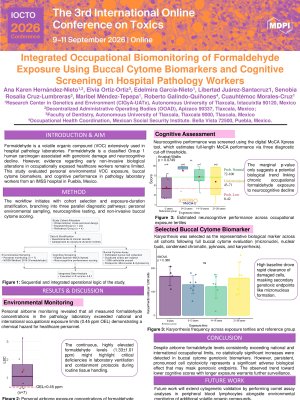
Introduction: Formaldehyde is a recognized human carcinogen used in pathology laboratories. Occupational exposure has been associated with genotoxic and neurocognitive effects; however, evidence regarding early biological alterations in healthcare workers remains limited. This study evaluated environmental formaldehyde exposure, buccal cytome biomarkers, and cognitive performance in pathology laboratory workers from a hospital in Mexico.
Methods: An observational, cross-sectional comparative study included 22 formaldehyde-exposed workers and 4 hospital workers without occupational exposure (reference-group). Demographic, occupational, and clinical information was obtained from questionnaires and clinical records. Exposed workers were categorized into tertiles according to years of occupational exposure for subgroup analyses. Cognitive performance was assessed using the digital Spanish version of MoCA Xpress. Buccal epithelial cells were collected, duplicate slides prepared, and 1,000 differentiated cells per slide scored for micronuclei and cytotoxicity endpoints. Personal formaldehyde concentrations were measured in seven representative workers using the NIOSH 2016 method. Statistical analyses were performed in R 4.6.1.
Results: Personal monitoring showed formaldehyde concentrations of 1.33 ± 1.01 ppm, exceeding the INSST (Spain) occupational exposure limit (0.3ppm) and the NIOSH recommended exposure limit (0.45ppm). Median micronucleus frequency was 0 (IQR 0.12) MN/1000 cells in the reference group and 0.12 (IQR 0.25) in exposed workers (p=0.532). Cytotoxicity markers were consistently elevated, highlighting mean karyorrhexis frequencies of 166.0 cells/1000 in the reference group and 121.0-158.0 cells/1000 across exposure tertiles, suggesting marked cytotoxicity that may have masked potential genotoxic effects. No significant group differences were observed, although cognitive scores tended to decline with exposure duration (p=0.068).
Conclusions: Despite formaldehyde concentrations exceeding recommended occupational exposure limits, no statistically significant differences were detected among study groups in buccal cytome biomarkers. Nevertheless, the marked cytotoxicity observed should be considered a relevant adverse biological effect and may have masked potential genotoxic effects. Larger studies integrating complementary biomarkers are warranted to clarify early occupational effects.
Keywords
Formaldehyde exposure
Occupational biomonitoring
Cognitive assessment
Buccal cytome assay
Cognitive screening
Poster
187372_HENK_IOCTO2026_1v0.pdf
Dose-Dependent Toxicity Assessment of Metronidazole in Developing Zebrafish (Danio rerio)
Cellular Genotoxicity of Commercial Herbal Products Containing Moringa oleifera and Tecoma stans in Human Lymphocytes