Event submissions
Published
This submission belongs to the session 4. Molecular and Cellular Mechanisms, Comparative Toxicology, and Multi-Omics Integration of the event The 3rd International Online Conference on Toxics
Published date
04 Sep, 2026
Academic Editor
'%3e%3cpath%20d='M12.6657%2010.9104C12.4185%2010.325%2012.0599%209.79327%2011.6097%209.34482C11.1609%208.89508%2010.6293%208.5365%2010.0442%208.28888C10.0389%208.28626%2010.0337%208.28495%2010.0285%208.28233C10.8446%207.69279%2011.3752%206.73249%2011.3752%205.64904C11.3752%203.8542%209.92103%202.39999%208.1262%202.39999C6.33136%202.39999%204.87715%203.8542%204.87715%205.64904C4.87715%206.73249%205.40774%207.69279%206.22393%208.28364C6.21869%208.28626%206.21345%208.28757%206.20821%208.29019C5.62129%208.5378%205.09463%208.89284%204.64265%209.34613C4.1929%209.79493%203.83432%2010.3266%203.58671%2010.9117C3.34345%2011.4845%203.21226%2012.0987%203.20023%2012.7209C3.19988%2012.7349%203.20233%2012.7488%203.20744%2012.7619C3.21255%2012.7749%203.22022%2012.7867%203.22998%2012.7968C3.23975%2012.8068%203.25142%2012.8147%203.26431%2012.8202C3.2772%2012.8256%203.29105%2012.8284%203.30504%2012.8284H4.09109C4.14874%2012.8284%204.19459%2012.7825%204.1959%2012.7262C4.2221%2011.7148%204.62823%2010.7676%205.34617%2010.0497C6.08899%209.30683%207.0755%208.89808%208.1262%208.89808C9.17689%208.89808%2010.1634%209.30683%2010.9062%2010.0497C11.6242%2010.7676%2012.0303%2011.7148%2012.0565%2012.7262C12.0578%2012.7838%2012.1037%2012.8284%2012.1613%2012.8284H12.9474C12.9613%2012.8284%2012.9752%2012.8256%2012.9881%2012.8202C13.001%2012.8147%2013.0126%2012.8068%2013.0224%2012.7968C13.0322%2012.7867%2013.0398%2012.7749%2013.0449%2012.7619C13.0501%2012.7488%2013.0525%2012.7349%2013.0522%2012.7209C13.0391%2012.0947%2012.9094%2011.4855%2012.6657%2010.9104ZM8.1262%207.9024C7.52486%207.9024%206.9589%207.6679%206.53312%207.24211C6.10733%206.81633%205.87283%206.25037%205.87283%205.64904C5.87283%205.0477%206.10733%204.48174%206.53312%204.05596C6.9589%203.63018%207.52486%203.39567%208.1262%203.39567C8.72753%203.39567%209.29349%203.63018%209.71927%204.05596C10.1451%204.48174%2010.3796%205.0477%2010.3796%205.64904C10.3796%206.25037%2010.1451%206.81633%209.71927%207.24211C9.29349%207.6679%208.72753%207.9024%208.1262%207.9024Z'%20fill='%235D1EE1'/%3e%3c/g%3e%3c/svg%3e) Yankai Xia
Yankai XiaCitation
Mónica Gómez-Zamora, Edelmira García-Nieto, Cuauhtémoc Morales-Cruz, Libertad Juárez-Santacruz, Maribel Méndez-Tepepa, Miriam Acosta-Tlapalamatl, Cellular Genotoxicity of Commercial Herbal Products Containing Moringa oleifera and Tecoma stans in Human Lymphocytes, in Proceedings of The 3rd International Online Conference on Toxics, 9 September–11 September 2026, MDPI: Basel, Switzerland
Share
Email
Facebook
Twitter
LinkedIn
Cellular Genotoxicity of Commercial Herbal Products Containing Moringa oleifera and Tecoma stans in Human Lymphocytes

Mónica Gómez-Zamora 1
'%3e%3cpath%20d='M12.6647%2010.9104C12.4176%2010.325%2012.0589%209.7933%2011.6088%209.34485C11.16%208.89511%2010.6283%208.53653%2010.0432%208.28891C10.038%208.28629%2010.0327%208.28498%2010.0275%208.28236C10.8437%207.69282%2011.3743%206.73252%2011.3743%205.64907C11.3743%203.85423%209.92005%202.40002%208.12522%202.40002C6.33038%202.40002%204.87618%203.85423%204.87618%205.64907C4.87618%206.73252%205.40677%207.69282%206.22296%208.28367C6.21772%208.28629%206.21248%208.2876%206.20724%208.29022C5.62031%208.53783%205.09365%208.89287%204.64167%209.34616C4.19192%209.79496%203.83334%2010.3266%203.58573%2010.9117C3.34247%2011.4846%203.21128%2012.0987%203.19925%2012.721C3.1989%2012.735%203.20135%2012.7489%203.20646%2012.7619C3.21157%2012.7749%203.21924%2012.7868%203.22901%2012.7968C3.23877%2012.8068%203.25045%2012.8148%203.26334%2012.8202C3.27623%2012.8256%203.29007%2012.8284%203.30406%2012.8284H4.09012C4.14776%2012.8284%204.19362%2012.7825%204.19493%2012.7262C4.22113%2011.7148%204.62726%2010.7676%205.34519%2010.0497C6.08802%209.30686%207.07452%208.89811%208.12522%208.89811C9.17592%208.89811%2010.1624%209.30686%2010.9052%2010.0497C11.6232%2010.7676%2012.0293%2011.7148%2012.0555%2012.7262C12.0568%2012.7839%2012.1027%2012.8284%2012.1603%2012.8284H12.9464C12.9604%2012.8284%2012.9742%2012.8256%2012.9871%2012.8202C13%2012.8148%2013.0117%2012.8068%2013.0214%2012.7968C13.0312%2012.7868%2013.0389%2012.7749%2013.044%2012.7619C13.0491%2012.7489%2013.0515%2012.735%2013.0512%2012.721C13.0381%2012.0947%2012.9084%2011.4856%2012.6647%2010.9104ZM8.12522%207.90243C7.52388%207.90243%206.95792%207.66793%206.53214%207.24215C6.10636%206.81636%205.87185%206.2504%205.87185%205.64907C5.87185%205.04773%206.10636%204.48177%206.53214%204.05599C6.95792%203.63021%207.52388%203.3957%208.12522%203.3957C8.72655%203.3957%209.29252%203.63021%209.7183%204.05599C10.1441%204.48177%2010.3786%205.04773%2010.3786%205.64907C10.3786%206.2504%2010.1441%206.81636%209.7183%207.24215C9.29252%207.66793%208.72655%207.90243%208.12522%207.90243Z'%20fill='%235D1EE1'/%3e%3c/g%3e%3c/svg%3e)
Edelmira García-Nieto 2
Cuauhtémoc Morales-Cruz 2
Libertad Juárez-Santacruz 2

Maribel Méndez-Tepepa 2
Miriam Acosta-Tlapalamatl 3
1. Faculty of Health Sciences, Bachelor's Degree in Clinical Chemistry, Autonomous University of Tlaxcala, Zacatelco 90750, Mexico
2. Research Center in Genetics and Environment (CIGyA-UATx), Autonomous University of Tlaxcala, Ixtacuixtla 90120, Mexico
3. Center for Scientific and Technological Studies No. 20 “Natalia Serdán Alatriste”, IPN, Puebla 72480, Mexico.
Abstract
Introduction
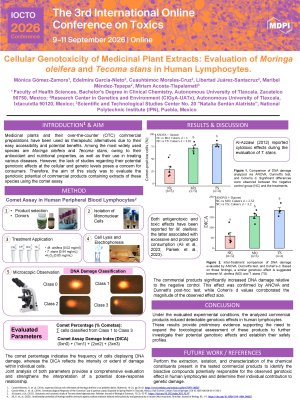
Medicinal plants are widely used because of their accessibility and perceived therapeutic benefits; however, the genomic safety of many commercial herbal products remains poorly characterized. Moringa oleifera and Tecoma stans are species commonly used in traditional medicine and frequently marketed as natural health-promoting products. This study aimed to evaluate the genotoxic potential of commercial products containing extracts of these species using the Comet assay as a sensitive screening tool for detecting DNA damage in human lymphocytes.
Methods
An exploratory in vitro study was conducted using lymphocytes obtained from five healthy volunteers. Two commercial products labeled as mainly containing M. oleifera and T. stans were tested at concentrations based on the manufacturer-recommended daily doses (M. oleifera, 0.02 mg/mL; T. stans, 0.54 mg/mL). For each donor and treatment, duplicate slides were prepared, and 100 cells per slide were scored, using negative and positive controls for comparison. DNA damage was quantified using comet frequency (%) and the DNA Damage Index from the Comet Assay (DICA). Statistical analyses included one-way ANOVA, Dunnett's post hoc test, and Cohen's d effect size estimation.
Results
Both commercial products produced significantly higher DNA damage than the negative control. Increased comet frequency and DICA values indicated increased DNA fragmentation following exposure. ANOVA and Dunnett's test confirmed significant treatment-related effects. Cohen's d values ranged from moderate to very large, supporting the biological relevance of the observed genotoxic response.
Conclusions
Under the evaluated experimental conditions, the tested commercial products induced detectable genotoxic effects in human lymphocytes. Although these findings are based on a single genotoxicity endpoint, they provide preliminary evidence supporting further toxicological investigation. Because commercial formulations may contain additional ingredients, the observed effects cannot be attributed exclusively to M. oleifera or T. stans. Further studies are needed to identify the compounds responsible for the observed genotoxicity.
Keywords
Genotoxicity
Comet assay
Tecoma stans
Moringa oleifera
Poster
Cellular Genotoxixity of Medicinal Plants Extracts. Evaluation of Moringa oleifera and Tecoma stans un Human Lymphocytes.pdf
Integrated Occupational Biomonitoring of Formaldehyde Exposure Using Buccal Cytome Biomarkers and Cognitive Screening in Hospital Pathology Workers
Toxicological impacts of fluoxetine on the freshwater microalga Raphidocelis subcapitata: a multi-endpoint assessment