Event submissions
Published
This submission belongs to the session 4. Molecular and Cellular Mechanisms, Comparative Toxicology, and Multi-Omics Integration of the event The 3rd International Online Conference on Toxics
Published date
04 Sep, 2026
Academic Editor
'%3e%3cpath%20d='M12.6657%2010.9104C12.4185%2010.325%2012.0599%209.79327%2011.6097%209.34482C11.1609%208.89508%2010.6293%208.5365%2010.0442%208.28888C10.0389%208.28626%2010.0337%208.28495%2010.0285%208.28233C10.8446%207.69279%2011.3752%206.73249%2011.3752%205.64904C11.3752%203.8542%209.92103%202.39999%208.1262%202.39999C6.33136%202.39999%204.87715%203.8542%204.87715%205.64904C4.87715%206.73249%205.40774%207.69279%206.22393%208.28364C6.21869%208.28626%206.21345%208.28757%206.20821%208.29019C5.62129%208.5378%205.09463%208.89284%204.64265%209.34613C4.1929%209.79493%203.83432%2010.3266%203.58671%2010.9117C3.34345%2011.4845%203.21226%2012.0987%203.20023%2012.7209C3.19988%2012.7349%203.20233%2012.7488%203.20744%2012.7619C3.21255%2012.7749%203.22022%2012.7867%203.22998%2012.7968C3.23975%2012.8068%203.25142%2012.8147%203.26431%2012.8202C3.2772%2012.8256%203.29105%2012.8284%203.30504%2012.8284H4.09109C4.14874%2012.8284%204.19459%2012.7825%204.1959%2012.7262C4.2221%2011.7148%204.62823%2010.7676%205.34617%2010.0497C6.08899%209.30683%207.0755%208.89808%208.1262%208.89808C9.17689%208.89808%2010.1634%209.30683%2010.9062%2010.0497C11.6242%2010.7676%2012.0303%2011.7148%2012.0565%2012.7262C12.0578%2012.7838%2012.1037%2012.8284%2012.1613%2012.8284H12.9474C12.9613%2012.8284%2012.9752%2012.8256%2012.9881%2012.8202C13.001%2012.8147%2013.0126%2012.8068%2013.0224%2012.7968C13.0322%2012.7867%2013.0398%2012.7749%2013.0449%2012.7619C13.0501%2012.7488%2013.0525%2012.7349%2013.0522%2012.7209C13.0391%2012.0947%2012.9094%2011.4855%2012.6657%2010.9104ZM8.1262%207.9024C7.52486%207.9024%206.9589%207.6679%206.53312%207.24211C6.10733%206.81633%205.87283%206.25037%205.87283%205.64904C5.87283%205.0477%206.10733%204.48174%206.53312%204.05596C6.9589%203.63018%207.52486%203.39567%208.1262%203.39567C8.72753%203.39567%209.29349%203.63018%209.71927%204.05596C10.1451%204.48174%2010.3796%205.0477%2010.3796%205.64904C10.3796%206.25037%2010.1451%206.81633%209.71927%207.24211C9.29349%207.6679%208.72753%207.9024%208.1262%207.9024Z'%20fill='%235D1EE1'/%3e%3c/g%3e%3c/svg%3e) Yankai Xia
Yankai XiaCitation
Marta Moreno-Torres, Polina Soluyanova, Ernesto López-Pascual, Erika Moro, Ramiro Jover, Pollutant exposure and pre-existing steatosis sensitize human hepatocytes to drug-induced liver injury, in Proceedings of The 3rd International Online Conference on Toxics, 9 September–11 September 2026, MDPI: Basel, Switzerland
Share
Email
Facebook
Twitter
LinkedIn
Pollutant exposure and pre-existing steatosis sensitize human hepatocytes to drug-induced liver injury

Marta Moreno-Torres 1,2,3
'%3e%3cpath%20d='M12.6647%2010.9104C12.4176%2010.325%2012.0589%209.7933%2011.6088%209.34485C11.16%208.89511%2010.6283%208.53653%2010.0432%208.28891C10.038%208.28629%2010.0327%208.28498%2010.0275%208.28236C10.8437%207.69282%2011.3743%206.73252%2011.3743%205.64907C11.3743%203.85423%209.92005%202.40002%208.12522%202.40002C6.33038%202.40002%204.87618%203.85423%204.87618%205.64907C4.87618%206.73252%205.40677%207.69282%206.22296%208.28367C6.21772%208.28629%206.21248%208.2876%206.20724%208.29022C5.62031%208.53783%205.09365%208.89287%204.64167%209.34616C4.19192%209.79496%203.83334%2010.3266%203.58573%2010.9117C3.34247%2011.4846%203.21128%2012.0987%203.19925%2012.721C3.1989%2012.735%203.20135%2012.7489%203.20646%2012.7619C3.21157%2012.7749%203.21924%2012.7868%203.22901%2012.7968C3.23877%2012.8068%203.25045%2012.8148%203.26334%2012.8202C3.27623%2012.8256%203.29007%2012.8284%203.30406%2012.8284H4.09012C4.14776%2012.8284%204.19362%2012.7825%204.19493%2012.7262C4.22113%2011.7148%204.62726%2010.7676%205.34519%2010.0497C6.08802%209.30686%207.07452%208.89811%208.12522%208.89811C9.17592%208.89811%2010.1624%209.30686%2010.9052%2010.0497C11.6232%2010.7676%2012.0293%2011.7148%2012.0555%2012.7262C12.0568%2012.7839%2012.1027%2012.8284%2012.1603%2012.8284H12.9464C12.9604%2012.8284%2012.9742%2012.8256%2012.9871%2012.8202C13%2012.8148%2013.0117%2012.8068%2013.0214%2012.7968C13.0312%2012.7868%2013.0389%2012.7749%2013.044%2012.7619C13.0491%2012.7489%2013.0515%2012.735%2013.0512%2012.721C13.0381%2012.0947%2012.9084%2011.4856%2012.6647%2010.9104ZM8.12522%207.90243C7.52388%207.90243%206.95792%207.66793%206.53214%207.24215C6.10636%206.81636%205.87185%206.2504%205.87185%205.64907C5.87185%205.04773%206.10636%204.48177%206.53214%204.05599C6.95792%203.63021%207.52388%203.3957%208.12522%203.3957C8.72655%203.3957%209.29252%203.63021%209.7183%204.05599C10.1441%204.48177%2010.3786%205.04773%2010.3786%205.64907C10.3786%206.2504%2010.1441%206.81636%209.7183%207.24215C9.29252%207.66793%208.72655%207.90243%208.12522%207.90243Z'%20fill='%235D1EE1'/%3e%3c/g%3e%3c/svg%3e)
Polina Soluyanova 2
Ernesto López-Pascual 1,2,3
Erika Moro 2

Ramiro Jover 1,2,3
1. Department of Biochemistry and Molecular Biology, University of Valencia, Valencia, Spain
2. Joint Unit in Experimental Hepatology, Health Research Institute La Fe (IISLAFE), Valencia, Spain
3. CIBER of Hepatic and Digestive Diseases (CIBERehd), Carlos III Health Institute, Madrid, Spain
Abstract
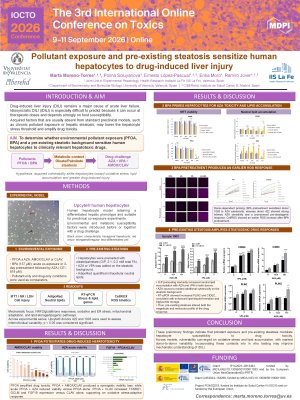
Introduction: Drug-induced liver injury (DILI) is a major cause of acute liver failure. Unlike intrinsic DILI, which is dose-dependent, idiosyncratic DILI (iDILI) occurs unpredictably at therapeutic doses and remains difficult to predict in standard preclinical models. Emerging evidence suggests that acquired conditions, including exposure to persistent organic pollutants (POPs) and pre-existing hepatic steatosis may increase susceptibility by enhancing drug toxicity.
Methods: Human Upcyte hepatocytes were exposed to perfluorooctanoic acid (PFOA) or bisphenol A (BPA), alone or in combination with azathioprine (AZA), amoxicillin/clavulanic acid (AMOX/CLAV) or clavulanic acid (CLAV). Cell injury was assessed by MTT, neutral red uptake or LDH release. Metabolic steatosis was induced by oleate/palmitate (O/P, 2:1), and the impact of AZA and valproic acid (VPA) on intracellular triglycerides was quantified by AdipoRed. Gene expression was analyzed by RT-qPCR.
Results: Environmental pollutants potentiated drug hepatotoxicity. A synergistic loss of viability was observed with PFOA+AMOX/CLAV and after acute co-exposure to PFOA +AZA when compared to PFOA . Co-treatment with PFOA and CLAV also increased expression of the NRF2-related genes and FGF19, when compared to CLAV alone, consistent with activation of oxidative stress-adaptive pathways. In parallel, supporting a synergistic interaction, co-exposure to AZA and BPA caused a greater-than-expected decrease in cell viability, increased ROS levels, promoted glutathione metabolism and a lipogenic gene expression profile, and induced triglyceride accumulation.
Preloading hepatocytes with O/P markedly modified their response to steatogenic drugs. In AZA-treated cells, O/P slightly enhanced cytotoxicity and strongly potentiated triglyceride accumulation. RT-qPCR analysis showed increased expression of several lipogenesis-related genes, particularly PLIN2, CIDEC, ACC2 and AGPAT5. O/P also potentiated VPA-induced triglyceride accumulation.
Conclusions: These preliminary findings suggest that environmental and metabolic context modulate hepatocyte susceptibility to drug toxicity. Incorporating pollutant exposure and steatotic background into in vitro testing may improve mechanistic understanding of iDILI.
Keywords
iDILI
PFOA
BPA
steatosis
hepatotoxicity
Poster
IOCTO_2026_Poster_Marta Moreno Torres.pdf
Extracellular vesicle release reflects dose-dependent hepatotoxic responses in HepG2 cells
Chronic Dual-Band Radiofrequency Exposure Selectively Affects Spatial Memory Retention Without Altering Anxiety-Like Behavior in Rats