Event submissions
Published
This submission belongs to the session 4. Molecular and Cellular Mechanisms, Comparative Toxicology, and Multi-Omics Integration of the event The 3rd International Online Conference on Toxics
Published date
04 Sep, 2026
Academic Editor
'%3e%3cpath%20d='M12.6657%2010.9104C12.4185%2010.325%2012.0599%209.79327%2011.6097%209.34482C11.1609%208.89508%2010.6293%208.5365%2010.0442%208.28888C10.0389%208.28626%2010.0337%208.28495%2010.0285%208.28233C10.8446%207.69279%2011.3752%206.73249%2011.3752%205.64904C11.3752%203.8542%209.92103%202.39999%208.1262%202.39999C6.33136%202.39999%204.87715%203.8542%204.87715%205.64904C4.87715%206.73249%205.40774%207.69279%206.22393%208.28364C6.21869%208.28626%206.21345%208.28757%206.20821%208.29019C5.62129%208.5378%205.09463%208.89284%204.64265%209.34613C4.1929%209.79493%203.83432%2010.3266%203.58671%2010.9117C3.34345%2011.4845%203.21226%2012.0987%203.20023%2012.7209C3.19988%2012.7349%203.20233%2012.7488%203.20744%2012.7619C3.21255%2012.7749%203.22022%2012.7867%203.22998%2012.7968C3.23975%2012.8068%203.25142%2012.8147%203.26431%2012.8202C3.2772%2012.8256%203.29105%2012.8284%203.30504%2012.8284H4.09109C4.14874%2012.8284%204.19459%2012.7825%204.1959%2012.7262C4.2221%2011.7148%204.62823%2010.7676%205.34617%2010.0497C6.08899%209.30683%207.0755%208.89808%208.1262%208.89808C9.17689%208.89808%2010.1634%209.30683%2010.9062%2010.0497C11.6242%2010.7676%2012.0303%2011.7148%2012.0565%2012.7262C12.0578%2012.7838%2012.1037%2012.8284%2012.1613%2012.8284H12.9474C12.9613%2012.8284%2012.9752%2012.8256%2012.9881%2012.8202C13.001%2012.8147%2013.0126%2012.8068%2013.0224%2012.7968C13.0322%2012.7867%2013.0398%2012.7749%2013.0449%2012.7619C13.0501%2012.7488%2013.0525%2012.7349%2013.0522%2012.7209C13.0391%2012.0947%2012.9094%2011.4855%2012.6657%2010.9104ZM8.1262%207.9024C7.52486%207.9024%206.9589%207.6679%206.53312%207.24211C6.10733%206.81633%205.87283%206.25037%205.87283%205.64904C5.87283%205.0477%206.10733%204.48174%206.53312%204.05596C6.9589%203.63018%207.52486%203.39567%208.1262%203.39567C8.72753%203.39567%209.29349%203.63018%209.71927%204.05596C10.1451%204.48174%2010.3796%205.0477%2010.3796%205.64904C10.3796%206.25037%2010.1451%206.81633%209.71927%207.24211C9.29349%207.6679%208.72753%207.9024%208.1262%207.9024Z'%20fill='%235D1EE1'/%3e%3c/g%3e%3c/svg%3e) Yankai Xia
Yankai XiaCitation
Anum Feroz, Abdul Rauf Shakoori, Farah Rauf Shakoori, Biochemical Disruption of Glutathione-Dependent and Independent Antioxidant Defense Systems under Synergistic Pesticide Exposure in Trogoderma granarium, in Proceedings of The 3rd International Online Conference on Toxics, 9 September–11 September 2026, MDPI: Basel, Switzerland
Share
Email
Facebook
Twitter
LinkedIn
Biochemical Disruption of Glutathione-Dependent and Independent Antioxidant Defense Systems under Synergistic Pesticide Exposure in Trogoderma granarium
'%3e%3cpath%20d='M12.6647%2010.9104C12.4176%2010.325%2012.0589%209.7933%2011.6088%209.34485C11.16%208.89511%2010.6283%208.53653%2010.0432%208.28891C10.038%208.28629%2010.0327%208.28498%2010.0275%208.28236C10.8437%207.69282%2011.3743%206.73252%2011.3743%205.64907C11.3743%203.85423%209.92005%202.40002%208.12522%202.40002C6.33038%202.40002%204.87618%203.85423%204.87618%205.64907C4.87618%206.73252%205.40677%207.69282%206.22296%208.28367C6.21772%208.28629%206.21248%208.2876%206.20724%208.29022C5.62031%208.53783%205.09365%208.89287%204.64167%209.34616C4.19192%209.79496%203.83334%2010.3266%203.58573%2010.9117C3.34247%2011.4846%203.21128%2012.0987%203.19925%2012.721C3.1989%2012.735%203.20135%2012.7489%203.20646%2012.7619C3.21157%2012.7749%203.21924%2012.7868%203.22901%2012.7968C3.23877%2012.8068%203.25045%2012.8148%203.26334%2012.8202C3.27623%2012.8256%203.29007%2012.8284%203.30406%2012.8284H4.09012C4.14776%2012.8284%204.19362%2012.7825%204.19493%2012.7262C4.22113%2011.7148%204.62726%2010.7676%205.34519%2010.0497C6.08802%209.30686%207.07452%208.89811%208.12522%208.89811C9.17592%208.89811%2010.1624%209.30686%2010.9052%2010.0497C11.6232%2010.7676%2012.0293%2011.7148%2012.0555%2012.7262C12.0568%2012.7839%2012.1027%2012.8284%2012.1603%2012.8284H12.9464C12.9604%2012.8284%2012.9742%2012.8256%2012.9871%2012.8202C13%2012.8148%2013.0117%2012.8068%2013.0214%2012.7968C13.0312%2012.7868%2013.0389%2012.7749%2013.044%2012.7619C13.0491%2012.7489%2013.0515%2012.735%2013.0512%2012.721C13.0381%2012.0947%2012.9084%2011.4856%2012.6647%2010.9104ZM8.12522%207.90243C7.52388%207.90243%206.95792%207.66793%206.53214%207.24215C6.10636%206.81636%205.87185%206.2504%205.87185%205.64907C5.87185%205.04773%206.10636%204.48177%206.53214%204.05599C6.95792%203.63021%207.52388%203.3957%208.12522%203.3957C8.72655%203.3957%209.29252%203.63021%209.7183%204.05599C10.1441%204.48177%2010.3786%205.04773%2010.3786%205.64907C10.3786%206.2504%2010.1441%206.81636%209.7183%207.24215C9.29252%207.66793%208.72655%207.90243%208.12522%207.90243Z'%20fill='%235D1EE1'/%3e%3c/g%3e%3c/svg%3e)
Anum Feroz 1
Abdul Rauf Shakoori 2
Farah Rauf Shakoori 1
1. Institute of Zoology, University of the Punjab, Quaid-i-Azam Campus, Lahore, PAKISTAN
2. School of Biological Sciences, University of the Punjab, Quaid-i-Azam Campus, Lahore PAKISTAN
Abstract
Introduction:
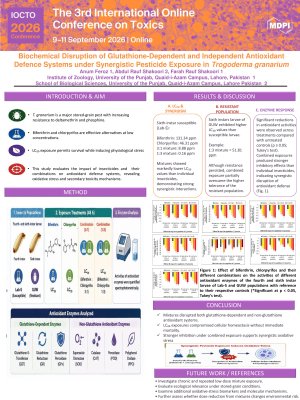
Trogoderma granarium is a major stored-grain pest with increasing resistance to commonly used insecticides deltamethrin and phosphine. Bifenthrin and chlorpyrifos are effective alternatives at low concentrations (Feroz et al. 2020). Sublethal exposures, particularly at LC20 levels, are environmentally relevant as they allow survival while inducing physiological stress. This study investigates how these insecticides and their synergistic combinations disrupt antioxidant defense systems, revealing secondary toxicity mechanisms and alterations in cellular redox homeostasis.
Methods:
Fourth- and sixth-instar larvae from susceptible (Lab-S) and resistant (GUW) populations were exposed for 48 h to LC20 concentrations of bifenthrin, chlorpyrifos, and their combinations (3:1 and 1:3). The activities of glutathione-dependent (glutathione-S-transferase, glutathione reductase, glutathione peroxidase) and non-glutathione antioxidant enzymes (superoxide dismutase, catalase, peroxidase, polyphenol oxidase) were quantified spectrophotometrically.
Results:
LC20 values demonstrated strong synergistic interactions, with mixtures showing markedly lower toxicity thresholds than individual insecticides. For example, in sixth instar susceptible larvae, LC20 values decreased from 131.34 ppm (bifenthrin) and 46.31 ppm (chlorpyrifos) to 8.88 ppm (3:1 mixture) and 0.16 ppm (1:3 mixture). Resistant populations exhibited higher LC20 values (e.g., 51.81 ppm at 1:3), though combinations partially overcame resistance. Enzymatic analyses revealed significant reductions (p ≤ 0.05, Tukey’s test) in antioxidant activities across all treatments compared to untreated controls. Combined exposures produced stronger inhibitory effects than individual treatments, indicating synergistic disruption of antioxidant defense systems.
Conclusion:
These results demonstrate that insecticide mixtures induce oxidative stress by disrupting both glutathione-dependent and independent antioxidant systems. Even at sublethal (LC20) levels, these exposures compromise cellular homeostasis without causing immediate mortality. Although combined treatments may reduce required chemical doses, the ecological risks of chronic low-dose mixture exposure require further investigation.
Feroz, A., Shakoori, F.R. and Riaz, T., Shakoori, A.R., 2020. Development of resistance in stored grain pest, Trogoderma granarium (Everts) against deltamethrin and its effective control by synergistic toxicity of bifenthrin and chlorpyrifos. Journal of Stored Products Research, 88: 101673.
Keywords
Trogoderma granarium
bifenthrin
chlorpyrifos
insecticide mixtures
synergism
LC20
antioxidant enzymes
glutathione system
oxidative stress
Poster
poster 2026.pdf
Investigation of Cellular and Molecular Mechanisms of PFAS-Induced Lung Inflammation in a Human Alveolar Epithelial Cell Line
Systems-level effects of plant-based cognitive enhancer extracts: A multi-omics perspective