Event submissions
Published
This submission belongs to the session 4. Molecular and Cellular Mechanisms, Comparative Toxicology, and Multi-Omics Integration of the event The 3rd International Online Conference on Toxics
Published date
04 Sep, 2026
Academic Editor
'%3e%3cpath%20d='M12.6657%2010.9104C12.4185%2010.325%2012.0599%209.79327%2011.6097%209.34482C11.1609%208.89508%2010.6293%208.5365%2010.0442%208.28888C10.0389%208.28626%2010.0337%208.28495%2010.0285%208.28233C10.8446%207.69279%2011.3752%206.73249%2011.3752%205.64904C11.3752%203.8542%209.92103%202.39999%208.1262%202.39999C6.33136%202.39999%204.87715%203.8542%204.87715%205.64904C4.87715%206.73249%205.40774%207.69279%206.22393%208.28364C6.21869%208.28626%206.21345%208.28757%206.20821%208.29019C5.62129%208.5378%205.09463%208.89284%204.64265%209.34613C4.1929%209.79493%203.83432%2010.3266%203.58671%2010.9117C3.34345%2011.4845%203.21226%2012.0987%203.20023%2012.7209C3.19988%2012.7349%203.20233%2012.7488%203.20744%2012.7619C3.21255%2012.7749%203.22022%2012.7867%203.22998%2012.7968C3.23975%2012.8068%203.25142%2012.8147%203.26431%2012.8202C3.2772%2012.8256%203.29105%2012.8284%203.30504%2012.8284H4.09109C4.14874%2012.8284%204.19459%2012.7825%204.1959%2012.7262C4.2221%2011.7148%204.62823%2010.7676%205.34617%2010.0497C6.08899%209.30683%207.0755%208.89808%208.1262%208.89808C9.17689%208.89808%2010.1634%209.30683%2010.9062%2010.0497C11.6242%2010.7676%2012.0303%2011.7148%2012.0565%2012.7262C12.0578%2012.7838%2012.1037%2012.8284%2012.1613%2012.8284H12.9474C12.9613%2012.8284%2012.9752%2012.8256%2012.9881%2012.8202C13.001%2012.8147%2013.0126%2012.8068%2013.0224%2012.7968C13.0322%2012.7867%2013.0398%2012.7749%2013.0449%2012.7619C13.0501%2012.7488%2013.0525%2012.7349%2013.0522%2012.7209C13.0391%2012.0947%2012.9094%2011.4855%2012.6657%2010.9104ZM8.1262%207.9024C7.52486%207.9024%206.9589%207.6679%206.53312%207.24211C6.10733%206.81633%205.87283%206.25037%205.87283%205.64904C5.87283%205.0477%206.10733%204.48174%206.53312%204.05596C6.9589%203.63018%207.52486%203.39567%208.1262%203.39567C8.72753%203.39567%209.29349%203.63018%209.71927%204.05596C10.1451%204.48174%2010.3796%205.0477%2010.3796%205.64904C10.3796%206.25037%2010.1451%206.81633%209.71927%207.24211C9.29349%207.6679%208.72753%207.9024%208.1262%207.9024Z'%20fill='%235D1EE1'/%3e%3c/g%3e%3c/svg%3e) Yankai Xia
Yankai XiaCitation
Maria Inês Machado, Helena Ramos, Ana Margarida Araújo, Isabel M. P. L. V. O. Ferreira, Miguel A. Faria, An Inflamed Gut is Not Always a Leaky Gut: Mycotoxin Permeability in a Co-culture Model, in Proceedings of The 3rd International Online Conference on Toxics, 9 September–11 September 2026, MDPI: Basel, Switzerland
Share
Email
Facebook
Twitter
LinkedIn
An Inflamed Gut is Not Always a Leaky Gut: Mycotoxin Permeability in a Co-culture Model
'%3e%3cpath%20d='M12.6647%2010.9104C12.4176%2010.325%2012.0589%209.7933%2011.6088%209.34485C11.16%208.89511%2010.6283%208.53653%2010.0432%208.28891C10.038%208.28629%2010.0327%208.28498%2010.0275%208.28236C10.8437%207.69282%2011.3743%206.73252%2011.3743%205.64907C11.3743%203.85423%209.92005%202.40002%208.12522%202.40002C6.33038%202.40002%204.87618%203.85423%204.87618%205.64907C4.87618%206.73252%205.40677%207.69282%206.22296%208.28367C6.21772%208.28629%206.21248%208.2876%206.20724%208.29022C5.62031%208.53783%205.09365%208.89287%204.64167%209.34616C4.19192%209.79496%203.83334%2010.3266%203.58573%2010.9117C3.34247%2011.4846%203.21128%2012.0987%203.19925%2012.721C3.1989%2012.735%203.20135%2012.7489%203.20646%2012.7619C3.21157%2012.7749%203.21924%2012.7868%203.22901%2012.7968C3.23877%2012.8068%203.25045%2012.8148%203.26334%2012.8202C3.27623%2012.8256%203.29007%2012.8284%203.30406%2012.8284H4.09012C4.14776%2012.8284%204.19362%2012.7825%204.19493%2012.7262C4.22113%2011.7148%204.62726%2010.7676%205.34519%2010.0497C6.08802%209.30686%207.07452%208.89811%208.12522%208.89811C9.17592%208.89811%2010.1624%209.30686%2010.9052%2010.0497C11.6232%2010.7676%2012.0293%2011.7148%2012.0555%2012.7262C12.0568%2012.7839%2012.1027%2012.8284%2012.1603%2012.8284H12.9464C12.9604%2012.8284%2012.9742%2012.8256%2012.9871%2012.8202C13%2012.8148%2013.0117%2012.8068%2013.0214%2012.7968C13.0312%2012.7868%2013.0389%2012.7749%2013.044%2012.7619C13.0491%2012.7489%2013.0515%2012.735%2013.0512%2012.721C13.0381%2012.0947%2012.9084%2011.4856%2012.6647%2010.9104ZM8.12522%207.90243C7.52388%207.90243%206.95792%207.66793%206.53214%207.24215C6.10636%206.81636%205.87185%206.2504%205.87185%205.64907C5.87185%205.04773%206.10636%204.48177%206.53214%204.05599C6.95792%203.63021%207.52388%203.3957%208.12522%203.3957C8.72655%203.3957%209.29252%203.63021%209.7183%204.05599C10.1441%204.48177%2010.3786%205.04773%2010.3786%205.64907C10.3786%206.2504%2010.1441%206.81636%209.7183%207.24215C9.29252%207.66793%208.72655%207.90243%208.12522%207.90243Z'%20fill='%235D1EE1'/%3e%3c/g%3e%3c/svg%3e)
Maria Inês Machado 1
Helena Ramos 1

Ana Margarida Araújo 1

Isabel M. P. L. V. O. Ferreira 1

Miguel A. Faria 1
1. LAQV-REQUIMTE, Laboratory of Bromatology and Hydrology, Faculty of Pharmacy, University of Porto, Porto, Portugal
Abstract
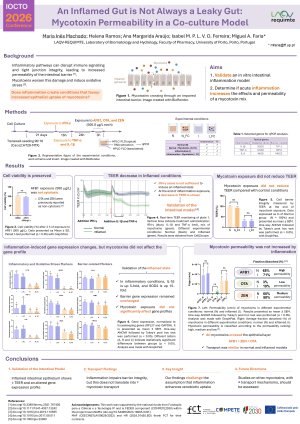
Inflammation can impair intestinal barrier function by disrupting tight junctions, altering immune signalling, and increasing epithelial permeability [1]. Mycotoxins like ochratoxin A (OTA), zearalenone (ZEN), and aflatoxin B1 (AFB1) are common food contaminants that can aggravate intestinal damage and oxidative stress [2]. Although inflammation is assumed to enhance xenobiotic uptake, evidence remains inconsistent [3]. Therefore, this study aimed to evaluate whether acute inflammation affects the toxicity and permeability of a mycotoxin mixture.
Caco-2/HT29-MTX (90:10) intestinal coculture model was differentiated for 21 days to establish a functional intestinal barrier. Inflammation was induced with a cytokine cocktail (IFN-γ, IL-1β, and TNF-α) [4]. Intestinal monolayers, either inflamed or normal, were subsequently exposed apically to a mixture of OTA, ZEN and AFB1 (500 µg/L each, non‑cytotoxicity assured by preliminary assays, level possible in foods[5]). Barrier integrity was monitored by real-time TEER, gene expression was analysed by qPCR, and mycotoxin transport (180 min) was quantified by HPLC-FLD.
Inflammation significantly reduced TEER and increased inflammatory (IL-1β, 5-fold) and oxidative stress (SOD2, 15-fold) markers, confirming successful induction. However, barrier-related gene expression remained unchanged, consistent with previous studies [6,7]. Mycotoxin exposure did not affect TEER or gene expression in either normal or inflamed monolayers. All three mycotoxins crossed the barrier, with AFB1 showing the highest permeability (3.81 × 10⁻⁶ cm/s), followed by ZEN (2.66 × 10⁻⁶) and OTA (7.70 × 10⁻⁸), consistent with previous reports [8]. Transport profiles were comparable under both conditions.
These findings indicate that acute inflammation induces inflammatory and oxidative responses without increasing mycotoxin permeability. This shows that reduced barrier integrity does not necessarily translate to enhanced xenobiotic transport, thereby emphasising the importance of functional and mechanistic permeability assessments beyond TEER measurements alone.
[1] doi.org/10.3389/fimmu.2021.767456
[2] doi.org/10.1111/1541-4337.13242
[3] doi.org/10.1080/10717540490280345
[4] doi.org/10.1038/s41598-024-74802-w
[5] doi.org/10.1002/jsfa.70686
[6] doi.org/10.1016/j.foodres.2025.115907
[7] doi.org/10.1016/S0002-9440(10)62264-X
[8] doi.org/10.1016/j.fct.2019.110595
Keywords
In vitro intestinal model
Intestinal absorption
Inflammation
TEER
Poster
Poster_Maria Machado.pdf
Chronic methylmercury exposure alters astrocytic morphology and NADPH diaphorase reactivity in the rat frontal cortex
Comparative neurotoxic effects of conventional and alternative plasticizers on microglia