Event submissions
Published
This submission belongs to the session 2. Wildlife Ecotoxicology, Sentinel Species, and Ecosystem Health of the event The 3rd International Online Conference on Toxics
Published date
04 Sep, 2026
Academic Editor
'%3e%3cpath%20d='M12.6657%2010.9104C12.4185%2010.325%2012.0599%209.79327%2011.6097%209.34482C11.1609%208.89508%2010.6293%208.5365%2010.0442%208.28888C10.0389%208.28626%2010.0337%208.28495%2010.0285%208.28233C10.8446%207.69279%2011.3752%206.73249%2011.3752%205.64904C11.3752%203.8542%209.92103%202.39999%208.1262%202.39999C6.33136%202.39999%204.87715%203.8542%204.87715%205.64904C4.87715%206.73249%205.40774%207.69279%206.22393%208.28364C6.21869%208.28626%206.21345%208.28757%206.20821%208.29019C5.62129%208.5378%205.09463%208.89284%204.64265%209.34613C4.1929%209.79493%203.83432%2010.3266%203.58671%2010.9117C3.34345%2011.4845%203.21226%2012.0987%203.20023%2012.7209C3.19988%2012.7349%203.20233%2012.7488%203.20744%2012.7619C3.21255%2012.7749%203.22022%2012.7867%203.22998%2012.7968C3.23975%2012.8068%203.25142%2012.8147%203.26431%2012.8202C3.2772%2012.8256%203.29105%2012.8284%203.30504%2012.8284H4.09109C4.14874%2012.8284%204.19459%2012.7825%204.1959%2012.7262C4.2221%2011.7148%204.62823%2010.7676%205.34617%2010.0497C6.08899%209.30683%207.0755%208.89808%208.1262%208.89808C9.17689%208.89808%2010.1634%209.30683%2010.9062%2010.0497C11.6242%2010.7676%2012.0303%2011.7148%2012.0565%2012.7262C12.0578%2012.7838%2012.1037%2012.8284%2012.1613%2012.8284H12.9474C12.9613%2012.8284%2012.9752%2012.8256%2012.9881%2012.8202C13.001%2012.8147%2013.0126%2012.8068%2013.0224%2012.7968C13.0322%2012.7867%2013.0398%2012.7749%2013.0449%2012.7619C13.0501%2012.7488%2013.0525%2012.7349%2013.0522%2012.7209C13.0391%2012.0947%2012.9094%2011.4855%2012.6657%2010.9104ZM8.1262%207.9024C7.52486%207.9024%206.9589%207.6679%206.53312%207.24211C6.10733%206.81633%205.87283%206.25037%205.87283%205.64904C5.87283%205.0477%206.10733%204.48174%206.53312%204.05596C6.9589%203.63018%207.52486%203.39567%208.1262%203.39567C8.72753%203.39567%209.29349%203.63018%209.71927%204.05596C10.1451%204.48174%2010.3796%205.0477%2010.3796%205.64904C10.3796%206.25037%2010.1451%206.81633%209.71927%207.24211C9.29349%207.6679%208.72753%207.9024%208.1262%207.9024Z'%20fill='%235D1EE1'/%3e%3c/g%3e%3c/svg%3e) Jose V. Tarazona
Jose V. TarazonaCitation
Edgar Alexander Zapata Vívenes, Osmar Nusetti Cárdenas, Autotomy and antioxidant responses as biomarkers of acute and chronic contaminant stress in Eurythoe complanata, in Proceedings of The 3rd International Online Conference on Toxics, 9 September–11 September 2026, MDPI: Basel, Switzerland
Share
Email
Facebook
Twitter
LinkedIn
Autotomy and antioxidant responses as biomarkers of acute and chronic contaminant stress in Eurythoe complanata

Edgar Alexander Zapata Vívenes 1
'%3e%3cpath%20d='M12.6647%2010.9104C12.4176%2010.325%2012.0589%209.7933%2011.6088%209.34485C11.16%208.89511%2010.6283%208.53653%2010.0432%208.28891C10.038%208.28629%2010.0327%208.28498%2010.0275%208.28236C10.8437%207.69282%2011.3743%206.73252%2011.3743%205.64907C11.3743%203.85423%209.92005%202.40002%208.12522%202.40002C6.33038%202.40002%204.87618%203.85423%204.87618%205.64907C4.87618%206.73252%205.40677%207.69282%206.22296%208.28367C6.21772%208.28629%206.21248%208.2876%206.20724%208.29022C5.62031%208.53783%205.09365%208.89287%204.64167%209.34616C4.19192%209.79496%203.83334%2010.3266%203.58573%2010.9117C3.34247%2011.4846%203.21128%2012.0987%203.19925%2012.721C3.1989%2012.735%203.20135%2012.7489%203.20646%2012.7619C3.21157%2012.7749%203.21924%2012.7868%203.22901%2012.7968C3.23877%2012.8068%203.25045%2012.8148%203.26334%2012.8202C3.27623%2012.8256%203.29007%2012.8284%203.30406%2012.8284H4.09012C4.14776%2012.8284%204.19362%2012.7825%204.19493%2012.7262C4.22113%2011.7148%204.62726%2010.7676%205.34519%2010.0497C6.08802%209.30686%207.07452%208.89811%208.12522%208.89811C9.17592%208.89811%2010.1624%209.30686%2010.9052%2010.0497C11.6232%2010.7676%2012.0293%2011.7148%2012.0555%2012.7262C12.0568%2012.7839%2012.1027%2012.8284%2012.1603%2012.8284H12.9464C12.9604%2012.8284%2012.9742%2012.8256%2012.9871%2012.8202C13%2012.8148%2013.0117%2012.8068%2013.0214%2012.7968C13.0312%2012.7868%2013.0389%2012.7749%2013.044%2012.7619C13.0491%2012.7489%2013.0515%2012.735%2013.0512%2012.721C13.0381%2012.0947%2012.9084%2011.4856%2012.6647%2010.9104ZM8.12522%207.90243C7.52388%207.90243%206.95792%207.66793%206.53214%207.24215C6.10636%206.81636%205.87185%206.2504%205.87185%205.64907C5.87185%205.04773%206.10636%204.48177%206.53214%204.05599C6.95792%203.63021%207.52388%203.3957%208.12522%203.3957C8.72655%203.3957%209.29252%203.63021%209.7183%204.05599C10.1441%204.48177%2010.3786%205.04773%2010.3786%205.64907C10.3786%206.2504%2010.1441%206.81636%209.7183%207.24215C9.29252%207.66793%208.72655%207.90243%208.12522%207.90243Z'%20fill='%235D1EE1'/%3e%3c/g%3e%3c/svg%3e)
Osmar Nusetti Cárdenas 2
1. Departamento de Acuicultura, Pesca y Recursos Naturales Renovables, Universidad Técnica de Manabí, Guevara
2. Departamento de Biología, Núcleo de Sucre, Universidad de Oriente, Cumaná
Abstract
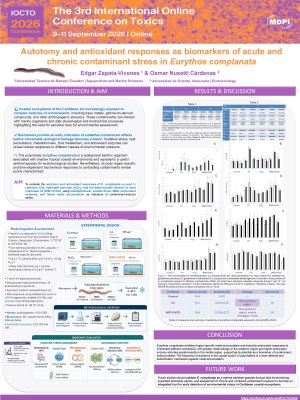
The biochemical responses of marine organisms to acute and chronic xenobiotic exposure may vary by tissue. Here, we examined enzymatic and non-enzymatic antioxidant responses in different body regions of the polychaete Eurythoe complanata exposed to cadmium (Cd, 200 μg L⁻¹), hydrogen peroxide (H₂O₂, 200 mmol L⁻¹), and a water-soluble fraction of used automobile crankcase oils (WSF-UAO, 3% m/v) in a static aquaria system for 7 and 14 d. Heavy metal concentrations, antioxidant enzyme activities―catalase (CAT), glutathione reductase (GR), glucose-6-phosphate dehydrogenase (G6PDH), and glutathione S-transferase (GST)―, lipid peroxidation, metallothioneins, and soluble thiols were measured in the anterior (A, 20-25 setigers), middle (M, 30-40 setigers), and posterior (P, 20 terminal setigers) regions. Additionally, the number of individuals exhibiting autotomy was recorded. Results showed significantly higher concentrations of Cd and other metals in the posterior region (3.8-fold higher than controls). The M region demonstrated high metabolic activity and antioxidant defense capacity. Thirteen percent of WSF-UAO-exposed polychaetes displayed autotomy in the P region. The increase in antioxidant responses across body regions of Cd- and WSF-UAO-exposed polychaetes suggests compensatory mechanisms against oxidative stress. Autotomy of the P region appears to serve as a detoxification strategy for the accumulation of xenobiotics and reactive oxygen species (ROS) in damaged tissue. These results improve our understanding of how E. complanata adapts to both short-term and long-term chemical stress and confirm its potential as a sentinel species for assessing the impact of complex pollutant mixtures in marine environments.
Keywords
Annelid
antioxidant compound
biomarkers
fragmentation
marine pollution
xenobiotic mixture
Poster
IOCTO2026_Eurythoe_complanata_poster_Zapata Vivenes.pdf
IM-MOTIC: An AI-Assisted Evidence-Driven Framework for Mechanism Mining, Target Exploration, and Validation in Environmental Chemical Toxicity
Microplastic contamination in Mytilus galloprovincialis from the Black Sea, Bulgaria