Event submissions
Published
This submission belongs to the session 1. Exposure Routes / Exposome of Emerging Contaminants and Materials in the Environment of the event The 3rd International Online Conference on Toxics
Published date
04 Sep, 2026
Academic Editor
'%3e%3cpath%20d='M12.6657%2010.9104C12.4185%2010.325%2012.0599%209.79327%2011.6097%209.34482C11.1609%208.89508%2010.6293%208.5365%2010.0442%208.28888C10.0389%208.28626%2010.0337%208.28495%2010.0285%208.28233C10.8446%207.69279%2011.3752%206.73249%2011.3752%205.64904C11.3752%203.8542%209.92103%202.39999%208.1262%202.39999C6.33136%202.39999%204.87715%203.8542%204.87715%205.64904C4.87715%206.73249%205.40774%207.69279%206.22393%208.28364C6.21869%208.28626%206.21345%208.28757%206.20821%208.29019C5.62129%208.5378%205.09463%208.89284%204.64265%209.34613C4.1929%209.79493%203.83432%2010.3266%203.58671%2010.9117C3.34345%2011.4845%203.21226%2012.0987%203.20023%2012.7209C3.19988%2012.7349%203.20233%2012.7488%203.20744%2012.7619C3.21255%2012.7749%203.22022%2012.7867%203.22998%2012.7968C3.23975%2012.8068%203.25142%2012.8147%203.26431%2012.8202C3.2772%2012.8256%203.29105%2012.8284%203.30504%2012.8284H4.09109C4.14874%2012.8284%204.19459%2012.7825%204.1959%2012.7262C4.2221%2011.7148%204.62823%2010.7676%205.34617%2010.0497C6.08899%209.30683%207.0755%208.89808%208.1262%208.89808C9.17689%208.89808%2010.1634%209.30683%2010.9062%2010.0497C11.6242%2010.7676%2012.0303%2011.7148%2012.0565%2012.7262C12.0578%2012.7838%2012.1037%2012.8284%2012.1613%2012.8284H12.9474C12.9613%2012.8284%2012.9752%2012.8256%2012.9881%2012.8202C13.001%2012.8147%2013.0126%2012.8068%2013.0224%2012.7968C13.0322%2012.7867%2013.0398%2012.7749%2013.0449%2012.7619C13.0501%2012.7488%2013.0525%2012.7349%2013.0522%2012.7209C13.0391%2012.0947%2012.9094%2011.4855%2012.6657%2010.9104ZM8.1262%207.9024C7.52486%207.9024%206.9589%207.6679%206.53312%207.24211C6.10733%206.81633%205.87283%206.25037%205.87283%205.64904C5.87283%205.0477%206.10733%204.48174%206.53312%204.05596C6.9589%203.63018%207.52486%203.39567%208.1262%203.39567C8.72753%203.39567%209.29349%203.63018%209.71927%204.05596C10.1451%204.48174%2010.3796%205.0477%2010.3796%205.64904C10.3796%206.25037%2010.1451%206.81633%209.71927%207.24211C9.29349%207.6679%208.72753%207.9024%208.1262%207.9024Z'%20fill='%235D1EE1'/%3e%3c/g%3e%3c/svg%3e) Rakesh Kanda
Rakesh KandaCitation
Natalia Nowak, Justyna Ośko, Piotr Kowalczyk, Kornelia Kadac-Czapska, Małgorzata Grembecka, How Bioavailable Are Polypropylene Microplastics? In Vitro Evidence and Potential Health Relevance, in Proceedings of The 3rd International Online Conference on Toxics, 9 September–11 September 2026, MDPI: Basel, Switzerland
Share
Email
Facebook
Twitter
LinkedIn
How Bioavailable Are Polypropylene Microplastics? In Vitro Evidence and Potential Health Relevance
'%3e%3cpath%20d='M12.6647%2010.9104C12.4176%2010.325%2012.0589%209.7933%2011.6088%209.34485C11.16%208.89511%2010.6283%208.53653%2010.0432%208.28891C10.038%208.28629%2010.0327%208.28498%2010.0275%208.28236C10.8437%207.69282%2011.3743%206.73252%2011.3743%205.64907C11.3743%203.85423%209.92005%202.40002%208.12522%202.40002C6.33038%202.40002%204.87618%203.85423%204.87618%205.64907C4.87618%206.73252%205.40677%207.69282%206.22296%208.28367C6.21772%208.28629%206.21248%208.2876%206.20724%208.29022C5.62031%208.53783%205.09365%208.89287%204.64167%209.34616C4.19192%209.79496%203.83334%2010.3266%203.58573%2010.9117C3.34247%2011.4846%203.21128%2012.0987%203.19925%2012.721C3.1989%2012.735%203.20135%2012.7489%203.20646%2012.7619C3.21157%2012.7749%203.21924%2012.7868%203.22901%2012.7968C3.23877%2012.8068%203.25045%2012.8148%203.26334%2012.8202C3.27623%2012.8256%203.29007%2012.8284%203.30406%2012.8284H4.09012C4.14776%2012.8284%204.19362%2012.7825%204.19493%2012.7262C4.22113%2011.7148%204.62726%2010.7676%205.34519%2010.0497C6.08802%209.30686%207.07452%208.89811%208.12522%208.89811C9.17592%208.89811%2010.1624%209.30686%2010.9052%2010.0497C11.6232%2010.7676%2012.0293%2011.7148%2012.0555%2012.7262C12.0568%2012.7839%2012.1027%2012.8284%2012.1603%2012.8284H12.9464C12.9604%2012.8284%2012.9742%2012.8256%2012.9871%2012.8202C13%2012.8148%2013.0117%2012.8068%2013.0214%2012.7968C13.0312%2012.7868%2013.0389%2012.7749%2013.044%2012.7619C13.0491%2012.7489%2013.0515%2012.735%2013.0512%2012.721C13.0381%2012.0947%2012.9084%2011.4856%2012.6647%2010.9104ZM8.12522%207.90243C7.52388%207.90243%206.95792%207.66793%206.53214%207.24215C6.10636%206.81636%205.87185%206.2504%205.87185%205.64907C5.87185%205.04773%206.10636%204.48177%206.53214%204.05599C6.95792%203.63021%207.52388%203.3957%208.12522%203.3957C8.72655%203.3957%209.29252%203.63021%209.7183%204.05599C10.1441%204.48177%2010.3786%205.04773%2010.3786%205.64907C10.3786%206.2504%2010.1441%206.81636%209.7183%207.24215C9.29252%207.66793%208.72655%207.90243%208.12522%207.90243Z'%20fill='%235D1EE1'/%3e%3c/g%3e%3c/svg%3e)
Natalia Nowak 1
Justyna Ośko 1

Piotr Kowalczyk 1

Kornelia Kadac-Czapska 1
Małgorzata Grembecka 1
1. Department of Bromatology, Medical University of Gdańsk, Al. Gen. J. Hallera 107, 80-416 Gdańsk
Abstract
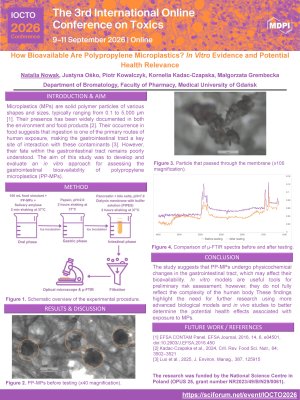
Introduction: Microplastics (MPs) are solid polymer particles of various shapes and sizes, typically ranging from 0.1 to 5,000 µm. Their presence has been widely documented in both the environment and food products. Their occurrence in food suggests that the gastrointestinal tract is one of the primary routes of human exposure to these contaminants. However, their fate within the gastrointestinal tract remains poorly understood. The aim of this study was to develop and evaluate an in vitro methodology for assessing the bioavailability of MPs in the human digestive system.
Methods: The bioavailability of polypropylene microparticles was assessed using a three-stage in vitro digestion model that simulates the functioning of the human gastrointestinal tract. The particles were subjected to simulated digestion under conditions corresponding to the oral, gastric and intestinal phases, at a temperature of 37°C. Dialysis membranes were used in the model to assess the extent to which the MPs passed into the intestinal lumen. After digestion, the particles were separated by filtration and analyzed using optical microscopy and μ-FTIR spectroscopy.
Results: The results showed that, independent of the type of matrix used, the MPs pass through the dialysis membrane. However, the presence of digestive processes leads to physicochemical changes of the polymer. Surface oxidation and morphological changes were identified using FTIR microspectroscopy (μ-FTIR) and optical microscopy.
Conclusions: The study suggests that polypropylene MPs undergo physicochemical changes in the gastrointestinal tract and may become bioavailable. In vitro models are useful tools for preliminary exposure risk assessment; however, they do not fully reflect the complexity of the human body These findings highlight the need for further research using more advanced biological models and in vivo studies to better determine the health relevance of exposure to MPs.
The research was funded by the National Science Centre in Poland (OPUS 25, grant number NR2023/49/B/N29/0061).
Keywords
microplastics
polypropylene
bioavailability
digestion model
in vitro
Poster
Sciforum-186534 Nowak poster.pdf
Microplastic contamination in Mytilus galloprovincialis from the Black Sea, Bulgaria
Tire Wear Particles and 6PPD-Quinone in Freshwater Ecosystems: Ecotoxicological Effects, Food-Web Transfer, and One Health Implications