Event submissions
Published
This submission belongs to the session 1. Exposure Routes / Exposome of Emerging Contaminants and Materials in the Environment of the event The 3rd International Online Conference on Toxics
Published date
04 Sep, 2026
Academic Editor
'%3e%3cpath%20d='M12.6657%2010.9104C12.4185%2010.325%2012.0599%209.79327%2011.6097%209.34482C11.1609%208.89508%2010.6293%208.5365%2010.0442%208.28888C10.0389%208.28626%2010.0337%208.28495%2010.0285%208.28233C10.8446%207.69279%2011.3752%206.73249%2011.3752%205.64904C11.3752%203.8542%209.92103%202.39999%208.1262%202.39999C6.33136%202.39999%204.87715%203.8542%204.87715%205.64904C4.87715%206.73249%205.40774%207.69279%206.22393%208.28364C6.21869%208.28626%206.21345%208.28757%206.20821%208.29019C5.62129%208.5378%205.09463%208.89284%204.64265%209.34613C4.1929%209.79493%203.83432%2010.3266%203.58671%2010.9117C3.34345%2011.4845%203.21226%2012.0987%203.20023%2012.7209C3.19988%2012.7349%203.20233%2012.7488%203.20744%2012.7619C3.21255%2012.7749%203.22022%2012.7867%203.22998%2012.7968C3.23975%2012.8068%203.25142%2012.8147%203.26431%2012.8202C3.2772%2012.8256%203.29105%2012.8284%203.30504%2012.8284H4.09109C4.14874%2012.8284%204.19459%2012.7825%204.1959%2012.7262C4.2221%2011.7148%204.62823%2010.7676%205.34617%2010.0497C6.08899%209.30683%207.0755%208.89808%208.1262%208.89808C9.17689%208.89808%2010.1634%209.30683%2010.9062%2010.0497C11.6242%2010.7676%2012.0303%2011.7148%2012.0565%2012.7262C12.0578%2012.7838%2012.1037%2012.8284%2012.1613%2012.8284H12.9474C12.9613%2012.8284%2012.9752%2012.8256%2012.9881%2012.8202C13.001%2012.8147%2013.0126%2012.8068%2013.0224%2012.7968C13.0322%2012.7867%2013.0398%2012.7749%2013.0449%2012.7619C13.0501%2012.7488%2013.0525%2012.7349%2013.0522%2012.7209C13.0391%2012.0947%2012.9094%2011.4855%2012.6657%2010.9104ZM8.1262%207.9024C7.52486%207.9024%206.9589%207.6679%206.53312%207.24211C6.10733%206.81633%205.87283%206.25037%205.87283%205.64904C5.87283%205.0477%206.10733%204.48174%206.53312%204.05596C6.9589%203.63018%207.52486%203.39567%208.1262%203.39567C8.72753%203.39567%209.29349%203.63018%209.71927%204.05596C10.1451%204.48174%2010.3796%205.0477%2010.3796%205.64904C10.3796%206.25037%2010.1451%206.81633%209.71927%207.24211C9.29349%207.6679%208.72753%207.9024%208.1262%207.9024Z'%20fill='%235D1EE1'/%3e%3c/g%3e%3c/svg%3e) Carlos Barata
Carlos BarataCitation
Khaoula Fouzai, Nedra Asses, Mercedes Fernández Serrano, Francisco Ríos Ruiz, Screening and Environmental Safety Assessment of Biosurfactant-Producing Bacteria from Tunisian Soil, in Proceedings of The 3rd International Online Conference on Toxics, 9 September–11 September 2026, MDPI: Basel, Switzerland
Share
Email
Facebook
Twitter
LinkedIn
Screening and Environmental Safety Assessment of Biosurfactant-Producing Bacteria from Tunisian Soil
'%3e%3cpath%20d='M12.6647%2010.9104C12.4176%2010.325%2012.0589%209.7933%2011.6088%209.34485C11.16%208.89511%2010.6283%208.53653%2010.0432%208.28891C10.038%208.28629%2010.0327%208.28498%2010.0275%208.28236C10.8437%207.69282%2011.3743%206.73252%2011.3743%205.64907C11.3743%203.85423%209.92005%202.40002%208.12522%202.40002C6.33038%202.40002%204.87618%203.85423%204.87618%205.64907C4.87618%206.73252%205.40677%207.69282%206.22296%208.28367C6.21772%208.28629%206.21248%208.2876%206.20724%208.29022C5.62031%208.53783%205.09365%208.89287%204.64167%209.34616C4.19192%209.79496%203.83334%2010.3266%203.58573%2010.9117C3.34247%2011.4846%203.21128%2012.0987%203.19925%2012.721C3.1989%2012.735%203.20135%2012.7489%203.20646%2012.7619C3.21157%2012.7749%203.21924%2012.7868%203.22901%2012.7968C3.23877%2012.8068%203.25045%2012.8148%203.26334%2012.8202C3.27623%2012.8256%203.29007%2012.8284%203.30406%2012.8284H4.09012C4.14776%2012.8284%204.19362%2012.7825%204.19493%2012.7262C4.22113%2011.7148%204.62726%2010.7676%205.34519%2010.0497C6.08802%209.30686%207.07452%208.89811%208.12522%208.89811C9.17592%208.89811%2010.1624%209.30686%2010.9052%2010.0497C11.6232%2010.7676%2012.0293%2011.7148%2012.0555%2012.7262C12.0568%2012.7839%2012.1027%2012.8284%2012.1603%2012.8284H12.9464C12.9604%2012.8284%2012.9742%2012.8256%2012.9871%2012.8202C13%2012.8148%2013.0117%2012.8068%2013.0214%2012.7968C13.0312%2012.7868%2013.0389%2012.7749%2013.044%2012.7619C13.0491%2012.7489%2013.0515%2012.735%2013.0512%2012.721C13.0381%2012.0947%2012.9084%2011.4856%2012.6647%2010.9104ZM8.12522%207.90243C7.52388%207.90243%206.95792%207.66793%206.53214%207.24215C6.10636%206.81636%205.87185%206.2504%205.87185%205.64907C5.87185%205.04773%206.10636%204.48177%206.53214%204.05599C6.95792%203.63021%207.52388%203.3957%208.12522%203.3957C8.72655%203.3957%209.29252%203.63021%209.7183%204.05599C10.1441%204.48177%2010.3786%205.04773%2010.3786%205.64907C10.3786%206.2504%2010.1441%206.81636%209.7183%207.24215C9.29252%207.66793%208.72655%207.90243%208.12522%207.90243Z'%20fill='%235D1EE1'/%3e%3c/g%3e%3c/svg%3e)
Khaoula Fouzai 1,2
Nedra Asses 1,3
Mercedes Fernández Serrano 4

Francisco Ríos Ruiz 4
1. Laboratory of Ecologies and Microbial Technology (LETMI), National Institute of Applied Science and Technology (INSAT), University of Carthage, 2 Boulevard de La Terre, B.P. 676, Tunis 1080
2. Department of Chemical Engineering, Faculty of Sciences, University of Granada, Campus Fuente Nueva s/n, Granada 18071, Spain
3. Higher Institute of Environmental Science and Technology, Borj Cedria, University of Carthage, BP-1003, Hammam-Lif 2050, Tunisia
4. Department of Chemical Engineering, Faculty of Sciences, University of Granada, Campus Fuente Nueva s/n, Granada 18071
Abstract
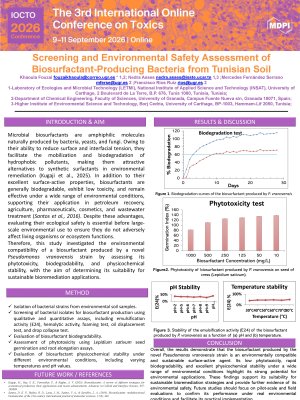
Biosurfactant-producing bacteria represent a promising and environmentally compatible alternative to synthetic surfactants; however, their large-scale application requires careful assessment of potential ecological toxicity and environmental impact. In this study, several bacterial strains were isolated from Tunisian soil and systematically screened for their ability to produce biosurfactants using standard qualitative and quantitative assays. The most efficient producers were selected for further characterization, and the biosurfactants obtained were evaluated for their environmental safety through a series of toxicity, stability, and biodegradability tests.
Phytotoxicity assays using Lepidium sativum seeds at biosurfactant concentrations ranging from 10 to 1000 mg/L showed no inhibitory effects on seed germination or root elongation, with a germination index (GI) exceeding 80% at all tested concentrations, indicating the absence of phytotoxicity. Biodegradability studies demonstrated rapid degradation, with more than 60% degradation achieved within four days, highlighting the biosurfactant's low environmental persistence. Stability assays showed that the emulsification activity (E24) remained stable after exposure to temperatures between 30 and 80°C and within a pH range of 4–10, demonstrating the robustness of the biosurfactant under a wide range of environmental conditions.
Overall, the results confirm that biosurfactants produced by the isolated soil bacteria exhibit a favorable ecotoxicological profile, supporting their potential use as safe, sustainable, and efficient agents in bioremediation and other environmental biotechnological applications.
Keywords
Biosurfactant
phytotoxicity
Biodegradation
eco friendly
Poster
Khaoula Fouzai Poster IOCTO Sciforum-185080.pdf
Preparation of Size-Defined TPU Nano- and Microplastics and Their Cellular Uptake by RAW264.7 Macrophages
Micro-plastics and Nano-plastics as Emerging Contaminants: A Systematic Review of Human Exposure Routes and Epidemiological Evidence of Health Outcomes