Event submissions
Published
This submission belongs to the session 1. Exposure Routes / Exposome of Emerging Contaminants and Materials in the Environment of the event The 3rd International Online Conference on Toxics
Published date
04 Sep, 2026
Academic Editor
'%3e%3cpath%20d='M12.6657%2010.9104C12.4185%2010.325%2012.0599%209.79327%2011.6097%209.34482C11.1609%208.89508%2010.6293%208.5365%2010.0442%208.28888C10.0389%208.28626%2010.0337%208.28495%2010.0285%208.28233C10.8446%207.69279%2011.3752%206.73249%2011.3752%205.64904C11.3752%203.8542%209.92103%202.39999%208.1262%202.39999C6.33136%202.39999%204.87715%203.8542%204.87715%205.64904C4.87715%206.73249%205.40774%207.69279%206.22393%208.28364C6.21869%208.28626%206.21345%208.28757%206.20821%208.29019C5.62129%208.5378%205.09463%208.89284%204.64265%209.34613C4.1929%209.79493%203.83432%2010.3266%203.58671%2010.9117C3.34345%2011.4845%203.21226%2012.0987%203.20023%2012.7209C3.19988%2012.7349%203.20233%2012.7488%203.20744%2012.7619C3.21255%2012.7749%203.22022%2012.7867%203.22998%2012.7968C3.23975%2012.8068%203.25142%2012.8147%203.26431%2012.8202C3.2772%2012.8256%203.29105%2012.8284%203.30504%2012.8284H4.09109C4.14874%2012.8284%204.19459%2012.7825%204.1959%2012.7262C4.2221%2011.7148%204.62823%2010.7676%205.34617%2010.0497C6.08899%209.30683%207.0755%208.89808%208.1262%208.89808C9.17689%208.89808%2010.1634%209.30683%2010.9062%2010.0497C11.6242%2010.7676%2012.0303%2011.7148%2012.0565%2012.7262C12.0578%2012.7838%2012.1037%2012.8284%2012.1613%2012.8284H12.9474C12.9613%2012.8284%2012.9752%2012.8256%2012.9881%2012.8202C13.001%2012.8147%2013.0126%2012.8068%2013.0224%2012.7968C13.0322%2012.7867%2013.0398%2012.7749%2013.0449%2012.7619C13.0501%2012.7488%2013.0525%2012.7349%2013.0522%2012.7209C13.0391%2012.0947%2012.9094%2011.4855%2012.6657%2010.9104ZM8.1262%207.9024C7.52486%207.9024%206.9589%207.6679%206.53312%207.24211C6.10733%206.81633%205.87283%206.25037%205.87283%205.64904C5.87283%205.0477%206.10733%204.48174%206.53312%204.05596C6.9589%203.63018%207.52486%203.39567%208.1262%203.39567C8.72753%203.39567%209.29349%203.63018%209.71927%204.05596C10.1451%204.48174%2010.3796%205.0477%2010.3796%205.64904C10.3796%206.25037%2010.1451%206.81633%209.71927%207.24211C9.29349%207.6679%208.72753%207.9024%208.1262%207.9024Z'%20fill='%235D1EE1'/%3e%3c/g%3e%3c/svg%3e) Rakesh Kanda
Rakesh KandaCitation
Bukola Obe, Abdulwaris Tijani, Micro-plastics and Nano-plastics as Emerging Contaminants: A Systematic Review of Human Exposure Routes and Epidemiological Evidence of Health Outcomes, in Proceedings of The 3rd International Online Conference on Toxics, 9 September–11 September 2026, MDPI: Basel, Switzerland
Share
Email
Facebook
Twitter
LinkedIn
Micro-plastics and Nano-plastics as Emerging Contaminants: A Systematic Review of Human Exposure Routes and Epidemiological Evidence of Health Outcomes
'%3e%3cpath%20d='M12.6647%2010.9104C12.4176%2010.325%2012.0589%209.7933%2011.6088%209.34485C11.16%208.89511%2010.6283%208.53653%2010.0432%208.28891C10.038%208.28629%2010.0327%208.28498%2010.0275%208.28236C10.8437%207.69282%2011.3743%206.73252%2011.3743%205.64907C11.3743%203.85423%209.92005%202.40002%208.12522%202.40002C6.33038%202.40002%204.87618%203.85423%204.87618%205.64907C4.87618%206.73252%205.40677%207.69282%206.22296%208.28367C6.21772%208.28629%206.21248%208.2876%206.20724%208.29022C5.62031%208.53783%205.09365%208.89287%204.64167%209.34616C4.19192%209.79496%203.83334%2010.3266%203.58573%2010.9117C3.34247%2011.4846%203.21128%2012.0987%203.19925%2012.721C3.1989%2012.735%203.20135%2012.7489%203.20646%2012.7619C3.21157%2012.7749%203.21924%2012.7868%203.22901%2012.7968C3.23877%2012.8068%203.25045%2012.8148%203.26334%2012.8202C3.27623%2012.8256%203.29007%2012.8284%203.30406%2012.8284H4.09012C4.14776%2012.8284%204.19362%2012.7825%204.19493%2012.7262C4.22113%2011.7148%204.62726%2010.7676%205.34519%2010.0497C6.08802%209.30686%207.07452%208.89811%208.12522%208.89811C9.17592%208.89811%2010.1624%209.30686%2010.9052%2010.0497C11.6232%2010.7676%2012.0293%2011.7148%2012.0555%2012.7262C12.0568%2012.7839%2012.1027%2012.8284%2012.1603%2012.8284H12.9464C12.9604%2012.8284%2012.9742%2012.8256%2012.9871%2012.8202C13%2012.8148%2013.0117%2012.8068%2013.0214%2012.7968C13.0312%2012.7868%2013.0389%2012.7749%2013.044%2012.7619C13.0491%2012.7489%2013.0515%2012.735%2013.0512%2012.721C13.0381%2012.0947%2012.9084%2011.4856%2012.6647%2010.9104ZM8.12522%207.90243C7.52388%207.90243%206.95792%207.66793%206.53214%207.24215C6.10636%206.81636%205.87185%206.2504%205.87185%205.64907C5.87185%205.04773%206.10636%204.48177%206.53214%204.05599C6.95792%203.63021%207.52388%203.3957%208.12522%203.3957C8.72655%203.3957%209.29252%203.63021%209.7183%204.05599C10.1441%204.48177%2010.3786%205.04773%2010.3786%205.64907C10.3786%206.2504%2010.1441%206.81636%209.7183%207.24215C9.29252%207.66793%208.72655%207.90243%208.12522%207.90243Z'%20fill='%235D1EE1'/%3e%3c/g%3e%3c/svg%3e)
Bukola Obe 1
Abdulwaris Tijani 1
1. Department of Animal Production and Health, Federal University of Technology, Akure
Abstract
Introduction:
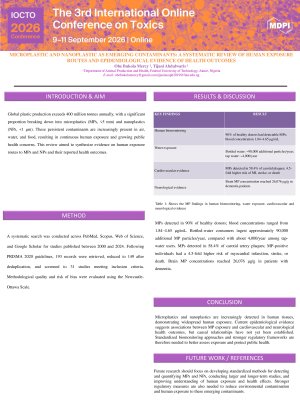
Global plastic production has surpassed 400 million tonnes annually, with a substantial fraction fragmenting into microplastics (MPs, <5mm) and nanoplastics (NPs, <1μm) that persistently contaminate air, water, and food. Continuous human exposure through multiple daily pathways raises urgent public health concerns. This review synthesizes evidence on MP and NP human exposure routes and associated health outcomes.
Methods:
A systematic search was conducted across PubMed, Scopus, Web of Science, and Google Scholar for studies published between 2000 and 2024. Following PRISMA 2020 guidelines, 193 records were retrieved, reduced to 149 after deduplication, and screened to 31 studies meeting inclusion criteria. Methodological quality and risk of bias were evaluated using the Newcastle-Ottawa Scale.
Results:
MPs were detected in 90% of healthy donors with blood concentrations of 1.84–4.65 μg/mL. Bottled water consumers ingest approximately 90,000 additional MP particles annually versus 4,000 for tap water users. A multicenter observational study detected MPs in carotid artery plaques of 58.4% of patients, with MP-positive individuals showing a 4.5-fold higher risk of myocardial infarction, stroke, or death over 34 months. Brain MP concentrations reached 26,076 μg/g in dementia patients. Most studies were of moderate-to-high quality, though small sample sizes and cross-sectional designs introduced risk of bias.
Conclusions:
MPs and NPs are widely detected in human tissues, with epidemiological studies reporting associations, not established causal relationships with cardiovascular disease and neurodegeneration. Standardized biomonitoring methods and strengthened global regulatory frameworks remain urgent priorities.
Keywords
Micro plastics
Nano plastics
emerging contaminants
exposure routes
bio monitoring
epidemiology
cardiovascular disease
public health.
Poster
POSTER.pdf
Screening and Environmental Safety Assessment of Biosurfactant-Producing Bacteria from Tunisian Soil
Dietary Exposure to Microbial Contaminants and Antibiotic Resistance Genes: Metagenomic Insights from Traditional Fermented Pork Fat