Event submissions
Published
This submission belongs to the session 1. Exposure Routes / Exposome of Emerging Contaminants and Materials in the Environment of the event The 3rd International Online Conference on Toxics
Published date
04 Sep, 2026
Academic Editor
'%3e%3cpath%20d='M12.6657%2010.9104C12.4185%2010.325%2012.0599%209.79327%2011.6097%209.34482C11.1609%208.89508%2010.6293%208.5365%2010.0442%208.28888C10.0389%208.28626%2010.0337%208.28495%2010.0285%208.28233C10.8446%207.69279%2011.3752%206.73249%2011.3752%205.64904C11.3752%203.8542%209.92103%202.39999%208.1262%202.39999C6.33136%202.39999%204.87715%203.8542%204.87715%205.64904C4.87715%206.73249%205.40774%207.69279%206.22393%208.28364C6.21869%208.28626%206.21345%208.28757%206.20821%208.29019C5.62129%208.5378%205.09463%208.89284%204.64265%209.34613C4.1929%209.79493%203.83432%2010.3266%203.58671%2010.9117C3.34345%2011.4845%203.21226%2012.0987%203.20023%2012.7209C3.19988%2012.7349%203.20233%2012.7488%203.20744%2012.7619C3.21255%2012.7749%203.22022%2012.7867%203.22998%2012.7968C3.23975%2012.8068%203.25142%2012.8147%203.26431%2012.8202C3.2772%2012.8256%203.29105%2012.8284%203.30504%2012.8284H4.09109C4.14874%2012.8284%204.19459%2012.7825%204.1959%2012.7262C4.2221%2011.7148%204.62823%2010.7676%205.34617%2010.0497C6.08899%209.30683%207.0755%208.89808%208.1262%208.89808C9.17689%208.89808%2010.1634%209.30683%2010.9062%2010.0497C11.6242%2010.7676%2012.0303%2011.7148%2012.0565%2012.7262C12.0578%2012.7838%2012.1037%2012.8284%2012.1613%2012.8284H12.9474C12.9613%2012.8284%2012.9752%2012.8256%2012.9881%2012.8202C13.001%2012.8147%2013.0126%2012.8068%2013.0224%2012.7968C13.0322%2012.7867%2013.0398%2012.7749%2013.0449%2012.7619C13.0501%2012.7488%2013.0525%2012.7349%2013.0522%2012.7209C13.0391%2012.0947%2012.9094%2011.4855%2012.6657%2010.9104ZM8.1262%207.9024C7.52486%207.9024%206.9589%207.6679%206.53312%207.24211C6.10733%206.81633%205.87283%206.25037%205.87283%205.64904C5.87283%205.0477%206.10733%204.48174%206.53312%204.05596C6.9589%203.63018%207.52486%203.39567%208.1262%203.39567C8.72753%203.39567%209.29349%203.63018%209.71927%204.05596C10.1451%204.48174%2010.3796%205.0477%2010.3796%205.64904C10.3796%206.25037%2010.1451%206.81633%209.71927%207.24211C9.29349%207.6679%208.72753%207.9024%208.1262%207.9024Z'%20fill='%235D1EE1'/%3e%3c/g%3e%3c/svg%3e) Rakesh Kanda
Rakesh KandaCitation
Surajit De Mandal, Dietary Exposure to Microbial Contaminants and Antibiotic Resistance Genes: Metagenomic Insights from Traditional Fermented Pork Fat , in Proceedings of The 3rd International Online Conference on Toxics, 9 September–11 September 2026, MDPI: Basel, Switzerland
Share
Email
Facebook
Twitter
LinkedIn
Dietary Exposure to Microbial Contaminants and Antibiotic Resistance Genes: Metagenomic Insights from Traditional Fermented Pork Fat
'%3e%3cpath%20d='M12.6647%2010.9104C12.4176%2010.325%2012.0589%209.7933%2011.6088%209.34485C11.16%208.89511%2010.6283%208.53653%2010.0432%208.28891C10.038%208.28629%2010.0327%208.28498%2010.0275%208.28236C10.8437%207.69282%2011.3743%206.73252%2011.3743%205.64907C11.3743%203.85423%209.92005%202.40002%208.12522%202.40002C6.33038%202.40002%204.87618%203.85423%204.87618%205.64907C4.87618%206.73252%205.40677%207.69282%206.22296%208.28367C6.21772%208.28629%206.21248%208.2876%206.20724%208.29022C5.62031%208.53783%205.09365%208.89287%204.64167%209.34616C4.19192%209.79496%203.83334%2010.3266%203.58573%2010.9117C3.34247%2011.4846%203.21128%2012.0987%203.19925%2012.721C3.1989%2012.735%203.20135%2012.7489%203.20646%2012.7619C3.21157%2012.7749%203.21924%2012.7868%203.22901%2012.7968C3.23877%2012.8068%203.25045%2012.8148%203.26334%2012.8202C3.27623%2012.8256%203.29007%2012.8284%203.30406%2012.8284H4.09012C4.14776%2012.8284%204.19362%2012.7825%204.19493%2012.7262C4.22113%2011.7148%204.62726%2010.7676%205.34519%2010.0497C6.08802%209.30686%207.07452%208.89811%208.12522%208.89811C9.17592%208.89811%2010.1624%209.30686%2010.9052%2010.0497C11.6232%2010.7676%2012.0293%2011.7148%2012.0555%2012.7262C12.0568%2012.7839%2012.1027%2012.8284%2012.1603%2012.8284H12.9464C12.9604%2012.8284%2012.9742%2012.8256%2012.9871%2012.8202C13%2012.8148%2013.0117%2012.8068%2013.0214%2012.7968C13.0312%2012.7868%2013.0389%2012.7749%2013.044%2012.7619C13.0491%2012.7489%2013.0515%2012.735%2013.0512%2012.721C13.0381%2012.0947%2012.9084%2011.4856%2012.6647%2010.9104ZM8.12522%207.90243C7.52388%207.90243%206.95792%207.66793%206.53214%207.24215C6.10636%206.81636%205.87185%206.2504%205.87185%205.64907C5.87185%205.04773%206.10636%204.48177%206.53214%204.05599C6.95792%203.63021%207.52388%203.3957%208.12522%203.3957C8.72655%203.3957%209.29252%203.63021%209.7183%204.05599C10.1441%204.48177%2010.3786%205.04773%2010.3786%205.64907C10.3786%206.2504%2010.1441%206.81636%209.7183%207.24215C9.29252%207.66793%208.72655%207.90243%208.12522%207.90243Z'%20fill='%235D1EE1'/%3e%3c/g%3e%3c/svg%3e)
Surajit De Mandal 1
1. Department of Microbiology, Shri Davara University, Raipur 493661
Abstract
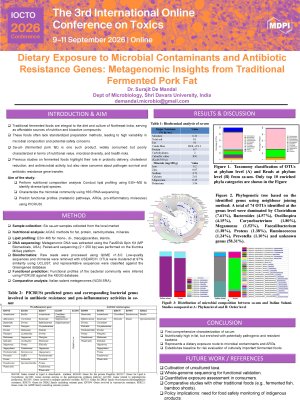
Traditional foods can represent important dietary sources of chemical and microbial exposures, yet their composition and potential health implications remain poorly characterized. This study aimed to comprehensively characterize the nutritional composition, lipid profile, and microbial community of a traditional fermented pork fat from Northeast India. Six samples of fermented pork fat were collected from different regions were analyzed using physicochemical methods, electrospray ionization mass spectrometry (ESI+-MS), and 16S rRNA gene amplicon sequencing with PICRUSt-based functional prediction. Physicochemical analysis showed that sa-um consisted predominantly of fat (~91% dry weight), with minor amounts of carbohydrates and proteins. Lipid profiling identified diverse mono-, di-, and triacylglycerides, including myristic acid-containing acylglycerides, sterols, and both saturated and unsaturated lipid species, reflecting a complex dietary lipid composition. Metagenomic analysis identified 72 bacterial genera, dominated by the phyla Firmicutes, Proteobacteria, and Bacteroidetes, with Clostridium representing the most abundant genus. Functional prediction suggested that the microbial community was primarily associated with energy, carbohydrate, amino acid, and lipid metabolism. PICRUSt analysis also predicted genes related to antibiotic resistance and bacterial components such as flagellin and lipid A biosynthesis, mainly associated with members of Bacillaceae, Bacteroidaceae, Clostridiaceae, Corynebacteriaceae, and Enterobacteriaceae. The analysis suggests that this traditional fermented pork may represent a potential source of microbial hazards; however, further in-depth studies are required to confirm the presence of viable pathogenic microorganisms, expressed virulence factors, and associated health risks. By integrating nutritional profiling, and metagenomic characterization, this study provides the first comprehensive assessment a traditional fermented foods. The findings establish a baseline for future quantitative exposure assessment and risk evaluation of culturally important fermented foods.
Keywords
Traditional food
Contaminants
metagenomic analysis
Poster
The 3rd International Online Conference on Toxics_ppt1.pdf
Micro-plastics and Nano-plastics as Emerging Contaminants: A Systematic Review of Human Exposure Routes and Epidemiological Evidence of Health Outcomes
Enantioselective Determination of Duvelisib in Wastewater Samples by Electrokinetic Chromatography after µSPEed Preconcentration