Event submissions
Published
This submission belongs to the session 3. Innovating Toxicology: NAMs and Computational Tools for Next-Generation Risk Assessment of the event The 3rd International Online Conference on Toxics
Published date
04 Sep, 2026
Academic Editor
'%3e%3cpath%20d='M12.6657%2010.9104C12.4185%2010.325%2012.0599%209.79327%2011.6097%209.34482C11.1609%208.89508%2010.6293%208.5365%2010.0442%208.28888C10.0389%208.28626%2010.0337%208.28495%2010.0285%208.28233C10.8446%207.69279%2011.3752%206.73249%2011.3752%205.64904C11.3752%203.8542%209.92103%202.39999%208.1262%202.39999C6.33136%202.39999%204.87715%203.8542%204.87715%205.64904C4.87715%206.73249%205.40774%207.69279%206.22393%208.28364C6.21869%208.28626%206.21345%208.28757%206.20821%208.29019C5.62129%208.5378%205.09463%208.89284%204.64265%209.34613C4.1929%209.79493%203.83432%2010.3266%203.58671%2010.9117C3.34345%2011.4845%203.21226%2012.0987%203.20023%2012.7209C3.19988%2012.7349%203.20233%2012.7488%203.20744%2012.7619C3.21255%2012.7749%203.22022%2012.7867%203.22998%2012.7968C3.23975%2012.8068%203.25142%2012.8147%203.26431%2012.8202C3.2772%2012.8256%203.29105%2012.8284%203.30504%2012.8284H4.09109C4.14874%2012.8284%204.19459%2012.7825%204.1959%2012.7262C4.2221%2011.7148%204.62823%2010.7676%205.34617%2010.0497C6.08899%209.30683%207.0755%208.89808%208.1262%208.89808C9.17689%208.89808%2010.1634%209.30683%2010.9062%2010.0497C11.6242%2010.7676%2012.0303%2011.7148%2012.0565%2012.7262C12.0578%2012.7838%2012.1037%2012.8284%2012.1613%2012.8284H12.9474C12.9613%2012.8284%2012.9752%2012.8256%2012.9881%2012.8202C13.001%2012.8147%2013.0126%2012.8068%2013.0224%2012.7968C13.0322%2012.7867%2013.0398%2012.7749%2013.0449%2012.7619C13.0501%2012.7488%2013.0525%2012.7349%2013.0522%2012.7209C13.0391%2012.0947%2012.9094%2011.4855%2012.6657%2010.9104ZM8.1262%207.9024C7.52486%207.9024%206.9589%207.6679%206.53312%207.24211C6.10733%206.81633%205.87283%206.25037%205.87283%205.64904C5.87283%205.0477%206.10733%204.48174%206.53312%204.05596C6.9589%203.63018%207.52486%203.39567%208.1262%203.39567C8.72753%203.39567%209.29349%203.63018%209.71927%204.05596C10.1451%204.48174%2010.3796%205.0477%2010.3796%205.64904C10.3796%206.25037%2010.1451%206.81633%209.71927%207.24211C9.29349%207.6679%208.72753%207.9024%208.1262%207.9024Z'%20fill='%235D1EE1'/%3e%3c/g%3e%3c/svg%3e) Emilio Benfenati
Emilio BenfenatiCitation
Ali Amini Harandi, Amin Ahmadi, Alireza Ansari Mahabadi, Mohammad Hossein Pakrooh, Seyed Arman Ahmadi, Machine Learning in Environmental Toxicology: Predicting Endocrine Disruption and Cross-Species Toxicity of Emerging Contaminants, in Proceedings of The 3rd International Online Conference on Toxics, 9 September–11 September 2026, MDPI: Basel, Switzerland
Share
Email
Facebook
Twitter
LinkedIn
Machine Learning in Environmental Toxicology: Predicting Endocrine Disruption and Cross-Species Toxicity of Emerging Contaminants
'%3e%3cpath%20d='M12.6647%2010.9104C12.4176%2010.325%2012.0589%209.7933%2011.6088%209.34485C11.16%208.89511%2010.6283%208.53653%2010.0432%208.28891C10.038%208.28629%2010.0327%208.28498%2010.0275%208.28236C10.8437%207.69282%2011.3743%206.73252%2011.3743%205.64907C11.3743%203.85423%209.92005%202.40002%208.12522%202.40002C6.33038%202.40002%204.87618%203.85423%204.87618%205.64907C4.87618%206.73252%205.40677%207.69282%206.22296%208.28367C6.21772%208.28629%206.21248%208.2876%206.20724%208.29022C5.62031%208.53783%205.09365%208.89287%204.64167%209.34616C4.19192%209.79496%203.83334%2010.3266%203.58573%2010.9117C3.34247%2011.4846%203.21128%2012.0987%203.19925%2012.721C3.1989%2012.735%203.20135%2012.7489%203.20646%2012.7619C3.21157%2012.7749%203.21924%2012.7868%203.22901%2012.7968C3.23877%2012.8068%203.25045%2012.8148%203.26334%2012.8202C3.27623%2012.8256%203.29007%2012.8284%203.30406%2012.8284H4.09012C4.14776%2012.8284%204.19362%2012.7825%204.19493%2012.7262C4.22113%2011.7148%204.62726%2010.7676%205.34519%2010.0497C6.08802%209.30686%207.07452%208.89811%208.12522%208.89811C9.17592%208.89811%2010.1624%209.30686%2010.9052%2010.0497C11.6232%2010.7676%2012.0293%2011.7148%2012.0555%2012.7262C12.0568%2012.7839%2012.1027%2012.8284%2012.1603%2012.8284H12.9464C12.9604%2012.8284%2012.9742%2012.8256%2012.9871%2012.8202C13%2012.8148%2013.0117%2012.8068%2013.0214%2012.7968C13.0312%2012.7868%2013.0389%2012.7749%2013.044%2012.7619C13.0491%2012.7489%2013.0515%2012.735%2013.0512%2012.721C13.0381%2012.0947%2012.9084%2011.4856%2012.6647%2010.9104ZM8.12522%207.90243C7.52388%207.90243%206.95792%207.66793%206.53214%207.24215C6.10636%206.81636%205.87185%206.2504%205.87185%205.64907C5.87185%205.04773%206.10636%204.48177%206.53214%204.05599C6.95792%203.63021%207.52388%203.3957%208.12522%203.3957C8.72655%203.3957%209.29252%203.63021%209.7183%204.05599C10.1441%204.48177%2010.3786%205.04773%2010.3786%205.64907C10.3786%206.2504%2010.1441%206.81636%209.7183%207.24215C9.29252%207.66793%208.72655%207.90243%208.12522%207.90243Z'%20fill='%235D1EE1'/%3e%3c/g%3e%3c/svg%3e)
Ali Amini Harandi 1
Amin Ahmadi 1
Alireza Ansari Mahabadi 1
Mohammad Hossein Pakrooh 1,2
Seyed Arman Ahmadi 1
1. Faculty of Veterinary Medicine, Shahrekord University, Chaharmahal & Bakhtiari, Iran
2. Institute of Intercontinental Student Veterinary (ISRI-RETM), Technology Development Center, Shahrekord University, Chaharmahal & Bakhtiari, Iran
Abstract
Introduction:
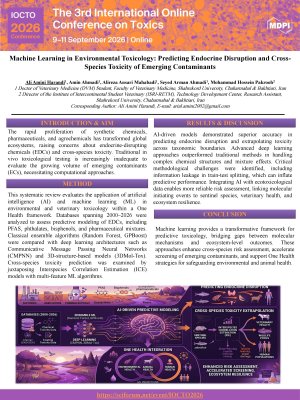
The rapid proliferation of synthetic chemicals, pharmaceuticals, and agrochemicals has transformed global ecosystems, raising concerns about endocrine-disrupting chemicals (EDCs) and cross-species toxicity. Traditional in vivo toxicological testing is increasingly inadequate to evaluate the growing volume of emerging contaminants (ECs), necessitating computational approaches.
Methods:
This systematic review evaluates the application of artificial intelligence (AI) and machine learning (ML) in environmental and veterinary toxicology within a One Health framework. Databases spanning 2000–2026 were analyzed to assess predictive modeling of EDCs, including PFAS, phthalates, bisphenols, and pharmaceutical mixtures. Classical ensemble algorithms (Random Forest, GPBoost) were compared with deep learning architectures such as Communicative Message Passing Neural Networks (CMPNN) and 3D-structure-based models (3DMol-Tox). Cross-species toxicity prediction was examined by juxtaposing Interspecies Correlation Estimation (ICE) models with multi-feature ML algorithms.
Results:
AI-driven models demonstrated superior accuracy in predicting endocrine disruption and extrapolating toxicity across taxonomic boundaries. Advanced deep learning approaches outperformed traditional methods in handling complex chemical structures and mixture effects. Critical methodological challenges were identified, including information leakage in train-test splitting, which can inflate predictive performance. Integrating AI with ecotoxicological data enables more reliable risk assessment, linking molecular initiating events to sentinel species, veterinary health, and ecosystem resilience.
Conclusions:
Machine learning provides a transformative framework for predictive toxicology, bridging gaps between molecular mechanisms and ecosystem-level outcomes. These approaches enhance cross-species risk assessment, accelerate screening of emerging contaminants, and support One Health strategies for safeguarding environmental and animal health.
Keywords
Predictive Toxicology
Machine Learning
Endocrine Disruption
Emerging Contaminants
One Health
Poster
Machine Learning in Environmental Toxicology.pdf
Enantioselective Determination of Duvelisib in Wastewater Samples by Electrokinetic Chromatography after µSPEed Preconcentration
Organic Sunscreens - infant exposure via breastfeeding