Event submissions
Published
This submission belongs to the session 1. Exposure Routes / Exposome of Emerging Contaminants and Materials in the Environment of the event The 3rd International Online Conference on Toxics
Published date
04 Sep, 2026
Academic Editor
'%3e%3cpath%20d='M12.6657%2010.9104C12.4185%2010.325%2012.0599%209.79327%2011.6097%209.34482C11.1609%208.89508%2010.6293%208.5365%2010.0442%208.28888C10.0389%208.28626%2010.0337%208.28495%2010.0285%208.28233C10.8446%207.69279%2011.3752%206.73249%2011.3752%205.64904C11.3752%203.8542%209.92103%202.39999%208.1262%202.39999C6.33136%202.39999%204.87715%203.8542%204.87715%205.64904C4.87715%206.73249%205.40774%207.69279%206.22393%208.28364C6.21869%208.28626%206.21345%208.28757%206.20821%208.29019C5.62129%208.5378%205.09463%208.89284%204.64265%209.34613C4.1929%209.79493%203.83432%2010.3266%203.58671%2010.9117C3.34345%2011.4845%203.21226%2012.0987%203.20023%2012.7209C3.19988%2012.7349%203.20233%2012.7488%203.20744%2012.7619C3.21255%2012.7749%203.22022%2012.7867%203.22998%2012.7968C3.23975%2012.8068%203.25142%2012.8147%203.26431%2012.8202C3.2772%2012.8256%203.29105%2012.8284%203.30504%2012.8284H4.09109C4.14874%2012.8284%204.19459%2012.7825%204.1959%2012.7262C4.2221%2011.7148%204.62823%2010.7676%205.34617%2010.0497C6.08899%209.30683%207.0755%208.89808%208.1262%208.89808C9.17689%208.89808%2010.1634%209.30683%2010.9062%2010.0497C11.6242%2010.7676%2012.0303%2011.7148%2012.0565%2012.7262C12.0578%2012.7838%2012.1037%2012.8284%2012.1613%2012.8284H12.9474C12.9613%2012.8284%2012.9752%2012.8256%2012.9881%2012.8202C13.001%2012.8147%2013.0126%2012.8068%2013.0224%2012.7968C13.0322%2012.7867%2013.0398%2012.7749%2013.0449%2012.7619C13.0501%2012.7488%2013.0525%2012.7349%2013.0522%2012.7209C13.0391%2012.0947%2012.9094%2011.4855%2012.6657%2010.9104ZM8.1262%207.9024C7.52486%207.9024%206.9589%207.6679%206.53312%207.24211C6.10733%206.81633%205.87283%206.25037%205.87283%205.64904C5.87283%205.0477%206.10733%204.48174%206.53312%204.05596C6.9589%203.63018%207.52486%203.39567%208.1262%203.39567C8.72753%203.39567%209.29349%203.63018%209.71927%204.05596C10.1451%204.48174%2010.3796%205.0477%2010.3796%205.64904C10.3796%206.25037%2010.1451%206.81633%209.71927%207.24211C9.29349%207.6679%208.72753%207.9024%208.1262%207.9024Z'%20fill='%235D1EE1'/%3e%3c/g%3e%3c/svg%3e) Carlos Barata
Carlos BarataCitation
Ukam Uno-Ubarei Uno, Idara Solomon Esua, Dominic Okena Ndum, Anthonia Ndang Akan, Modulatory effects of vitamin C on lead induced organotoxicity and histopathology in male albino rats., in Proceedings of The 3rd International Online Conference on Toxics, 9 September–11 September 2026, MDPI: Basel, Switzerland
Share
Email
Facebook
Twitter
LinkedIn
Modulatory effects of vitamin C on lead induced organotoxicity and histopathology in male albino rats.
'%3e%3cpath%20d='M12.6647%2010.9104C12.4176%2010.325%2012.0589%209.7933%2011.6088%209.34485C11.16%208.89511%2010.6283%208.53653%2010.0432%208.28891C10.038%208.28629%2010.0327%208.28498%2010.0275%208.28236C10.8437%207.69282%2011.3743%206.73252%2011.3743%205.64907C11.3743%203.85423%209.92005%202.40002%208.12522%202.40002C6.33038%202.40002%204.87618%203.85423%204.87618%205.64907C4.87618%206.73252%205.40677%207.69282%206.22296%208.28367C6.21772%208.28629%206.21248%208.2876%206.20724%208.29022C5.62031%208.53783%205.09365%208.89287%204.64167%209.34616C4.19192%209.79496%203.83334%2010.3266%203.58573%2010.9117C3.34247%2011.4846%203.21128%2012.0987%203.19925%2012.721C3.1989%2012.735%203.20135%2012.7489%203.20646%2012.7619C3.21157%2012.7749%203.21924%2012.7868%203.22901%2012.7968C3.23877%2012.8068%203.25045%2012.8148%203.26334%2012.8202C3.27623%2012.8256%203.29007%2012.8284%203.30406%2012.8284H4.09012C4.14776%2012.8284%204.19362%2012.7825%204.19493%2012.7262C4.22113%2011.7148%204.62726%2010.7676%205.34519%2010.0497C6.08802%209.30686%207.07452%208.89811%208.12522%208.89811C9.17592%208.89811%2010.1624%209.30686%2010.9052%2010.0497C11.6232%2010.7676%2012.0293%2011.7148%2012.0555%2012.7262C12.0568%2012.7839%2012.1027%2012.8284%2012.1603%2012.8284H12.9464C12.9604%2012.8284%2012.9742%2012.8256%2012.9871%2012.8202C13%2012.8148%2013.0117%2012.8068%2013.0214%2012.7968C13.0312%2012.7868%2013.0389%2012.7749%2013.044%2012.7619C13.0491%2012.7489%2013.0515%2012.735%2013.0512%2012.721C13.0381%2012.0947%2012.9084%2011.4856%2012.6647%2010.9104ZM8.12522%207.90243C7.52388%207.90243%206.95792%207.66793%206.53214%207.24215C6.10636%206.81636%205.87185%206.2504%205.87185%205.64907C5.87185%205.04773%206.10636%204.48177%206.53214%204.05599C6.95792%203.63021%207.52388%203.3957%208.12522%203.3957C8.72655%203.3957%209.29252%203.63021%209.7183%204.05599C10.1441%204.48177%2010.3786%205.04773%2010.3786%205.64907C10.3786%206.2504%2010.1441%206.81636%209.7183%207.24215C9.29252%207.66793%208.72655%207.90243%208.12522%207.90243Z'%20fill='%235D1EE1'/%3e%3c/g%3e%3c/svg%3e)
Ukam Uno-Ubarei Uno 1
Idara Solomon Esua 2
Dominic Okena Ndum 1
Anthonia Ndang Akan 1
1. Department of Biology, University of Education and Entrepreneurship, Akamkpa
2. Department of Genetics and Biotechnology, University of Calabar, Calabar
Abstract
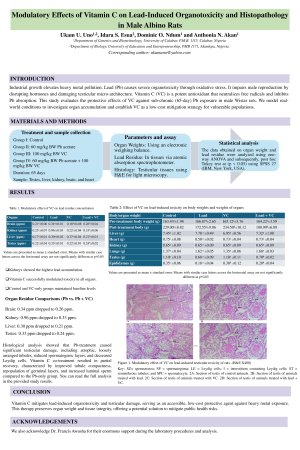
Lead (Pb) toxicity remains a major global public health concern, particularly in low-income regions with persistent environmental and occupational exposure. This study evaluated the protective effects of Vitamin C (VC) against Pb-induced organotoxicity and testicular histopathological alterations in male albino rats as a mammalian experimental model. Twenty-four male albino rats were randomly assigned into four groups (n = 6): control, Pb acetate (60 mg/kg body weight), Vitamin C (100 mg/kg body weight), and combined Pb + VC treatment, administered orally for 65 days to simulate prolonged exposure. Lead residues in tissues were quantified using atomic absorption spectrophotometry following acid digestion. Body and organ weights were recorded, and testes were processed for histopathological examination. Statistical analysis was performed using one-way ANOVA, with significance set at p < 0.05. Pb exposure significantly increased Pb residues in the brain, kidney, liver, and testes, while Vitamin C co-administration reduced tissue Pb levels by approximately 24–66%, with the greatest reduction observed in the kidney. Pb also caused significant reductions in post-treatment body weight (172.6 g vs 229.0 g in controls) and reproductive organ weights. Vitamin C partially ameliorated these effects, improving body weight (180.9 g) and restoring heart weight to near-control values. Histopathological evaluation revealed severe degeneration and disorganization of seminiferous tubules in Pb-exposed testes, whereas Vitamin C co-treatment markedly preserved spermatogenic architecture and cellular integrity. These findings demonstrate that Vitamin C mitigates Pb-induced organotoxicity and reproductive damage in male albino rats by reducing tissue Pb accumulation and preserving testicular structure. While the results highlight the potential of Vitamin C as an accessible and low-cost protective agent against lead toxicity, further studies are required to validate these effects in human populations before clinical extrapolation.
Keywords
Lead
Vitamin C
Organotoxicity
Histopathology and Modulatory effect.
Poster
Poster Presentation_3.pdf
Tamarix aphylla Leaves Synthesized Biochar Loaded Fe doped MgO Nanocomposites for Dye Pollutants Removal from Water
Effect of Aflatoxin Contamination on Oxidative Stress, Hematological Indices, and Growth Performance of Broiler Chickens