Event submissions
Published
This submission belongs to the session 1. Exposure Routes / Exposome of Emerging Contaminants and Materials in the Environment of the event The 3rd International Online Conference on Toxics
Published date
04 Sep, 2026
Academic Editor
'%3e%3cpath%20d='M12.6657%2010.9104C12.4185%2010.325%2012.0599%209.79327%2011.6097%209.34482C11.1609%208.89508%2010.6293%208.5365%2010.0442%208.28888C10.0389%208.28626%2010.0337%208.28495%2010.0285%208.28233C10.8446%207.69279%2011.3752%206.73249%2011.3752%205.64904C11.3752%203.8542%209.92103%202.39999%208.1262%202.39999C6.33136%202.39999%204.87715%203.8542%204.87715%205.64904C4.87715%206.73249%205.40774%207.69279%206.22393%208.28364C6.21869%208.28626%206.21345%208.28757%206.20821%208.29019C5.62129%208.5378%205.09463%208.89284%204.64265%209.34613C4.1929%209.79493%203.83432%2010.3266%203.58671%2010.9117C3.34345%2011.4845%203.21226%2012.0987%203.20023%2012.7209C3.19988%2012.7349%203.20233%2012.7488%203.20744%2012.7619C3.21255%2012.7749%203.22022%2012.7867%203.22998%2012.7968C3.23975%2012.8068%203.25142%2012.8147%203.26431%2012.8202C3.2772%2012.8256%203.29105%2012.8284%203.30504%2012.8284H4.09109C4.14874%2012.8284%204.19459%2012.7825%204.1959%2012.7262C4.2221%2011.7148%204.62823%2010.7676%205.34617%2010.0497C6.08899%209.30683%207.0755%208.89808%208.1262%208.89808C9.17689%208.89808%2010.1634%209.30683%2010.9062%2010.0497C11.6242%2010.7676%2012.0303%2011.7148%2012.0565%2012.7262C12.0578%2012.7838%2012.1037%2012.8284%2012.1613%2012.8284H12.9474C12.9613%2012.8284%2012.9752%2012.8256%2012.9881%2012.8202C13.001%2012.8147%2013.0126%2012.8068%2013.0224%2012.7968C13.0322%2012.7867%2013.0398%2012.7749%2013.0449%2012.7619C13.0501%2012.7488%2013.0525%2012.7349%2013.0522%2012.7209C13.0391%2012.0947%2012.9094%2011.4855%2012.6657%2010.9104ZM8.1262%207.9024C7.52486%207.9024%206.9589%207.6679%206.53312%207.24211C6.10733%206.81633%205.87283%206.25037%205.87283%205.64904C5.87283%205.0477%206.10733%204.48174%206.53312%204.05596C6.9589%203.63018%207.52486%203.39567%208.1262%203.39567C8.72753%203.39567%209.29349%203.63018%209.71927%204.05596C10.1451%204.48174%2010.3796%205.0477%2010.3796%205.64904C10.3796%206.25037%2010.1451%206.81633%209.71927%207.24211C9.29349%207.6679%208.72753%207.9024%208.1262%207.9024Z'%20fill='%235D1EE1'/%3e%3c/g%3e%3c/svg%3e) Natalia Garcia-Reyero
Natalia Garcia-ReyeroCitation
Ukam Uno-Ubarei Uno, Idara Solomon Esua, Utip Benjamin Ekaluo, Effect of Aflatoxin Contamination on Oxidative Stress, Hematological Indices, and Growth Performance of Broiler Chickens, in Proceedings of The 3rd International Online Conference on Toxics, 9 September–11 September 2026, MDPI: Basel, Switzerland
Share
Email
Facebook
Twitter
LinkedIn
Effect of Aflatoxin Contamination on Oxidative Stress, Hematological Indices, and Growth Performance of Broiler Chickens
'%3e%3cpath%20d='M12.6647%2010.9104C12.4176%2010.325%2012.0589%209.7933%2011.6088%209.34485C11.16%208.89511%2010.6283%208.53653%2010.0432%208.28891C10.038%208.28629%2010.0327%208.28498%2010.0275%208.28236C10.8437%207.69282%2011.3743%206.73252%2011.3743%205.64907C11.3743%203.85423%209.92005%202.40002%208.12522%202.40002C6.33038%202.40002%204.87618%203.85423%204.87618%205.64907C4.87618%206.73252%205.40677%207.69282%206.22296%208.28367C6.21772%208.28629%206.21248%208.2876%206.20724%208.29022C5.62031%208.53783%205.09365%208.89287%204.64167%209.34616C4.19192%209.79496%203.83334%2010.3266%203.58573%2010.9117C3.34247%2011.4846%203.21128%2012.0987%203.19925%2012.721C3.1989%2012.735%203.20135%2012.7489%203.20646%2012.7619C3.21157%2012.7749%203.21924%2012.7868%203.22901%2012.7968C3.23877%2012.8068%203.25045%2012.8148%203.26334%2012.8202C3.27623%2012.8256%203.29007%2012.8284%203.30406%2012.8284H4.09012C4.14776%2012.8284%204.19362%2012.7825%204.19493%2012.7262C4.22113%2011.7148%204.62726%2010.7676%205.34519%2010.0497C6.08802%209.30686%207.07452%208.89811%208.12522%208.89811C9.17592%208.89811%2010.1624%209.30686%2010.9052%2010.0497C11.6232%2010.7676%2012.0293%2011.7148%2012.0555%2012.7262C12.0568%2012.7839%2012.1027%2012.8284%2012.1603%2012.8284H12.9464C12.9604%2012.8284%2012.9742%2012.8256%2012.9871%2012.8202C13%2012.8148%2013.0117%2012.8068%2013.0214%2012.7968C13.0312%2012.7868%2013.0389%2012.7749%2013.044%2012.7619C13.0491%2012.7489%2013.0515%2012.735%2013.0512%2012.721C13.0381%2012.0947%2012.9084%2011.4856%2012.6647%2010.9104ZM8.12522%207.90243C7.52388%207.90243%206.95792%207.66793%206.53214%207.24215C6.10636%206.81636%205.87185%206.2504%205.87185%205.64907C5.87185%205.04773%206.10636%204.48177%206.53214%204.05599C6.95792%203.63021%207.52388%203.3957%208.12522%203.3957C8.72655%203.3957%209.29252%203.63021%209.7183%204.05599C10.1441%204.48177%2010.3786%205.04773%2010.3786%205.64907C10.3786%206.2504%2010.1441%206.81636%209.7183%207.24215C9.29252%207.66793%208.72655%207.90243%208.12522%207.90243Z'%20fill='%235D1EE1'/%3e%3c/g%3e%3c/svg%3e)
Ukam Uno-Ubarei Uno 1
Idara Solomon Esua 2
Utip Benjamin Ekaluo 2
1. Department of Biology, University of Education and Entrepreneurship, Akamkpa
2. Department of Genetics and Biotechnology, University of Calabar, Calabar
Abstract
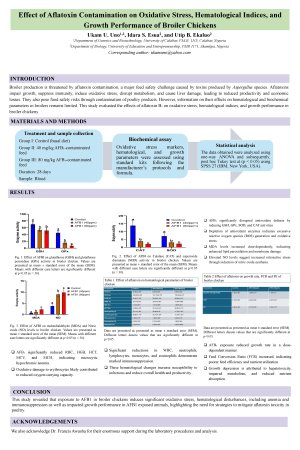
Aflatoxin B₁ (AFB₁) is among the most potent mycotoxins affecting poultry production. Hence, this study evaluated the dose-dependent effects of AFB₁ exposure on oxidative stress biomarkers, hematological indices, and growth performance in broiler chickens. Ninety healthy broiler chickens were randomly assigned to three groups (n = 30) in a completely randomized design. Group I (control) received basal feed; Group II and Group III received AFB1-contaminated feed at 40 mg/kg and 80 mg/kg feed, respectively, for 28 days. Aflatoxin B1 concentrations used in this study are consistent with previously reported models assessing high-dose exposure for mechanistic and dose-dependent toxicological evaluations. AFB₁ (≥98% purity) was sourced commercially and incorporated into feed following standard laboratory protocols. Ethical approval for the use of animals was obtained (Approval No. BIOSC24-12). Growth parameters: body weight gain, feed conversion ratio (FCR), and feed efficiency (FE), were monitored, while blood samples were analyzed for antioxidant enzymes, oxidative damage markers, and hematological indices. Data were analyzed using one-way ANOVA, with differences considered significant at p < 0.05. AFB₁ exposure resulted in a significant, dose-dependent reduction in glutathione, glutathione peroxidase, catalase, and superoxide dismutase activities, alongside marked elevations in malondialdehyde and nitric oxide levels. Hematological assessment revealed significant decreases in red blood cell count, hemoglobin concentration, and packed cell volume. Results showed 13% and 27 % reduction in body weight gain in groups II and III, respectively. FCR increased significantly from 0.18 in the control group to 0.24 in group II and 0.27 in group III, indicating poorer feed utilization. Correspondingly, FE declined from 5.55 in the control to 4.17 and 3.70 in the treated groups, respectively, demonstrating AFB₁-induced growth suppression. These findings provide integrated biochemical, hematological, and performance-based evidence of AFB₁-induced toxicity in broiler chickens, establishing an experimental framework for evaluating mitigation strategies against aflatoxicosis in poultry production systems.
Keywords
Aflatoxin B1
Broiler chicken
Oxidative stress
Hematology
Growth performance.
Poster
Poster Presentation.pdf
Modulatory effects of vitamin C on lead induced organotoxicity and histopathology in male albino rats.
PFOS at human-relevant concentrations activates a KLF-1–P450 mitochondrial protective axis in Caenorhabditis elegans