Event submissions
Published
This submission belongs to the session 1. Exposure Routes / Exposome of Emerging Contaminants and Materials in the Environment of the event The 3rd International Online Conference on Toxics
Published date
04 Sep, 2026
Academic Editor
'%3e%3cpath%20d='M12.6657%2010.9104C12.4185%2010.325%2012.0599%209.79327%2011.6097%209.34482C11.1609%208.89508%2010.6293%208.5365%2010.0442%208.28888C10.0389%208.28626%2010.0337%208.28495%2010.0285%208.28233C10.8446%207.69279%2011.3752%206.73249%2011.3752%205.64904C11.3752%203.8542%209.92103%202.39999%208.1262%202.39999C6.33136%202.39999%204.87715%203.8542%204.87715%205.64904C4.87715%206.73249%205.40774%207.69279%206.22393%208.28364C6.21869%208.28626%206.21345%208.28757%206.20821%208.29019C5.62129%208.5378%205.09463%208.89284%204.64265%209.34613C4.1929%209.79493%203.83432%2010.3266%203.58671%2010.9117C3.34345%2011.4845%203.21226%2012.0987%203.20023%2012.7209C3.19988%2012.7349%203.20233%2012.7488%203.20744%2012.7619C3.21255%2012.7749%203.22022%2012.7867%203.22998%2012.7968C3.23975%2012.8068%203.25142%2012.8147%203.26431%2012.8202C3.2772%2012.8256%203.29105%2012.8284%203.30504%2012.8284H4.09109C4.14874%2012.8284%204.19459%2012.7825%204.1959%2012.7262C4.2221%2011.7148%204.62823%2010.7676%205.34617%2010.0497C6.08899%209.30683%207.0755%208.89808%208.1262%208.89808C9.17689%208.89808%2010.1634%209.30683%2010.9062%2010.0497C11.6242%2010.7676%2012.0303%2011.7148%2012.0565%2012.7262C12.0578%2012.7838%2012.1037%2012.8284%2012.1613%2012.8284H12.9474C12.9613%2012.8284%2012.9752%2012.8256%2012.9881%2012.8202C13.001%2012.8147%2013.0126%2012.8068%2013.0224%2012.7968C13.0322%2012.7867%2013.0398%2012.7749%2013.0449%2012.7619C13.0501%2012.7488%2013.0525%2012.7349%2013.0522%2012.7209C13.0391%2012.0947%2012.9094%2011.4855%2012.6657%2010.9104ZM8.1262%207.9024C7.52486%207.9024%206.9589%207.6679%206.53312%207.24211C6.10733%206.81633%205.87283%206.25037%205.87283%205.64904C5.87283%205.0477%206.10733%204.48174%206.53312%204.05596C6.9589%203.63018%207.52486%203.39567%208.1262%203.39567C8.72753%203.39567%209.29349%203.63018%209.71927%204.05596C10.1451%204.48174%2010.3796%205.0477%2010.3796%205.64904C10.3796%206.25037%2010.1451%206.81633%209.71927%207.24211C9.29349%207.6679%208.72753%207.9024%208.1262%207.9024Z'%20fill='%235D1EE1'/%3e%3c/g%3e%3c/svg%3e) Carlos Barata
Carlos BarataCitation
Maria Carolina Ramirez Hernandez, Mateus Alencar Bezerra Silva, Jesley Nogueira Bandeira, Lucrecia Pacheco Batista, Paulo Sergio Fernandes das Chagas, Claudinei Cruz, Daniel Valadão Silva, Chronic diuron exposure alters photosynthetic pigments and antioxidant responses in Eichhornia crassipes, in Proceedings of The 3rd International Online Conference on Toxics, 9 September–11 September 2026, MDPI: Basel, Switzerland
Share
Email
Facebook
Twitter
LinkedIn
Chronic diuron exposure alters photosynthetic pigments and antioxidant responses in Eichhornia crassipes
'%3e%3cpath%20d='M12.6647%2010.9104C12.4176%2010.325%2012.0589%209.7933%2011.6088%209.34485C11.16%208.89511%2010.6283%208.53653%2010.0432%208.28891C10.038%208.28629%2010.0327%208.28498%2010.0275%208.28236C10.8437%207.69282%2011.3743%206.73252%2011.3743%205.64907C11.3743%203.85423%209.92005%202.40002%208.12522%202.40002C6.33038%202.40002%204.87618%203.85423%204.87618%205.64907C4.87618%206.73252%205.40677%207.69282%206.22296%208.28367C6.21772%208.28629%206.21248%208.2876%206.20724%208.29022C5.62031%208.53783%205.09365%208.89287%204.64167%209.34616C4.19192%209.79496%203.83334%2010.3266%203.58573%2010.9117C3.34247%2011.4846%203.21128%2012.0987%203.19925%2012.721C3.1989%2012.735%203.20135%2012.7489%203.20646%2012.7619C3.21157%2012.7749%203.21924%2012.7868%203.22901%2012.7968C3.23877%2012.8068%203.25045%2012.8148%203.26334%2012.8202C3.27623%2012.8256%203.29007%2012.8284%203.30406%2012.8284H4.09012C4.14776%2012.8284%204.19362%2012.7825%204.19493%2012.7262C4.22113%2011.7148%204.62726%2010.7676%205.34519%2010.0497C6.08802%209.30686%207.07452%208.89811%208.12522%208.89811C9.17592%208.89811%2010.1624%209.30686%2010.9052%2010.0497C11.6232%2010.7676%2012.0293%2011.7148%2012.0555%2012.7262C12.0568%2012.7839%2012.1027%2012.8284%2012.1603%2012.8284H12.9464C12.9604%2012.8284%2012.9742%2012.8256%2012.9871%2012.8202C13%2012.8148%2013.0117%2012.8068%2013.0214%2012.7968C13.0312%2012.7868%2013.0389%2012.7749%2013.044%2012.7619C13.0491%2012.7489%2013.0515%2012.735%2013.0512%2012.721C13.0381%2012.0947%2012.9084%2011.4856%2012.6647%2010.9104ZM8.12522%207.90243C7.52388%207.90243%206.95792%207.66793%206.53214%207.24215C6.10636%206.81636%205.87185%206.2504%205.87185%205.64907C5.87185%205.04773%206.10636%204.48177%206.53214%204.05599C6.95792%203.63021%207.52388%203.3957%208.12522%203.3957C8.72655%203.3957%209.29252%203.63021%209.7183%204.05599C10.1441%204.48177%2010.3786%205.04773%2010.3786%205.64907C10.3786%206.2504%2010.1441%206.81636%209.7183%207.24215C9.29252%207.66793%208.72655%207.90243%208.12522%207.90243Z'%20fill='%235D1EE1'/%3e%3c/g%3e%3c/svg%3e)
Maria Carolina Ramirez Hernandez 1,2
Mateus Alencar Bezerra Silva 2
Jesley Nogueira Bandeira 2
Lucrecia Pacheco Batista 2
Paulo Sergio Fernandes das Chagas 2
Claudinei Cruz 3
Daniel Valadão Silva 2
1. Department of Ecology and Conservation - Federal University of Lavras, Lavras
2. Department of Agronomic and Forestry Sciences, Federal Rural University of the Semi-Arid, Mossoró
3. Ecotoxicology and Pesticide Efficacy Laboratory, Barretos Educational Foundation University Centre, Barretos
Abstract
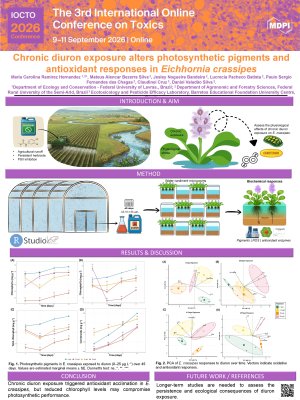
Diuron is a persistent photosystem II inhibitor frequently detected in aquatic environments, where it may affect the metabolism of non-target aquatic macrophytes. However, the physiological responses of floating species under chronic exposure are still poorly understood. This study evaluated the physiological and biochemical responses of Eichhornia crassipes exposed to diuron in water–sediment microcosms at 2.5, 10, and 25 µg L⁻¹ for 45 days. These concentrations were selected to represent an environmentally relevant gradient, ranging from a low concentration close to the reported NOEC and typical environmental levels, to a concentration near the maximum detected in Brazilian aquatic environments, and a higher but plausible critical contamination scenario. Chlorophyll a, chlorophyll b, total chlorophyll, carotenoids, hydrogen peroxide (H₂O₂), malondialdehyde (MDA), and the activities of catalase (CAT), ascorbate peroxidase (APX), and peroxidase (POX) were evaluated at 6, 20, 31, and 45 days after exposure. Higher diuron concentrations reduced chlorophyll levels during the experimental period, indicating a continuous effect on the photosynthetic apparatus. In contrast, carotenoid levels increased in response to the oxidative imbalance caused by the herbicide. Antioxidant enzyme activities varied according to concentration and exposure time, with CAT and APX increasing mainly between 20 and 31 days, suggesting activation of mechanisms related to H₂O₂ detoxification and redox regulation. Although H₂O₂ levels increased under higher concentrations, MDA remained relatively stable throughout the experiment, indicating limited lipid peroxidation under chronic exposure conditions. PCA separated the control from treatments exposed to 10 and 25 µg L⁻¹ over time, reinforcing the physiological effects caused by prolonged diuron exposure. Overall, E. crassipes showed metabolic acclimation to chronic diuron exposure through antioxidant and photoprotective responses. This acclimation may help maintain plant survival in contaminated aquatic systems and support its potential use in phytoremediation. However, the sustained reduction in chlorophyll levels suggests that prolonged exposure may compromise photosynthetic performance, with possible consequences for macrophyte productivity, ecosystem functioning, and long-term remediation efficiency.
Keywords
PSII inhibition
Redox homeostasis
Chronic exposure
Aquatic macrophytes
Physiological responses
Poster
MDPI- Carolina_Ramírez_.pdf
PFOS at human-relevant concentrations activates a KLF-1–P450 mitochondrial protective axis in Caenorhabditis elegans
ASSESSMENT OF THE EXPOSOME AND EXPOSURE ROUTES OF ANTIBIOTIC RESIDUES AND HEAVY METALS IN BIRDS: IMPLICATIONS FOR ECOSYSTEM HEALTH - A SYSTEMATIC REVIEW