Event submissions
Published
This submission belongs to the session 1. Exposure Routes / Exposome of Emerging Contaminants and Materials in the Environment of the event The 3rd International Online Conference on Toxics
Published date
04 Sep, 2026
Academic Editor
'%3e%3cpath%20d='M12.6657%2010.9104C12.4185%2010.325%2012.0599%209.79327%2011.6097%209.34482C11.1609%208.89508%2010.6293%208.5365%2010.0442%208.28888C10.0389%208.28626%2010.0337%208.28495%2010.0285%208.28233C10.8446%207.69279%2011.3752%206.73249%2011.3752%205.64904C11.3752%203.8542%209.92103%202.39999%208.1262%202.39999C6.33136%202.39999%204.87715%203.8542%204.87715%205.64904C4.87715%206.73249%205.40774%207.69279%206.22393%208.28364C6.21869%208.28626%206.21345%208.28757%206.20821%208.29019C5.62129%208.5378%205.09463%208.89284%204.64265%209.34613C4.1929%209.79493%203.83432%2010.3266%203.58671%2010.9117C3.34345%2011.4845%203.21226%2012.0987%203.20023%2012.7209C3.19988%2012.7349%203.20233%2012.7488%203.20744%2012.7619C3.21255%2012.7749%203.22022%2012.7867%203.22998%2012.7968C3.23975%2012.8068%203.25142%2012.8147%203.26431%2012.8202C3.2772%2012.8256%203.29105%2012.8284%203.30504%2012.8284H4.09109C4.14874%2012.8284%204.19459%2012.7825%204.1959%2012.7262C4.2221%2011.7148%204.62823%2010.7676%205.34617%2010.0497C6.08899%209.30683%207.0755%208.89808%208.1262%208.89808C9.17689%208.89808%2010.1634%209.30683%2010.9062%2010.0497C11.6242%2010.7676%2012.0303%2011.7148%2012.0565%2012.7262C12.0578%2012.7838%2012.1037%2012.8284%2012.1613%2012.8284H12.9474C12.9613%2012.8284%2012.9752%2012.8256%2012.9881%2012.8202C13.001%2012.8147%2013.0126%2012.8068%2013.0224%2012.7968C13.0322%2012.7867%2013.0398%2012.7749%2013.0449%2012.7619C13.0501%2012.7488%2013.0525%2012.7349%2013.0522%2012.7209C13.0391%2012.0947%2012.9094%2011.4855%2012.6657%2010.9104ZM8.1262%207.9024C7.52486%207.9024%206.9589%207.6679%206.53312%207.24211C6.10733%206.81633%205.87283%206.25037%205.87283%205.64904C5.87283%205.0477%206.10733%204.48174%206.53312%204.05596C6.9589%203.63018%207.52486%203.39567%208.1262%203.39567C8.72753%203.39567%209.29349%203.63018%209.71927%204.05596C10.1451%204.48174%2010.3796%205.0477%2010.3796%205.64904C10.3796%206.25037%2010.1451%206.81633%209.71927%207.24211C9.29349%207.6679%208.72753%207.9024%208.1262%207.9024Z'%20fill='%235D1EE1'/%3e%3c/g%3e%3c/svg%3e) Natalia Garcia-Reyero
Natalia Garcia-ReyeroCitation
Abdulwaris Tijani, Gbenga Ayodele, ASSESSMENT OF THE EXPOSOME AND EXPOSURE ROUTES OF ANTIBIOTIC RESIDUES AND HEAVY METALS IN BIRDS: IMPLICATIONS FOR ECOSYSTEM HEALTH - A SYSTEMATIC REVIEW, in Proceedings of The 3rd International Online Conference on Toxics, 9 September–11 September 2026, MDPI: Basel, Switzerland
Share
Email
Facebook
Twitter
LinkedIn
ASSESSMENT OF THE EXPOSOME AND EXPOSURE ROUTES OF ANTIBIOTIC RESIDUES AND HEAVY METALS IN BIRDS: IMPLICATIONS FOR ECOSYSTEM HEALTH - A SYSTEMATIC REVIEW
'%3e%3cpath%20d='M12.6647%2010.9104C12.4176%2010.325%2012.0589%209.7933%2011.6088%209.34485C11.16%208.89511%2010.6283%208.53653%2010.0432%208.28891C10.038%208.28629%2010.0327%208.28498%2010.0275%208.28236C10.8437%207.69282%2011.3743%206.73252%2011.3743%205.64907C11.3743%203.85423%209.92005%202.40002%208.12522%202.40002C6.33038%202.40002%204.87618%203.85423%204.87618%205.64907C4.87618%206.73252%205.40677%207.69282%206.22296%208.28367C6.21772%208.28629%206.21248%208.2876%206.20724%208.29022C5.62031%208.53783%205.09365%208.89287%204.64167%209.34616C4.19192%209.79496%203.83334%2010.3266%203.58573%2010.9117C3.34247%2011.4846%203.21128%2012.0987%203.19925%2012.721C3.1989%2012.735%203.20135%2012.7489%203.20646%2012.7619C3.21157%2012.7749%203.21924%2012.7868%203.22901%2012.7968C3.23877%2012.8068%203.25045%2012.8148%203.26334%2012.8202C3.27623%2012.8256%203.29007%2012.8284%203.30406%2012.8284H4.09012C4.14776%2012.8284%204.19362%2012.7825%204.19493%2012.7262C4.22113%2011.7148%204.62726%2010.7676%205.34519%2010.0497C6.08802%209.30686%207.07452%208.89811%208.12522%208.89811C9.17592%208.89811%2010.1624%209.30686%2010.9052%2010.0497C11.6232%2010.7676%2012.0293%2011.7148%2012.0555%2012.7262C12.0568%2012.7839%2012.1027%2012.8284%2012.1603%2012.8284H12.9464C12.9604%2012.8284%2012.9742%2012.8256%2012.9871%2012.8202C13%2012.8148%2013.0117%2012.8068%2013.0214%2012.7968C13.0312%2012.7868%2013.0389%2012.7749%2013.044%2012.7619C13.0491%2012.7489%2013.0515%2012.735%2013.0512%2012.721C13.0381%2012.0947%2012.9084%2011.4856%2012.6647%2010.9104ZM8.12522%207.90243C7.52388%207.90243%206.95792%207.66793%206.53214%207.24215C6.10636%206.81636%205.87185%206.2504%205.87185%205.64907C5.87185%205.04773%206.10636%204.48177%206.53214%204.05599C6.95792%203.63021%207.52388%203.3957%208.12522%203.3957C8.72655%203.3957%209.29252%203.63021%209.7183%204.05599C10.1441%204.48177%2010.3786%205.04773%2010.3786%205.64907C10.3786%206.2504%2010.1441%206.81636%209.7183%207.24215C9.29252%207.66793%208.72655%207.90243%208.12522%207.90243Z'%20fill='%235D1EE1'/%3e%3c/g%3e%3c/svg%3e)
Abdulwaris Tijani 1
Gbenga Ayodele 1
1. Department of Animal Production and Health, Federal University of Technology, Akure
Abstract
Introduction:
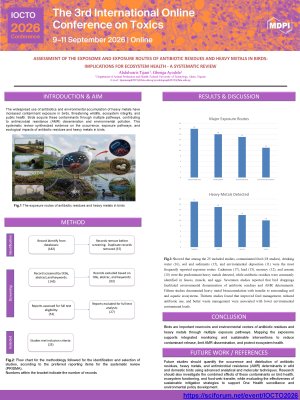
The widespread use of antibiotics and environmental accumulation of heavy metals have increased contaminant exposure in birds, threatening wildlife, ecosystem integrity, and public health. Birds acquire these contaminants through multiple pathways, contributing to antimicrobial resistance (AMR) dissemination and environmental pollution. Understanding the exposome and major exposure routes is essential for developing effective mitigation strategies. This systematic review synthesized evidence on the occurrence, exposure pathways, and ecological impacts of antibiotic residues and heavy metals in birds.
Methods:
A systematic review was conducted following PRISMA 2020 guidelines. Scopus, Web of Science, PubMed, and Google Scholar were searched for studies published between 2000 and 2025 using keywords including “antibiotic residues,” “heavy metals,” “birds,” “exposure routes,” “manure,” and “ecosystem impact.” Out of 182 records, 145 remained after duplicate removal. Following title and abstract screening, 52 full-text articles were assessed, and 25 studies met the inclusion criteria for qualitative synthesis.
Results:
Among the 25 included studies, contaminated feed (18 studies), drinking water (16), soil and sediments (15), and environmental deposition (11) were the most frequently reported exposure routes. Cadmium (17), lead (15), mercury (12), and arsenic (10) were the predominant heavy metals detected, while antibiotic residues were commonly identified in feces, muscle, and eggs. Seventeen studies reported that bird droppings facilitated environmental dissemination of antibiotic residues and AMR determinants. Fifteen studies documented heavy metal bioaccumulation with transfer to surrounding soil and aquatic ecosystems. Thirteen studies found that improved feed management, reduced antibiotic use, and better waste management were associated with lower environmental contaminant loads.
Conclusions:
Birds are important reservoirs and environmental vectors of antibiotic residues and heavy metals through multiple exposure pathways. Mapping the exposome supports integrated monitoring and sustainable interventions to reduce contaminant release, limit AMR dissemination, and protect ecosystem health.
Keywords
Antibiotic residues
heavy metals
birds
exposome
exposure routes
antimicrobial resistance
ecosystem health.
Poster
Postal T.pdf
Chronic diuron exposure alters photosynthetic pigments and antioxidant responses in Eichhornia crassipes
Spatiotemporal Prediction of PM2.5 Pollution in Dhaka District Using Ensemble Machine Learning and Satellite-Derived Indices (2019–2025)