Event submissions
Published
This submission belongs to the session 1. Exposure Routes / Exposome of Emerging Contaminants and Materials in the Environment of the event The 3rd International Online Conference on Toxics
Published date
04 Sep, 2026
Academic Editor
'%3e%3cpath%20d='M12.6657%2010.9104C12.4185%2010.325%2012.0599%209.79327%2011.6097%209.34482C11.1609%208.89508%2010.6293%208.5365%2010.0442%208.28888C10.0389%208.28626%2010.0337%208.28495%2010.0285%208.28233C10.8446%207.69279%2011.3752%206.73249%2011.3752%205.64904C11.3752%203.8542%209.92103%202.39999%208.1262%202.39999C6.33136%202.39999%204.87715%203.8542%204.87715%205.64904C4.87715%206.73249%205.40774%207.69279%206.22393%208.28364C6.21869%208.28626%206.21345%208.28757%206.20821%208.29019C5.62129%208.5378%205.09463%208.89284%204.64265%209.34613C4.1929%209.79493%203.83432%2010.3266%203.58671%2010.9117C3.34345%2011.4845%203.21226%2012.0987%203.20023%2012.7209C3.19988%2012.7349%203.20233%2012.7488%203.20744%2012.7619C3.21255%2012.7749%203.22022%2012.7867%203.22998%2012.7968C3.23975%2012.8068%203.25142%2012.8147%203.26431%2012.8202C3.2772%2012.8256%203.29105%2012.8284%203.30504%2012.8284H4.09109C4.14874%2012.8284%204.19459%2012.7825%204.1959%2012.7262C4.2221%2011.7148%204.62823%2010.7676%205.34617%2010.0497C6.08899%209.30683%207.0755%208.89808%208.1262%208.89808C9.17689%208.89808%2010.1634%209.30683%2010.9062%2010.0497C11.6242%2010.7676%2012.0303%2011.7148%2012.0565%2012.7262C12.0578%2012.7838%2012.1037%2012.8284%2012.1613%2012.8284H12.9474C12.9613%2012.8284%2012.9752%2012.8256%2012.9881%2012.8202C13.001%2012.8147%2013.0126%2012.8068%2013.0224%2012.7968C13.0322%2012.7867%2013.0398%2012.7749%2013.0449%2012.7619C13.0501%2012.7488%2013.0525%2012.7349%2013.0522%2012.7209C13.0391%2012.0947%2012.9094%2011.4855%2012.6657%2010.9104ZM8.1262%207.9024C7.52486%207.9024%206.9589%207.6679%206.53312%207.24211C6.10733%206.81633%205.87283%206.25037%205.87283%205.64904C5.87283%205.0477%206.10733%204.48174%206.53312%204.05596C6.9589%203.63018%207.52486%203.39567%208.1262%203.39567C8.72753%203.39567%209.29349%203.63018%209.71927%204.05596C10.1451%204.48174%2010.3796%205.0477%2010.3796%205.64904C10.3796%206.25037%2010.1451%206.81633%209.71927%207.24211C9.29349%207.6679%208.72753%207.9024%208.1262%207.9024Z'%20fill='%235D1EE1'/%3e%3c/g%3e%3c/svg%3e) Carlos Barata
Carlos BarataCitation
Joy Awulika Oladimeji-Salami, Yvonne Adaobi Onmonya, David Adeyemi, Abidemi Akindele, Olufumilayo O Adeyemi, Pharmaceutical Contaminants in Lagos Water Bodies as Cross-Species Toxicological Hazards, in Proceedings of The 3rd International Online Conference on Toxics, 9 September–11 September 2026, MDPI: Basel, Switzerland
Share
Email
Facebook
Twitter
LinkedIn
Pharmaceutical Contaminants in Lagos Water Bodies as Cross-Species Toxicological Hazards
'%3e%3cpath%20d='M12.6647%2010.9104C12.4176%2010.325%2012.0589%209.7933%2011.6088%209.34485C11.16%208.89511%2010.6283%208.53653%2010.0432%208.28891C10.038%208.28629%2010.0327%208.28498%2010.0275%208.28236C10.8437%207.69282%2011.3743%206.73252%2011.3743%205.64907C11.3743%203.85423%209.92005%202.40002%208.12522%202.40002C6.33038%202.40002%204.87618%203.85423%204.87618%205.64907C4.87618%206.73252%205.40677%207.69282%206.22296%208.28367C6.21772%208.28629%206.21248%208.2876%206.20724%208.29022C5.62031%208.53783%205.09365%208.89287%204.64167%209.34616C4.19192%209.79496%203.83334%2010.3266%203.58573%2010.9117C3.34247%2011.4846%203.21128%2012.0987%203.19925%2012.721C3.1989%2012.735%203.20135%2012.7489%203.20646%2012.7619C3.21157%2012.7749%203.21924%2012.7868%203.22901%2012.7968C3.23877%2012.8068%203.25045%2012.8148%203.26334%2012.8202C3.27623%2012.8256%203.29007%2012.8284%203.30406%2012.8284H4.09012C4.14776%2012.8284%204.19362%2012.7825%204.19493%2012.7262C4.22113%2011.7148%204.62726%2010.7676%205.34519%2010.0497C6.08802%209.30686%207.07452%208.89811%208.12522%208.89811C9.17592%208.89811%2010.1624%209.30686%2010.9052%2010.0497C11.6232%2010.7676%2012.0293%2011.7148%2012.0555%2012.7262C12.0568%2012.7839%2012.1027%2012.8284%2012.1603%2012.8284H12.9464C12.9604%2012.8284%2012.9742%2012.8256%2012.9871%2012.8202C13%2012.8148%2013.0117%2012.8068%2013.0214%2012.7968C13.0312%2012.7868%2013.0389%2012.7749%2013.044%2012.7619C13.0491%2012.7489%2013.0515%2012.735%2013.0512%2012.721C13.0381%2012.0947%2012.9084%2011.4856%2012.6647%2010.9104ZM8.12522%207.90243C7.52388%207.90243%206.95792%207.66793%206.53214%207.24215C6.10636%206.81636%205.87185%206.2504%205.87185%205.64907C5.87185%205.04773%206.10636%204.48177%206.53214%204.05599C6.95792%203.63021%207.52388%203.3957%208.12522%203.3957C8.72655%203.3957%209.29252%203.63021%209.7183%204.05599C10.1441%204.48177%2010.3786%205.04773%2010.3786%205.64907C10.3786%206.2504%2010.1441%206.81636%209.7183%207.24215C9.29252%207.66793%208.72655%207.90243%208.12522%207.90243Z'%20fill='%235D1EE1'/%3e%3c/g%3e%3c/svg%3e)
Joy Awulika Oladimeji-Salami 1
Yvonne Adaobi Onmonya 2
David Adeyemi 3
Abidemi Akindele 4
Olufumilayo O Adeyemi 4
1. Medical Biotechnology Department, National Biotechnology Research and Development Agency, Abuja
2. Environmental Science Department, National Open University of Nigeria, Abuja
3. Department of Pharmaceutical Chemistry, University of Lagos, Lagos
4. Department of Pharmacology, Therapeutics and Toxicology, University of Lagos, Lagos
Abstract
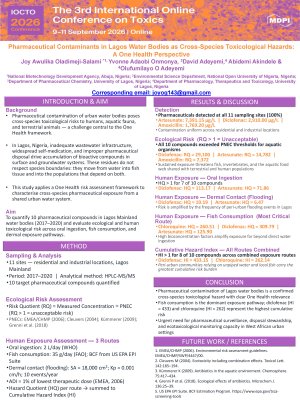
Introduction: Pharmaceutical contamination of urban water bodies poses cross-species toxicological risks to humans, aquatic fauna, and terrestrial animals — a concern central to the One Health framework. In Lagos, Nigeria, inadequate wastewater infrastructure, self-medication, and improper drug disposal drive the accumulation of pharmaceuticals in surface and groundwater systems.
Methods: Water samples were collected from 11 sites across Lagos Mainland, spanning residential and industrial locations. Ten pharmaceutical compounds were quantified by HPLC-MS/MS. Ecological risk was assessed using risk quotients (RQs) based on measured concentrations and predicted no-effect concentrations. Human exposure was evaluated across three routes, oral ingestion, fish consumption, and dermal contact during flooding, using established bioconcentration factors and an acceptable daily intake set at 1% of the lowest therapeutic dose.
Results: Pharmaceuticals were detected at all sampling sites, with artesunate, diclofenac, and amoxicillin showing the highest mean concentrations. All ten compounds exceeded PNEC thresholds for aquatic organisms, with diclofenac posing the greatest ecological risk (RQ > 29,000). Oral ingestion produced hazard quotients above 1 for seven compounds, while fish consumption emerged as the most critical human exposure pathway, particularly for chloroquine, diclofenac, and artesunate. Cumulative Hazard Indices exceeded 1 for eight of ten compounds, with diclofenac and chloroquine recording the highest overall risk.
Conclusion: These findings indicate that pharmaceutical contamination of Lagos water bodies poses a measurable cross-species toxicological hazard, with clear relevance to One Health. Findings underscore the urgent need for pharmaceutical surveillance, disposal stewardship, and strengthened ecotoxicological monitoring capacity across West African urban settings.
Keywords
Pharmaceutical pollution
ecotoxicology
Lagos state
One Health
water safety
risk assessment
Poster
IOCTO2026 JOS Poster.pdf
Spatiotemporal Prediction of PM2.5 Pollution in Dhaka District Using Ensemble Machine Learning and Satellite-Derived Indices (2019–2025)
Association between Urinary Metal Exposure and Child Growth and Development with Dietary Modification Effects